Thinking about Critical Health and Learning Disabilities

We walk Sid, our scruffy dog, up the road most days to a nature spot called Lightwood. A stunner of a piece of Peak District and the site of Buxton water. A regular and wise wildlife lover, known locally as ‘Mr Lightwood’, was up there on Friday bending over a fence post.

‘Look!’ he said, calling us over. ‘The ladybirds are here.’

Wooden posts with ladybirds. In the middle of winter.

I never knew.

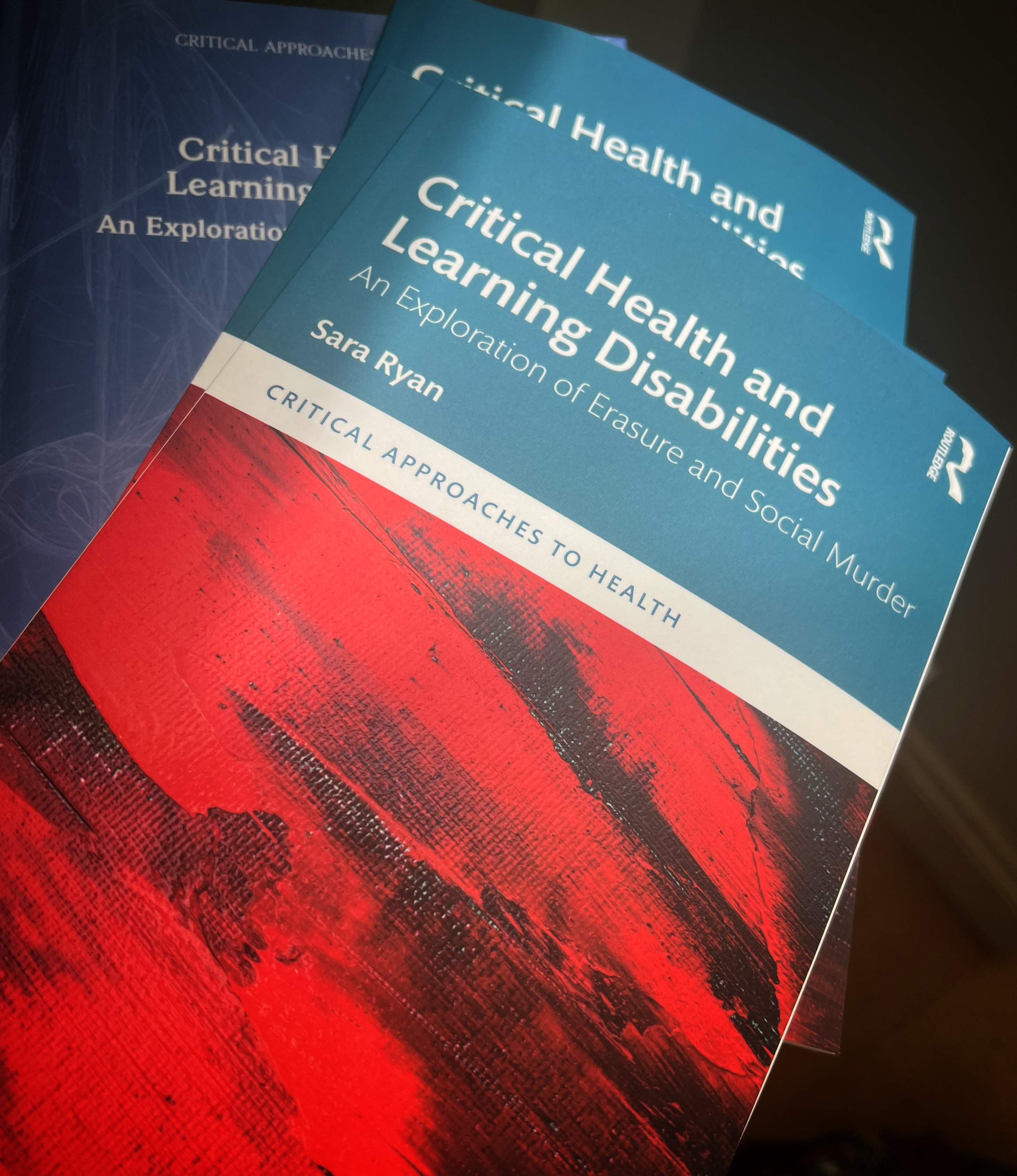
In my book ‘Critical Health and Learning Disabilities’ (including a link to a downloadable plain English summary), I argue people’s impoverished lives and preventable deaths are a form of social murder. We know why and how people die early and nothing is done to ameliorate this. I suggest many are complicit in this, including researchers. Through our work, words, writing, assumptions.

David Abbott’s reflections on reading the book beautifully capture this;

People being denied citizenship, denied life, denied love. Systematically, casually, deliberately. It made me want to cry tears of anger and deep, deep sadness, see my own part in it all and then get on with trying to be a useful ally. That the book is needed is a terrible indictment. The question it leaves me with is what now? It cannot be more of the same.

What now indeedy?

I’ll start with a short series of posts picking over key ideas in the book. Starting with absurdities which remind me of a fridge magnet back in the chaotic and delightfully groaning space when our kids were pups. A Voltaire quote captured in a stark font coated in a neat and snazzy Perspex rectangle fridge magnet accompanied the opening, grabbing and repeated slamming of the fridge door:

Those who can make you believe absurdities can make you commit atrocities.

Absurdities and atrocities. Powerful, important words that seemed at the time to apply to way bigger stuff than us.

Some examples of absurdities from the book…

People with learning disabilities experience baffling levels of surveillance and control across their lives. A chapter on sex and intimacies draws on research documenting open bedroom door policies in supported living effectively inhibiting privacy. A swift snog in a day centre can lead to the removal of one of the loved-up pair. Permanently. There are few opportunities for socialising.

At the same time, around 1 in 4 women with learning disabilities experience sexual abuse. One safeguarding report described how a woman was dressed in ‘high tight knickers’ and locked in her room to keep men away from her. The use of infantile language effectively downgrades consideration of abuse, and resistance to discussing sexual intimacy creates conditions that allow the unspeakable to happen.

There is little support, information or advice to help negotiate relationships leaving people unsure of, or easily persuaded that, intimate relationships and children are not an option. If a woman becomes pregnant she is unlikely to receive appropriate antenatal support and more than likely to have the baby taken from her. Evidence shows family court judges cook the books to ensure this.

Actual evidence.

There is evidence people (a wide range of people) uncritically accept these absurdities without apparent knowledge, sense or clarity. I was a guest with Pam Bebbington on a BBC Access All Areas podcast. The programme ‘The 40 year olds who are in bed by 5pm’ discussed our Growing Older research findings. In relation to 5pm bedtimes, the disabled presenter commented;

But Sara, many of the professional bodies who are looking at the quality of care for older people with learning disabilities might say that the system is working because these people have access to good food, they have access to decent lodgings. I mean, you’ve mentioned many of the problems, but I guess it’s hard for a professional body to say something is wrong if the basic needs are met.

Basic needs met. Nosh, warm home with the cost of a blanket 5pm ‘bedtime’. No whiff of wondering what this might feel like, or what other indignities or worse are inflicted on people who count so little they are systematically denied evening time. Every day.

A final absurdity (for now). The surveillance and control bouncing across people’s lives is meticulously switched off when they unexpectedly die. Mandatory death reporting and investigatory processes do not apply.

The person died of ‘natural causes’, the bedroom door finally closes and those who should be doing or saying something are silent, absent even.

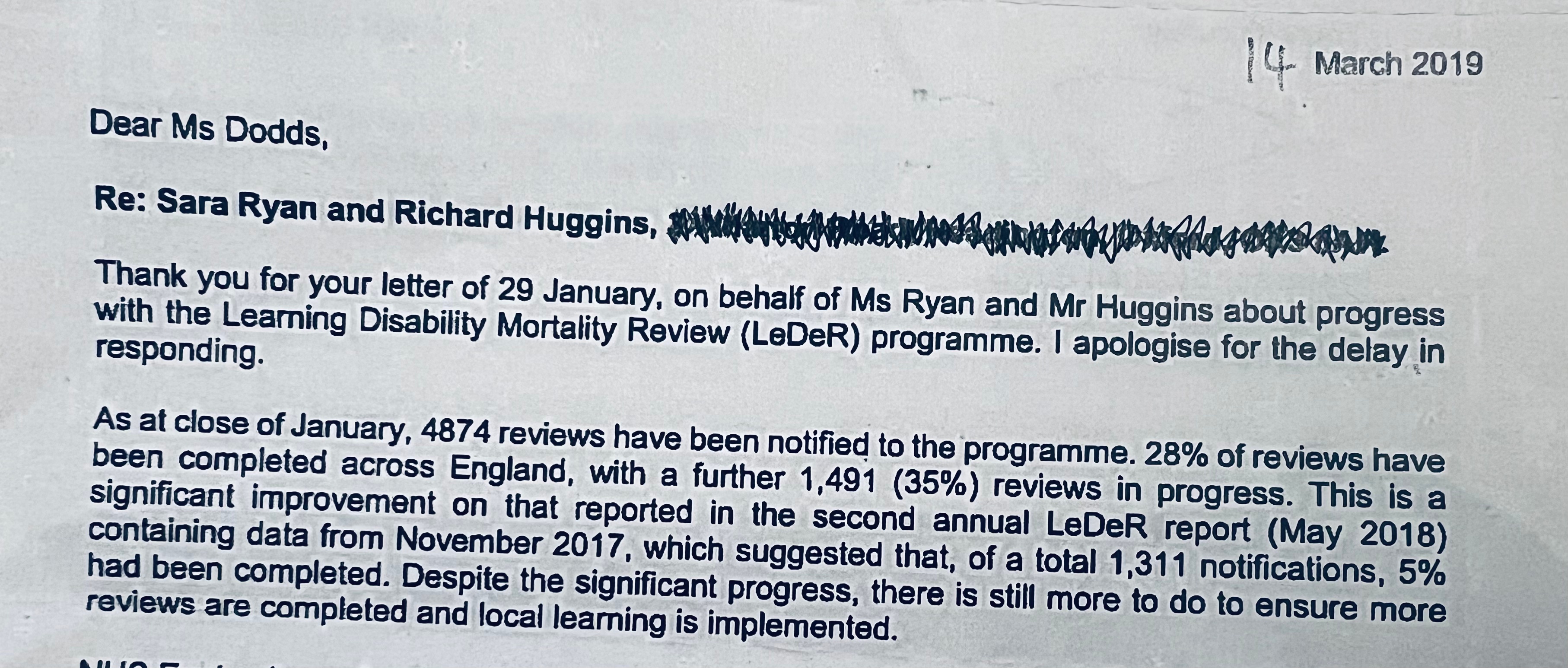
No curiosity. No interest. The recent retraction of the latest, ridiculously delayed Leder report is a classic example of these absurdities in relation to the deaths of people with learning disabilities. No information beyond the retraction and a blanket ignoring* of questions about it from anyone involved (the government, NHS England, three universities and three organisations). Not a dicky bird.

Nothing to see here. Unless you look carefully.

*A caveat to this is the work Paul Scriven has been doing in the Lords to try to gain answers and accountability.

Come again?

Another day, another inquest. George Julian in court in Woking. Her commitment to shedding light on the horrors embedded within our health and social care systems is extraordinary. This week, it’s 41 year old Daniel. Daniel was living in a 16 ‘bed’ place called Ballater House. He died of choking.

Yesterday the witnesses included two nurses and a support worker. The evidence was woeful. Nobody could say anything about Daniel other than he liked folding clothes and trainers. Trainers were used to bribe him to eat. What was that? To bribe him to eat? Yep. He was told he could see pictures of trainers if he ate his food.

Bribing. Connor was told he could go home if he attended a social group in the unit.

For some months before he died, Daniel made noises at meal times. This definitely was not related to swallowing problems said the clinical lead nurse. Definitely not. Daniel was “nauseating”. And how do you know this, asked the coroner. Because it was nauseating.

Alongside the unusual retching type noises which definitely weren’t swallowing related, Daniel refused to eat anything other than sandwiches for a month before he died. Sandwiches for breakfast, lunch and tea. The nauseating continued and nobody cared enough to really do anything.

Virtual appointments were held with GPs, the hospital phoned the ‘home’ on four separate occasions about Daniel’s health. The calls went to a voice machine in the nurses office and no one bothered to listen back to them.

There was the usual lies and bullshit on show. The lead clinician demonstrated next to no knowledge about diabetes care and said he was not on duty the night Daniel died. He seemed to think he had no responsibility if he wasn’t in sight of Daniel. The absence of healthcare was nothing to do with him. He knew about diabetes from back in the day.

The coroner proved herself to be part of the collective (a loosely defined group of people who contribute to the impoverishment of people’s lives) I write about in my book. She slapped down the family barrister for asking the witnesses questions she’d asked. There were no answers though. No answers at all.

Each question was met with fumbled words generating more questions. More bafflement. More rage and more disgust at the shite that passes for care in this country at such a human cost (well and the ££££s these places charge). Local authorities and commissioners are slumbering or simply do not care. Containment is the name of the game here, as each inquest covered by George reveals. And if that containment is lacking in any basic care, so be it. Disrespect was also in the room. Witness phones ringing and a lack of listening to the questions.

Come again?

This is social murder.

Excuses, delays, death and social murder

George Julian has taken on the grim task of working her way through responses to Freedom of Information requests she sent to every Integrated Care Board (ICB) in England. [The words ‘integrated care board’ ratchet up my snooze button so I’m trying to stay jiggy writing this, not succumb to the malaise and weariness these terms generate.] George asked them for their latest Leder data and publication plans for their next reports. She was trying to find out the state of play with the data that has been collected by each ICB since the data included in the latest (2023) Leder report (published in Sept). Each ICB feeds its data/reports to the mothership now based at Imperial College under the quiet (silent even) steer of Prof Strydom.

[I took a trip down blog memory lane and found this post about the 2017 Leder review, also published late and covered up. There is form here. Depressing to note the publication of the review generated live national news coverage then. Now it’s as if someone has left the report on the returned book shelves at an unmarked local library.]

So what can we conclude from the ICB responses to the Leder process?

  1. Rumours of changes to the Leder programme.
  2. No dosh to do the work effectively and an associated lack of staff with dedicated time.
  3. Problems with systems, accessing and uploading data. Outages and smoutages.
  4. ICB restructuring has worsened the process. [There’s always a restructure to be had].
  5. Delay, delay, excuses, excuses and a further muddying of report years and deaths reported.

It’s fair to say the Leder process has erased any consideration of the people who died. It’s a clunky, dilapidated conveyor belt of ‘notifications in’, ‘complete reviews’ out and a growing number of unfinished reviews. A dogs dinner. A flawed process which has descended into farce. Hints and whispers of ‘this process is shite’, ‘who cares’, and ‘I don’t want to do this’ foot stamping.

And then chillingly Dorset report: “Approximately 90% of all reviews have identified little or no significant learning in the last year, which raises the question of the value of completing a review for every case.”

Get that sledgehammer out Dorset and smash the remaining bits of humanity, respect and reason for trying to learn from the premature and often avoidable deaths of people with learning disabilities and/or autistic people.

There’s no new learning, people are gonna die cos we ain’t changing shite so let’s just stop reviewing every death.

And there I was, literally a month ago, publishing a book about the social murder of people with learning disabilities.

10 years, 10 points, 10 minutes

Last night LDN Charity organised an event ‘Spotlight on the abuse of people with learning disabilities’ at the London Canal Museum. The panel, chaired by Simon Jarrett, consisted of Alexis Quinn, George Julian, Amanda Topps and me. Contributions from the audience were as powerful as the panel presentations and the sense of anger and commitment to change in the packed room was palpable. This is what I said:

Last week was the 10-year anniversary of our son Connor’s death in an NHS run ATU. He drowned in the bath while staff did an online Tesco order in the office next door. Ten years has allowed time to think about what unfolded and why, and in doing so different aspects have become more prominent. 

Given we each have 10 minutes to talk it seemed appropriate to produce 10 points of reflection about what happened to Connor (and others) and to think about what the lack of any real shift in the use of ATUs means.  

ONE. Connor was a beautiful, much loved, funny, talented and wonderfully complicated young man. He loved deeply and contributed so much to our family (and wider) that we are left with a chasm in our lives and hearts so full of love I can sometimes barely breathe.  

TWO. The day we had Connor admitted to the assessment and treatment unit (ATU) a mile or so from where we lived, I didn’t know Winterbourne View was an ATU. I didn’t know what an ATU was. I thought we were taking Connor to a specialist NHS hospital unit that would be staffed by uniformed and identifiable health professionals for a few weeks to understand why he had become so distressed and unpredictable. Connor had loved visiting his grandad at the JR hospital just weeks earlier. The locum medic who came to our home to assess Connor beforehand even said there would be a ward round that evening.  

I’m not sure what this not knowing, this ignorance means still. There was so much we didn’t know then. And so much people don’t know now.  

THREE. Connor was admitted on a Tuesday evening. The responsible clinician whose office was in a building across the car park from the unit, didn’t bother to walk across and see him the next day. Wednesday. Or on the Thursday or Friday. On Saturday, she went off on holiday for two weeks. Again, we had no idea. There was no ward round, no crisis specialist intervention, no urgency, information, interest. No nothing. Just our boy catapulted from his family home into a space that defies words. 

And this was apparently fine. 

FOUR. We met the lead paramedic who responded to the call that hot, sunny July morning before we moved from Oxford in May 2021. He was a friend of a friend of one of our children and asked to meet us. He said the ambulance overshot the turn for the unit that morning, There was no one outside directing it in. When they got to the unit, the door was locked and someone was painting the outside windows. He was bewildered by this lack of urgency and the absence of information from those present. He said his team had nothing to work with, nothing to base their treatment decisions on. The unit staff were literally clueless and said nothing. There is no pretence of healthcare, death care or any care in these places.  

And this is apparently fine. 

FIVE. After 2 years of health and local authority records being disclosed and 4 pre-inquest hearings Connor’s inquest was unexpectedly halted in the second week in October 2015. The responsible clinician’s barrister produced evidence that a patient, Henry, had died in the same bath a few years earlier. Photographs of the bathroom taken after Henry’s death were shared with us. Some of the same staff were on duty the day Henry died. The lack of disclosing Henry’s death for over two years is extraordinary. A second psychiatrist, present the day Connor died, looked at Henry and told the coroner by phone he died of natural causes. There was no postmortem and no inquest.  

When Connor’s inquest ended the coroner asked for Henry’s death to be investigated and the police took witness accounts from those present. The student nurse who was with Henry said he was told to leave the bathroom by professional X before the ambulance arrived. Professional X said he arrived at the unit after the ambulance. The coroner said it was long ago and there were bound to be contradictions. He dismissed Henry’s death again. 

And this is apparently fine. 

SIX. A death review commissioned by NHS England on our request was conducted by an international consultancy firm Mazars led by Marie Ann Bruce. It found only 2 out of 327 unexpected deaths of people with learning disabilities in the NHS Trust between 2011-2015 were investigated. Providing unassailable evidence you can punt human rights, regulatory procedures and processes off the nearest bridge when people with learning disabilities are involved. 

SEVEN. We don’t know how many people have died in assessment and treatment units. A Dispatches film by Alison Millar ‘Under Lock and Key’ shown in 2017 included the story of Bill who died in 2011. His parents then in their 70s were given what they called ‘blood money’ after an inquest found he died as an outcome of neglect.  

An early morning round table meeting was organised at Channel 4 the morning after the documentary was aired. An expectation that there would be an outcry Winterbourne View styley. No one really cared. We were coasting downwards by then, slowly and carefully unmaking scandals. I sat next to Bill’s parents who were pretty quiet. I wonder what they were thinking of this early morning shindig in central London that turned to nothing. Other than further evidence of bridge punting. 

EIGHT. There is no doubt that these places deprive people of their freedoms and rights. This deprivation manifests in myriad ways from being restrained, over medicated or secluded to being denied the basic opportunities to walk in nature, experience the wind on your face or have a drink with a mate.  Abuse, disrespect and devaluing profoundly erode wellbeing. We know this. Wiseman and Watson (2021) have written about the complex forms of violence experienced by people with learning disabilities and how these are critical to understanding the significant inequalities in health and wellbeing experienced by this group. And yet the numbers of those incarcerated in these places remain the same. 

NINE. The unmaking of this scandal, the greedy and self-interested actors that have jostled to drink at the fountain of self-serving opportunities and nosh on the plates of croissant crumbs, to line their pockets, seize media opportunities is grotesque. The stuffing of laminated photos of dead loved ones into the hands of bereaved and battered families… There has been no auditing of the money spent, contracts doshed out, time wasted, or individuals rewarded for no success.

We know these places are trauma generating and yet a paper published just this year found that just under 50% of 44 admissions and discharges from two ATUS from February 2019 to March 2022 were delayed. The most prevalent reasons for discharge delays were identification of a new placement, recruitment of care staff and building work (Gibson et al 2023). Two young men close to me have been in and out of ATUs over the past decade. One is currently back in an ATU while the other has been waiting years for the local authority to sort out a home for him. Both families have been the driving force at extraordinary emotional, financial and physical cost to try to get their boys a life worth living. 

This is apparently fine. 

TEN. I was struck by Simon Jarrett mentioning at a conference just yesterday that the exclusion of people with learning disabilities during the industrial revolution when enormous institutions were built was arbitrary, as many people could have worked in factories. There is a direct and remarkably enduring line from then to now where we have people formally incarcerated in ATUs, or in versions of ATUs dressed up as supported living or residential homes where people don’t even know their neighbours and their neighbours don’t know them.

All our lives are impoverished by the exclusion of a proportion of the population, and the way in which we, as a society, are failing people is something we should all take responsibility for. 

None of what we are talking about this evening is fine. None of it. Stop pretending it apparently is. 

Thank you. 
The photo

Joanna Bailey’s inquest finished today. Joanna, 36, died at a private Jeesal Group ‘hospital’, Cawston Park in April 2018. A day after her parents warned staff they thought she was about to have a seizure. ‘We’ll take care of her’ they were told. Joanna wasn’t observed that night, her sleep apnoea machine wasn’t working and when she was found unconscious in the early hours of the morning, four staff members stood by bickering about CPR until the paramedics arrived.

After a week of chilling evidence the coroner this morning told the legal counsels she would direct the jury to determine that Joanna died of natural causes. There was no budging on this. The family’s barrister Oliver Lewis asked if the jury could be shown a photo of Joanna.

The virtual air across the Microsoft Teams court platform became frosty. The coroner talked about this practice happening in criminal courts. It spilled into her courtroom sometimes [‘prison suicides’] and there was apparent agreement between her and the Jeesal Counsel, Mr Walsh, about underhand motives and the emotiveness of photo sharing. The coroner said:

“I really don’t know what purpose there would be unless it’s to register the fact she’s a human and I think the jury know that,”

After a week of being viscerally dissected in front of her family and wider public with a focus on deficit and deceit, fake seizures, allegations of abuse and troublesomeness, this seemed a stretch.

Mr Walsh insisted if the jury had to see the photo [howl], it should be after the jury had delivered their determination. Hmm, that’s not relevant given the jury has just been told exactly what to write. The coroner made this point to him but Mr Walsh would not budge.

“In my submission Ma’am, the usual practice in this court is not to do so. The only concession would be if it’s still required after the jury return to deliver the determination.”

Joanna’s parents were present during this tussle. Witnessing their daughter being treated with the contempt she was treated with in life.

“Could you show us the photo Mr Lewis?” asked the coroner.

A beautiful photo of a young woman appeared on our screens.

“When was this taken?”

“I’m not sure of the exact date Ma’am, it was within the last six months of Joanna’s life.”

The coroner was visibly surprised. Six months? She looks so different. The small photo she had in her bundle was difficult to see but Joanna looked so, so different [from what she’d imagined? Human even?] She decided that the jury could see the photo briefly.

The jury returned. Joanna’s photo was shown on the screen behind the coroner for about 20 seconds.

The blame

The stench of blame is never far from families of people who die in the hands of the state. As consistent and persistent as the production and content of a Big Mac. The photo exchange was horrible to witness. It highlighted the insidious practices of ‘defence’ barriers in dehumanising the dead to serve the agenda of their clients. It further revealed the assumptions and judgements of the coroner which had dripped across the proceedings like a slightly faulty tap. Why the sea change on seeing the photo?

An A4 photo of Connor stood on the coroner’s desk during his inquest. We even swapped it in week two. The coroner’s assistant made sure it was facing the jury daily. Swapping not swaying. We wanted the various, random members of public sitting in witness to our beautiful son’s preventable death to be able to see and hear about him as a person not a composite of revolting records.

As today unfolded and after Joanna’s photo was fleetingly shown, the coroner faced resistance among jury members to her instruction. The jury had asked informed, engaged questions across the week and were rightly puzzled as to why they were suddenly being told exactly what to write. The coroner’s answers were thin and full of holes. When asked why there was a jury, she gave a classic ‘because’ answer. It’s the law.

They eventually produced a list of eleven concerns about the ‘care’ Joanna received and wrote additional detail on the Record of Inquest form. Bloody legends.

A Jeesal medic, Dr Oyefesu, then continued with evidence about improvements the company had made since Joanna’s death. A tough listen in the context of the deaths of a patient both before and after Joanna. During a fantastical account of the glowing Cawston Park focus on health and wellbeing (despite a very recent CQC failing inspection review) Dr Oyefesu mentioned that Joanna’s family had brought her a McDonalds the day before she died.

“Yes… I saw that’, said the coroner.

For some (many?) of us there’s constant rage around these atrocity stories. A rage, deep sadness and despair. Thomas Rawnsley’s inquest also finished this week with a determination of natural causes. His mum, Paula, fighting every step of the way for her son’s rights in life and death while facing brutal resistance. The coroner’s casual and careless apparent agreement with Dr Oyefesu was devastating. The ‘them’ and ‘us’ the discussion had descended into. The worthy and unworthy. The blameworthy and judgemental response in front of Joanna’s parents.

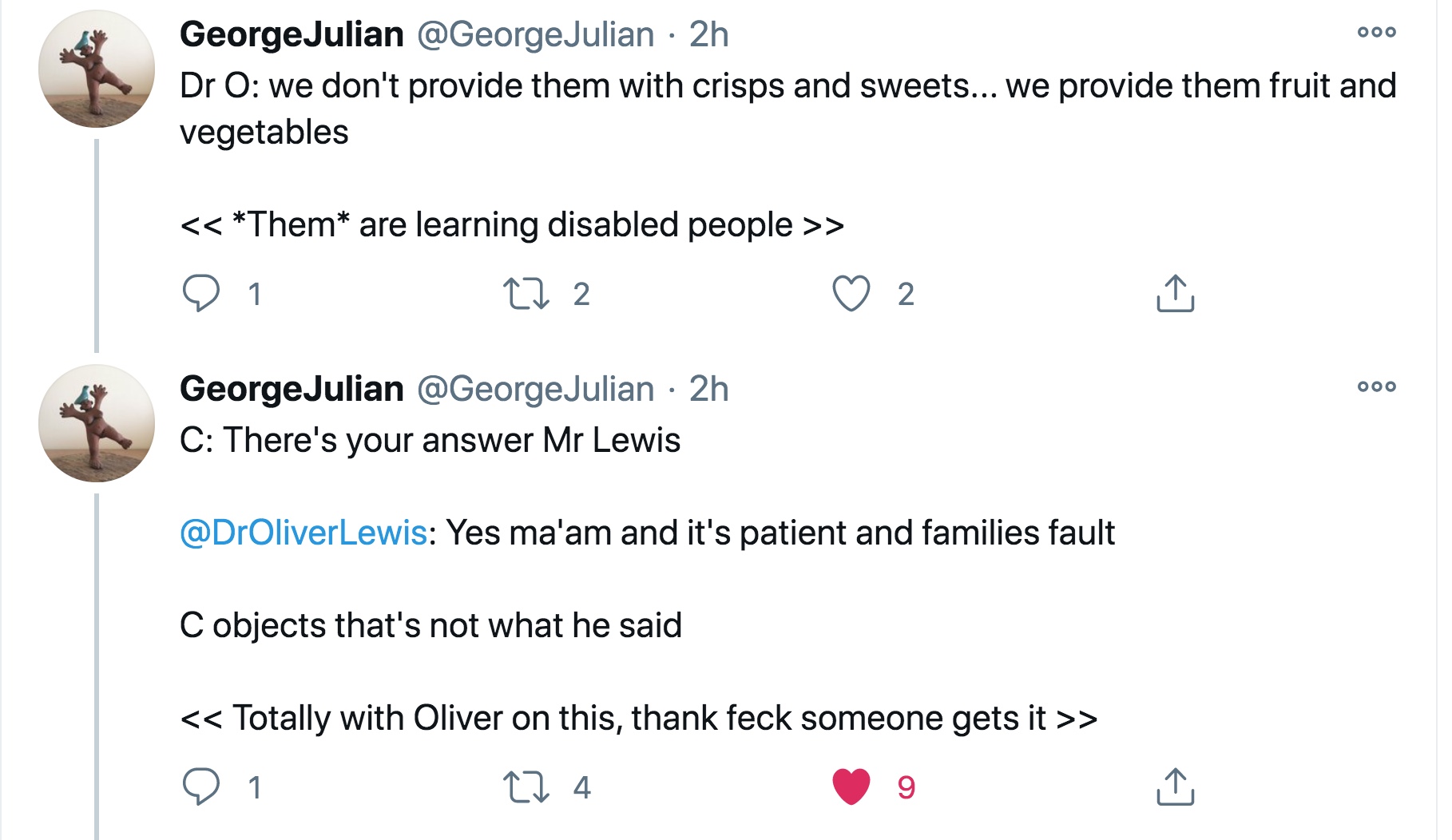
“It’s patient and families fault,” said Oliver Lewis.

Pantomime swiftly ensued. Oh for senior figures to get as angry about the treatment of marginalised people. The coroner and Mr Walsh jostled for position on the outrage stage: “Such an inappropriate comment!” “How very dare you!” “You must apologise to Dr O.” “Mr Lewis you must apologise now!” “I can’t make you apologise Mr Lewis but I certainly invite you to…” The term abuse was even used.

Oliver Lewis apologised if he’d come across as ‘rude and ungracious’ and suggested there was little to be gained from continuing with the evidence.

This evening Joanna’s dad Keith said:

“We have listened in the last five days to a catalogue of mistakes, system problems and poor care provided by Jeesal Group to our vulnerable daughter. We desperately wanted the jury to be able to consider that our daughter’s death was contributed to by neglect because of the gross failure by the Jeesal Group to provide basic medical care. We are disappointed that the coroner refused to permit the jury to consider that Joanna died of SUDEP contributed to by neglect. We are grateful to the jury who took the time and care with the evidence and raised eleven concerns about the services of Jeesal Group which we fully endorse. We have lost our loving, funny and fabulous daughter and, in our opinion, there were so many missed opportunities to avoid her premature death.”
 

Laminating the dead

These posts are coming a bit quicker right now. Sign of grim times still. There was an All Party Parliamentary Group (APPG) on Learning Disability meeting yesterday. Barbara Keeley MP tweeted after the meeting clearly laying out the continuing failure to get people out of ATUs. The meeting involved a mother talking about her son’s ongoing inpatient treatment then a load of blather. Helen Whately, Care Minister, was present and again, seemingly excelled in mediocrity.

I don’t know why, nearly 10 years on from Winterbourne View these meetings need to involve the live retelling of atrocity stories. We’ve heard so many now it’s become almost voyeuristic, generating faux horror from a bunch of dusty parliamentarians many of whom couldn’t give a flying fuck outside of that space. It can also be parasitic and draining emotional labour for the storytellers and others present.

The way in which these meetings are organised sustains a narrative of disposable humans and bleak lives while taking time from what should be a clear, focused and strategic discussion on, er, action. It always seems to be the same parents in attendance too. The same small group of cherry picked bods.

This morning on twitter the discussion continued with John Lish dismissing APPGs as a meaningless industry. Five seconds of googling found that it is our old chum Mencrap which organises these meetings. Bit of a giveaway really in calling it ‘Our APPG’ on the website.

Holy macaroni. I tumbled straight back to an underground cafe near the Houses of Parliament where, months after Connor died Rich and I were invited to a meeting at the House of Commons by Mencrap. Not the learning disability APPG I’m now wondering? Surely not… In that dim space, we met other bereaved families and I was given an A4 laminated photo of Connor. Eh?

An hour later, ‘important’ people spoke at the meeting while families sat silently around the edge of the room. Five minutes before the end of the meeting, we were told to stand and hold up our laminated dead.

Seven years on and Mencrap is still laminating the dead. Still following the same revolting template of presenting bereaved or devastated parents to a room of pomp and performance. Nothing has changed. John is right. This is an industry. And further evidence that nothing will change while Mencrap retains the power the organisation has to effectively maintain the status quo in its own self interest.

Memory sticks

Slow, slow countdown to July 4. Year seven.

Back in the day I wrote raw, fuck you accounts of grief. Real time, incoherent pain accounting. Trying to translate the unimaginable, unspeakable, incomprehensible into words. Into some sort of coherence.

Writing grief.

Seven years on it feels more like shades of a shipping forecast.

Lighter impact. in terms of dominating everyday life, tasks, being and doing.

Timing. winding and wounding moments, longer spaces between.

Emotional state. tears. water. drowning. sadness.

June 18 and my eyes (heart) have started the random, now familiar, tear filling gig. Working from home/Zoom meetings offer unexpectedly novel passing options. The immediacy of being able to delay joining meetings for a few moments. Of not turning on the camera.

longer spaces between.

I’ve taken to decanting the content of old memory sticks onto google drive. Memory sticks. Tumbling into particular date space clusters: presentations, photos and files. Recalling a conference or ten with seventeen hundred versions of a mediocre paper and flight details. Interspersed with detritus from the last seven years. Screen grabs, documents, reports and more, laying bare the outlandish and unspeakable. Snippets of horror and the inhumane.

Then every so often a photo pauses time.

Thinking photography

Post-death, photos demand forensic scrutiny. The whole shebang followed by a meticulous poring over the minutiae. The cast, the setting, the props, the clothes. The weather, the light. Faces, emotions, action and more. My eyes repeatedly drawn back to Connor. Sit kneeling in that funky way he did. Slightly disconnected from engaging with whatever is capturing the attention of his classmates off camera.

I sit and imagine him going back to his class, eventually getting his book bag, a mini bus journey taking a good 40-50 minutes to travel the 6 miles home and late afternoon/evening unfolding in familiar, unseen, unremarkable ways.

When you have a finite time with your child, each piece of stuff – photo, anecdote, a piece of school work, school diary entry, painting – becomes something so much more than it ever was in the moment. The dustings of unfolding life tend to be lost in the complacency of an imagined forever.

I’ll take shipping forecast grief. And a focus on the good times. Beautiful, beautiful, cheeky chappy.

Men at work: Day 105

LB went to the farm yesterday for the first time in weeks. He’s timetabled to go every Monday and Friday but has consistently refused. Even though he always enjoys it when he’s there and works hard.

Apparently he’s been interested in the decorators, carpet fitters and electricians who’ve been working at the unit for the last few weeks. Yesterday it was turn of the gardeners.

“You hear that sound LB?”, asked his support worker.
“Yes,” said LB.
“What is it?”
“Lawnmower.”
“No, it’s the sound of men at work.”

And that was it. Bowl of porridge (or two) and off to work. Beautifully done.


‘Am I mainstream now Mum?’

We passed the 100 day mark this week. 100 days. 100 days of incarceration (though not according to some involved in this story who insist the locked door isn’t stopping LB leaving the unit). Let’s park that detail for now. And the emotions associated with this experience.

Leaving sounds are being made. Most vocally by LB. The slow wheels of social care are groaning into a ‘lets talk about potential provision at some vague meeting at some unspecified point in the near-ish future’ position’. I suspect (sadly) this may be quite something in social care activity terms in the case of young dudes like LB.

Incarceration came about because there was no care or support available. This (incarceration) has given us – er, I’m making some unsubstantiated assumptions here that Goffman would possibly be proud of – a slightly better position in terms of access to support. I’m less than optimistic about what that support might look like, given anecdotal and other information, but the bar is set so low from where we are, support of any shape that actually supports, is progress.

Reading between the lines (because nothing is transparent here) unnamed people (in health/social care/education?) are aware that LB is ready and in need of support to enable him to be released from the (I’m assuming) costly provision he’s been an inmate of for the last 100 or so days. Not that he’s locked up or anything.

Now there’s the rub. For the first time, we’re insisting on effective and appropriate support. This position makes me feel slightly heady, slightly hysterical, hugely enraged but mainly sad.

But hey. What about LB? How’s he doing?

Three things jump out this week.

1. He attended the ‘feelings’ group which was progress after the first meeting when he turned up, gave everyone the finger and left.

2. He’s asked me repeatedly this week if he’s mainstream now.

3. When I ring and they pass the phone to him, he has a nifty exchange with me – ‘Yeah, right’ ‘Yeah, cool, see you then.’ ‘Right, yes, cool, yeah’.

I’d take these three things as a sign that there is some shaking down in his mind of who he is, and what he wants.

C’mon social care (if you hold the power here). Let’s act on that and create him a space in which to live productively. And, while I’m at it, can I chuck back into the mix the feelings of siblings who are offered no support, and, if under 16, not allowed to visit their brother or sister on site?

It shouldn’t be like this.

Squashing, starving and filling the dishwasher

LB wants to come home. And we haven’t got support yet to have him home. The care manager is looking into options. The unit have pretty much reached the end of the road in terms of helping him. They’re upping his activity level, encouraging him to empty the dishwasher and creating some social stories.

An email from the care manager last week states;  “There is a meeting currently being arranged I understand it’s the 8 July but no time has been set yet to discuss in more detail this option [support].”

Eh?  Seriously? July 8th? No time set?

Just in case anyone has forgotten, this is an 18 year old young dude. How long is it going to take to put some sort of appropriate support in place? To enable him to come home? What value is being attached to his life? [Well I’d guess crap all to the last question].

At the weekend, LB succumbed to bear hugs from both Rosie and Owen and, just as uncharacteristically, said ‘I miss you so much’.

Heartbreaking.

Today when I visited, his room had been painted. All the posters, photos, drawings and detritus built up over the last few months, were removed and piled up on a cupboard. He was kneeling on the floor. Flicking through a truck magazine on his bed. Surrounded by white walls and nothingness. Even his unwanted, unsought after ‘space from home’, was open to destruction. Timetabled to fit with some tendered/purchase ordered, person discounted process. He wasn’t happy.

It’s as if any semblance of family life, of anything and everything we’ve tried to create and achieve (including filling the dishwasher) is at the mercy of some peculiar and arbitrary non-space between health and social care, between learning disability and mental health. A space created through the provision of no effective support/care and mediated through a bizarre emphasis on  ‘choice’, thoughtlessness and the vagaries of what’s called “service provision” despite not really offering a ‘service’.

In one of those funny twists of fate? coincidence? general shite? I got an email reminder today about a new university wide autism interest group. The first meeting is on Thursday afternoon. On the distribution list was Dr X (who I’ve now re-named Doc Dire). The one who suggested we did the hunter gatherer diet and holding therapy all those years ago. There is no evidence to support the former (still) and there are, according to Autism Research, “numerous personal accounts of the damage caused to people with autism and other conditions” in relation to holding therapy. So, the advice from the experts* from yesteryear was to starve LB and squash him. And now he’s waiting in limbo, for some faceless people to “set a time” to discuss future support “in detail”.

Marks out of 10 for health and social care provision over the years?

Let’s not go there.

*The other advice from Doc Dire was to avoid support groups because they were just filled with a bunch of moaning women. Hilarious.