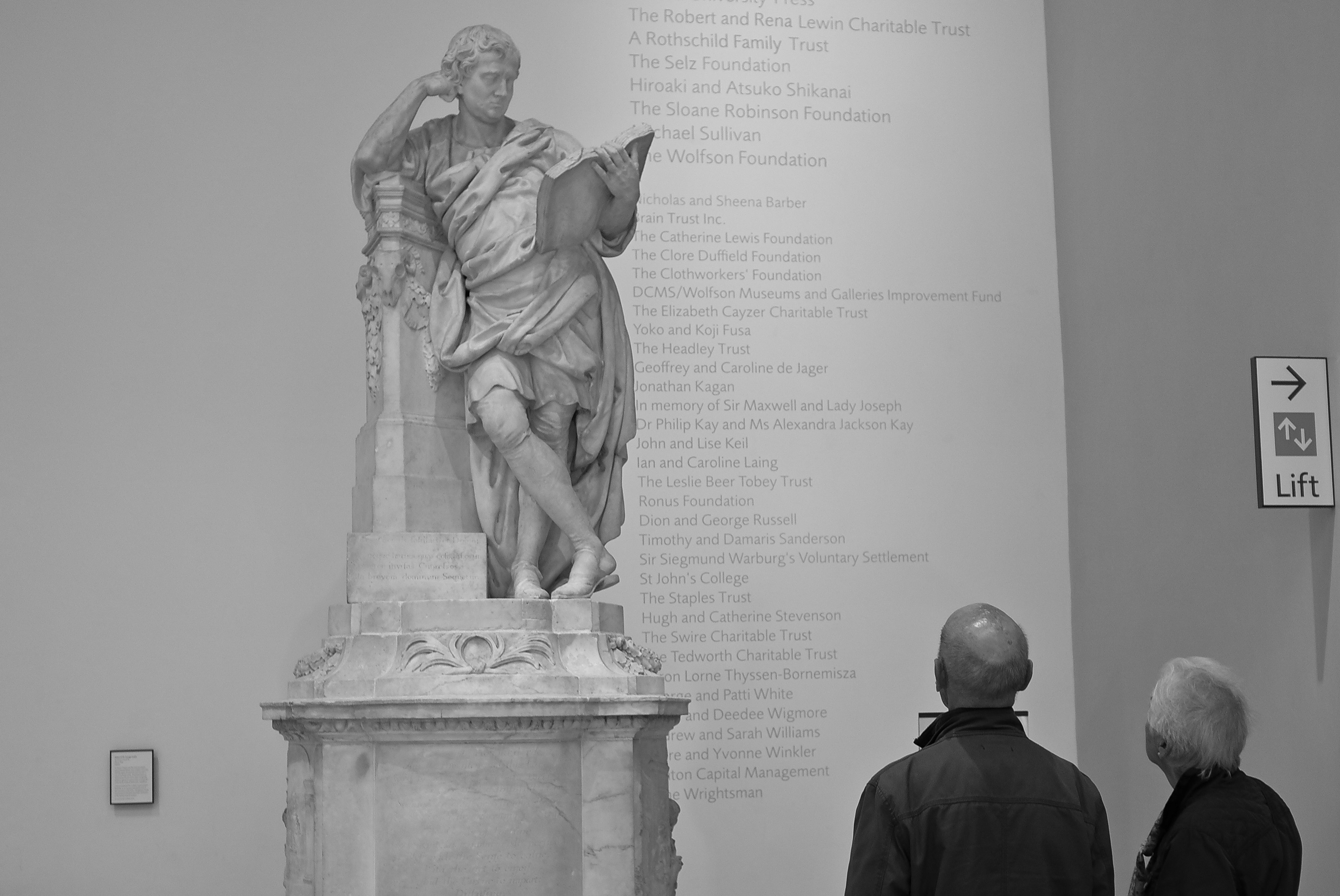


Disembodied Ashmolean
Reply

Full weight of mental health/learning disability bureaucracy/uncertainty yesterday, with LB’s CPA (Care Plan Approach) meeting. Anxiety was compounded by the rumour (don’t ask) that a CPA meeting was linked to discharge. Eh? Discharge? After the effective deskilling implications of the “choice” agenda for both him and us over the past months?
Adding to the general mix of uncertainty, on Sunday we went to London (one of LB’s fave and regular, pre-unit, activities), organised optimistically with thoughts of his possible impeding discharge in mind. After a good day hanging out, he punched himself so badly in the face on the motorway home that his nose didn’t stop bleeding for nearly 20 minutes.
Discharge seemed to be the implicit focus of the meeting based on the fact there is little more to be gained from his stay there. If there are no answers emerging through this process, who do we turn to? Er. Mmm. Good question. I suspect the answer to this, for the health and social care world, is twofold; 1. More drugs. 2. Some ‘independent supported living’ gig in which LB watches tv and YouTube all day while underpaid and untrained staff scratch their arses. A type of drugged up independently supported no life.
Anyway. Back to the CPA. Jan Sunman from Oxfordshire Family Support Network, with the support of Fran Steep, introduced a person centred dimension to the meeting. With varying levels of engagement and resistance. This disrupted proceedings healthily, making visible rigidity and entrenched expectations. It also enabled us to move beyond a 20th century medical model of learning disability and look at LB as an individual and not a set of behaviours. LB pitched up and made a contribution, muttering under his breath ‘this is bollocks’. Love him.
Anyway. There was no discharge date. Well not one we know of. Instead his activity level is to be increased, including some chores, to bring him back to a level where he’s able to do more than watch the tv all day. In the meantime, we will grub around trying to find some meaningful support. It shouldn’t be this hard.
Yesterday I got home about 7pm. I rang the unit to ask if LB wanted me to visit that evening or today. I don’t feel I have to see him every day, but I like him to know that we’re around.
The staff passed LB the phone and I asked him the question.
“Today“, he said, straightaway.
“Are you sure?” I asked,one eye on a bottle of wine chilling in the fridge.
“Today, Mum, today“, was the firm answer.
When I turned up at the unit, the staff were surprised to see me. He’d given the phone back to them and said I wasn’t coming. Funny. Or is it?
The unit team have produced a communication care plan for LB which is stuck on his bedroom wall. The first objective is;
Mmmm.
The Department of Health only days ago published a joint statement with various partners about post-Winterbourne care for learning disabled people, which included a recognition of the learning disabled people in other NHS-funded hospital care. A commitment was made in the Winterbourne View concordat “to ensure that by 1 June they will all have had their care reviewed and a personal care plan developed, built around their particular needs, taking into account the views of their family carers”. [italics added]
Now, these things (as usual) ain’t rocket science, but I would have thought LB’s communication care plan could have started with any one of a billion objectives that would support and facilitate his communication with others. Starting with this one is kind of problematic to me, as it sets us up as a problem, or an obstruction to LB’s development. An issue that emerged in the very early unit days. Given that only a few months ago, LB was a typical teenager, living with his family, I’m not sure what sense he makes of it, which may be why he told the staff I wasn’t coming, having told me I should. The communication plan is on fire, clearly.
But then, as with most of these things, there is a helluva lot of talking the talk, but little walking the walk. It doesn’t matter what grand statements are made at the top, if they ain’t going to translate into practice. And the irony is, I/we/carers are forced to become ‘problematic’ to try to get some walking done.
Choice anyone?

I had a call yesterday from the person running a specialist arm of a charity providing educational support to young learning disabled people/children. A care provider basically. I was put in touch with her through a mate, who met her in connection with her daughter’s transition to adulthood. My mate rang me to say that this woman was one to speak to about LB. The subtext in this exchange is that there are a lot of people it ain’t worth speaking to. Something I think most parents of disabled children learn sooner or later.
At the time of the call, I was at a local retreat where we go for concentrated writing days a couple of times a year. The woman’s matter of fact summation of our situation contrasted with the scenery and sunshine. She reflected on how odd it was that various things hadn’t happened all those weeks ago; before we were ‘driven to such an extreme measure as admitting LB to the unit’.
Whoah.
That is an extreme measure. I almost forget the brutality of it. And here we are 80 days later, nearly a quarter of LB’s 18th year spent in hospital. Kind of beyond extreme really. This so should not have happened.
Specialist woman zoomed into action over the phone and made a plan to plan a possible programme to support LB’s return to school. Depending on funding of course. Cough cough. She was definitely one to speak to. But then she would be if she was recommended by a mate. Someone with personal experience of the gig. That’s the way it works.
If we’re going to talk about hierarchies of knowledge, my money is on the mate/mother network every time. Efficient, effective and it don’t cost a penny.

I was away for five days last week. It seemed kind of good timing as LB was a lot more like his old self. I was at the Nordic Network of Disability Research (NNDR) conference in Finland where several papers were about choice, autonomy and learning disabled people.
Rich took my mum and Owen to see LB while I was away. He was fairly disengaged and not doing much. Going to see him yesterday evening, after this break, was pretty disheartening. It made me want to toss the whole choice/autonomy agenda in the nearest skip.
His anxiety levels/aggression and hostility have seemingly reduced. Fab. At the same time, he basically spends every day watching DVDs. Unless there is the option of a trump card outing, a ‘b’ card; burger or bus museum. This is in contrast to his school timetable a few months ago.
We’ve consistently said/thought/believed/argued that LB, and dudes like him, should lead a productive life. [I’m seriously boring myself now saying this over and over again with no sniff of a productive life anywhere in sight round this way, but I refuse to give it up]. Outside of some small and hugely oversubscribed/or hidden away pockets of brilliance, there ain’t much substantive choice for young learning disabled people. Especially with current cuts and welfare reform.
Call me a crappily cynical old baglet (yep, please do, because I’d love to be proved wrong), but it strikes me that the ‘choice/autonomy’ agenda is a bit of a cheap and effective tool really. It doesn’t cost much to ‘choose’ to watch DVDs all day, with an occasional ‘b’ outing. The long term implications (outside of cost – health, social, emotional and political) of people leading lives like this are too enormous to even begin to wince at.
One of the presentations at NNDR (twitter feed #nndr2013), was by Alan Roulstone who talked about choice, autonomy, community and risk. One of his conclusions was the importance of engaging with a “realism that never lets go of ambition” and “ambition that never lets go of realism”. He was weighing up risk and vulnerability in terms of hate/mate/(and general neglect) crime, but I wonder if his focus on ambition is a bit ambitious in reality [sorry]. Ambition, for learning disabled people, is a bit of a stretch. And way too pricey.
There is a new realism for LB though. About doing very little with very little expected.


I was given/awarded? earned? a ‘one off payment’ after filling in a carers assessment form. Wow. A brief letter asked for my bank details to transfer the money. Wow. I picked myself off the floor and decided to tag an extra day on to my Finnish work trip. A day and night in Helsinki. A carers break.
It was fab, fun and sunny.
Today I got a letter from the County Council asking for confirmation that the money has been spent in line with the scheme. Eh? The scheme? With receipts.
Oh.






 mydaftlife