
A bizarre bit of journalism popped up in the Sunday Times last weekend. About Lisa who was locked in a room for 9 years in an assessment and treatment unit (ATU) until she was ‘discovered’ by the Challenging Behaviour Foundation (CBF) ‘expert by experience’ on a CQC inspection. Much is made of the role of the CBF in this short piece. Not sure we need Viv Cooper, CBF CEO, to point out this is ‘deeply concerning and shocking’. It’s also a bit bizarre that the Sunday Times ‘can reveal’ this horrific story when it was published by the CQC last summer in their 3 Lives report.
But that ain’t all on the bizarre menu.
The story moves on to discuss Stephanie Bincliffe who died in an ATU (privately run by the Huntercombe Group) aged 25 and weighing almost 26 stone. Her inquest is ongoing. Why someone who died [died] and is (well should be) currently ‘news’ is mentioned after Lisa (who should have been but never was) is baffling.
But that ain’t all that is baffling.
Other than The Sunday Times, there has been no media coverage of Stephanie Bincliffe’s death despite the inquest being a public event. She was locked in a room for seven years (like Lisa). The Sunday Times reports:

Two women. Two rooms. And media interest worthy of a local break-in in a disused warehouse in a disused retail park (earmarked for building a new, large scale, residential facility for learning disabled people perceived to be bothersome).
I can’t stop thinking about Lisa and Stephanie. I’ve really struggled with LB’s 107 days in STATT. 107 days. Howl. I battered Rich’s ear yesterday trying to remember what holidays we had in the 9 years before LB died. How could someone be locked in a room for years? In a health unit supposed to treat and assess? Howl.
Both Lisa and Stephanie had their ‘care’ commissioned. Both were sectioned which should involve a whole raft of built in processes/checks/regulation. Involving health and social care professionals and commissioners.
When I first heard Lisa’s chilling story at the CQC event back in February, David Harling who talked about it, used a photo to illustrate what a suite at the Ritz (or some other swanky London hotel) looked like at a cost of £12,600 per week.
I’ve googled and found this little baby for comparison:
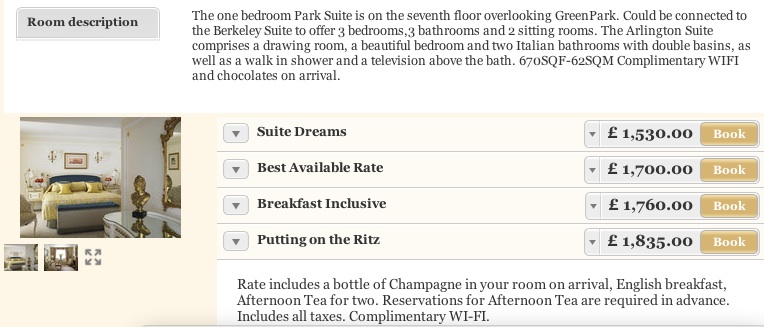
The money is irrelevant in many ways. We’re talking people’s lives. But it isn’t. The story woven around these bothersome patients who need ‘care packages’ so off the scale of expensive must involve collusion across a whole range of health and social professionals/NHS/private providers. £12,600 a week? Really?
And, ironically, the real cost of the (anti) care provided (a bit of hatch opening, pill pushing, hair brushing from a distance and a staffing ratio of .001? to 1) costs fuck all.
It stinks of a win win situation financially for the provider (NHS or private). A level of ignorance on the part of commissioners. A further battered health/social care budget for learning disability provision and a complete lack of care or interest across the board.
People who have committed no crime but are such a menace that locking them up for years is ok, even when they, er, die. Aged 25.
Moving quickly on because there really ain’t nothing to see in this room….
What role do key charities (in this case those originally set up by families to improve the lives of their kids) actually play? And what do they actually do? And why?
Tumbleweed.
Or worse. Clearly.
 mydaftlife