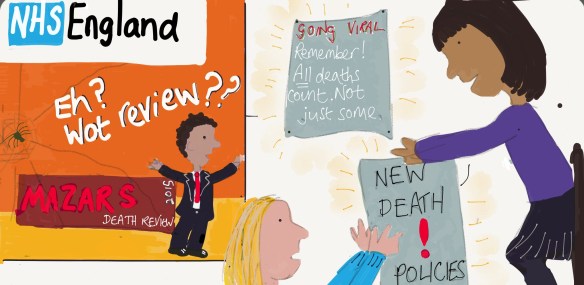
On December 10 2015, the scandalous findings of the Mazars review (into Sloven’s investigation practices when learning disability and mental health service user patients died unexpectedly) were leaked to the BBC. The headlines were horrific.
Heidi Alexander tabled an urgent question in the House of Commons that morning and serious discussion followed. Deeply serious we thought at the time. A stack of MPs asked important and relevant questions.The full text of the session can be read here. Or you can watch it here.
The Mazars review was ‘profoundly shocking’. The stuff of scandal.
Heidi A nailed the central issue with this statement, love her:
The report raises broader questions about the care of people with learning disabilities or mental health problems. Just because some individuals have less ability to communicate concerns about their care, that must never mean that any less attention is paid to their treatment or their death. That would be the ultimate abrogation of responsibility, and one which should shame us all. The priority now must be to understand how this was allowed to happen, and to ensure this is put right so it can never happen again.
Unmaking the scandal
But the scandal was unmade. Over the course of a few weeks. Urgency dissipated and nothing happened. The Sloven CEO and Board remained untouched despite the report clearly laying the failings at their feet (and despite public appearances that still make my toes wince with awkwardness for just how crap they clearly are).
Why the scandal was unmade is a tricky one. How is a bit easier to unravel. First, there was the cracking timing of the eventual publication of the report. Just as MPs finished for the Christmas break. Literally. This built in a two week or so hiatus allowing some of the intensity of feeling around the findings to ease. This timing was, ostensibly the decision of NHS England. Though given the news this morning that Simon Stevens, NHS England CEO, was leant on by the government over NHS funding, it was quite possibly an order from above. The dove from above.
The dove from above may also explain the utterly unimpressive and ineffective responses from NHS England, Monitor and the CQC. Giving a goldfish a knife and fork and expecting it to eat, type approaches. Worse than hopeless. Just pointless.
Having met Jeremy Hunt this year and listening to what he said carefully (a courtesy he didn’t extend to us), I re-read the Commons discussion from December this morning and realised how much he didn’t say. I think at the time we were so bowled over he’d sprung into action we didn’t pay proper attention to what he did say.
 Jezza laid out three steps ‘that will help create change in the culture we need’.
- Independently assured, Ofsted type style ratings of the quality of care offered to learning disabled people will be published for each of the 209 clinical commissioning group areas.
- NHS England have commissioned Bristol university to do an independent study into mortality rates of learning disabled people.
- Bruce Keogh will develop a methodology to publishing the number of avoidable deaths per trust. Central to that will be establishing a no-blame reporting culture across the NHS, with people being rewarded, not penalised, for speaking openly and transparently about mistakes.
Not sure where 1. came from but 2. and 3. were already underway before the Mazars findings were circulated. So not a big response by the Secretary of State. The Bristol review stuff is a bit of a waste of time because it’s underfunded and stripped back to the bare bones of research (though I’ve no doubt the team are doing the best job they can within these confines).
In the thirty minute question and answer session that followed this opening statement Jezza repeated human factor speak over and over again. Pretty much ignoring the implications of the review. He only mentioned learning disabled people once. Many of his responses (see below) to various MPs were irrelevant to the Mazars findings given there was no blame culture. No investigations. Nobody cared. People were expected to die early and when they did it was natural causes. No questions asked.
We have to move away from a blame culture in the NHS to a culture in which doctors and nurses are supported if they speak out, which too often is not the case. (to Heidi Alexander)
The hon. Lady has been a practising clinician, so I am sure she will understand that at the heart of this issue is the need to get the culture right. (to Dr Philippa Whitford)
There is an interesting comparison with the airline industry: when it investigate accidents, the vast majority of times, those investigations point to systemic failure. When the NHS investigates clinical accidents, the vast majority of times we point to individual failure. (to Jeremy Lefroy)
I do not see the treatment of people with learning difficulties as distinct from the broader lessons in the Francis report, but if we fail to make progress, I know that the right hon. Gentleman will come back to me, and rightly so. (to Norman Lamb)
I also think, however, that there is a systemic issue in relation to the low reporting of avoidable and preventable deaths and harm, and the failure to develop a true learning culture in the NHS, which in the end is what doctors, nurses and patients all want and need. (to Caroline Nokes)
..if we are going to improve the reporting culture, which in the end is what the report is about, we have to change the fear that many doctors and nurses have that if they are open and transparent about mistakes they have made or seen, they will get dumped on. That is a real worry for many people. Part of this is about creating a supportive culture, so that when people take the brave decision to be open about something that has gone wrong they get the support that they deserve. (to Cheryl Gillan)
When there is a problem, we need a culture where the NHS is totally open and as keen as the families are themselves to understand what happened, whether it could be avoided, and what lessons can be learned. (to Diana Johnson)
We have to recognise that everyone is human, but, uniquely, doctors are in a profession where when they make mistakes, as we all do in our own worlds, people sometimes die. The result of that should not automatically be to say that the doctor was clinically negligent. Ninety-nine times out of 100, we should deduce from the mistake what can be learned to avoid it happening in future. Of course, where there is gross negligence, due process should take its course, but that is only on a minority of occasions. (to Bob Blackman)
He is right about making sure that we get the culture right. It is about creating a more supportive environment for people who do a very, very tough job every day of the week. (to Barry Sheerman)
We need a culture where, when people raise concerns, they are confident they will be listened to. (to Jim Cunningham)
Jezza’s performance was simply a warm up to his recent patient safety global summit gig. Astonishing really. And how he could host a global patient safety summit, bigging up NHS efforts in this arena while ignoring the thorny issue of a group of people consistently dying prematurely in NHS care, without question, without blame and without learning is extraordinary.
But patients aren’t equal of course. Even in the NHS. There’s consistent evidence for this. And some people aren’t really patients.
When we met Jezza he steadfastly refused to engage with or acknowledge that, given the Mazars review revealed that less than 1%* of the deaths of learning disabled people were investigated, urgent scrutiny was needed to look at what was happening and how this was allowed to happen. He repeated human factor stuff. Stepford wife styley.
[*The two deaths that were investigated were LB and, from local intelligence, another patient in the same unit who died a week or so after him so the figure could easily have been 0. 0. 0. 0. 0… 0… ]
Such wilful stubbornness (with sprinklings of stupidity and arrogance) has (ironically) probably consigned a very rare window for proper scrutiny and focus to be turned onto a group of people who die early back to blackout.
Why? Why has this been allowed to happen? The most scandalous report in the history of learning disability history kicked into the long grass? I dunno. Here’s a few suggestions. A bit of an overlapping jumble as it’s difficult to tease this stuff out.
- The extent of eugenic practices that occur under the ‘watchful eye’ of NHS/social care is too big to go near.
- Uncovering such practices is feared a) morally (way too uncomfortable and messy to go near); b) economically (potential litigation costs relating to the uncovering of further scandalous practices together with the cost of budgets associated with longer living people are too high).
- Premature deaths are ok really or even welcomed because a) certain people ain’t fully human b) are costly, burdensome and unproductive c) the old ‘better off dead’/lives unworthy of life type arguments.
- People in positions who can do something about this, and there are some bloody brilliant people who are doing their best, are obstructed from doing their jobs.
- Jeremy Hunt sees the HF thing as a calling and has got a bit of a chunky god complex going on. The Mazars review is a pesky complication best ignored.
The dove from above factor.




 mydaftlife