
I re-read the FOI docs from Oxon County Council (OCC) at the weekend. What they demonstrate is so depressing I thought I’d write a bit about them with the hope that other local authorities/commissioners might look at their own responses (and their staff responses) to learning disability type issues in their work and think differently.
The unit LB was in (STATT) was jointly commissioned by OCC and the Oxon Clinical Commissioning Group. OCC were in charge of reviewing the quality at the unit. What still astonishes me is that, after LB died, there was no immediate flocking to STATT to check the quality of the provision. In fact, an updated quality control review conducted in May 2013 was being circulated on July 22, just over two weeks after LB died:

Clearly no concerns whatsoever about the quality of provision at the unit. And LB?
Who?
At this stage of course, Sloven had decided he’d died of, er, natural causes, so everyone could carry on with business as usual. Learning disability trumping every other part of a quirky, gentle, humorous, young dude. To such an extent that no one in Sloven, OCC or OCCG seemed to say “Eh? 18 years old? In the bath? Something is clearly wrong here.”
Rich and I have often thought how, if LB hadn’t died, the provision at STATT could have continued indefinitely but really it wasn’t his death that put a stop to it. It was the CQC pitching up two months later. They failed the unit on everything and published an inspection report that makes the back of my hands prickle, it is so damning. It documented a place that had long lost any whiff of care. A space empty of any meaningful interaction, any therapeutic engagement, dirty, unsafe, empty and toxic.
A shocking, shameful uncovering.
So how did OCC towers respond to this? They’d allowed a group of people to ‘live’ in such a terrible environment even after a young person died? At a cost of £3500 per week each. (Around £112,000 in the time between LB dying and the inspectors arriving). The response seems to be a mix of fear, defensiveness and bravado. And statements that reveal the inhumanity with which learning disabled people are both treated and perceived.
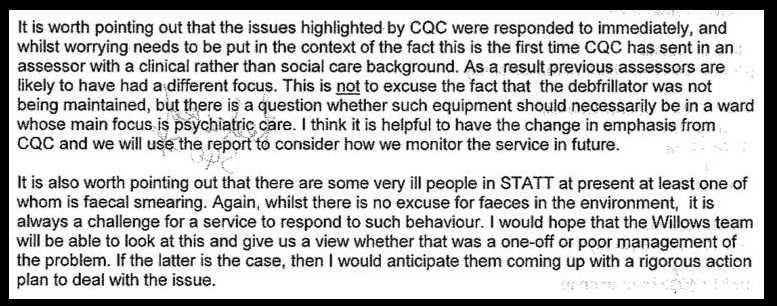 Again, an astonishing response. On so many levels. But no one challenged it. Despite the blinking, bleeding obvious awfulness of it…

Perhaps an essential ingredient for culture change is a more critical engagement with how applicants perceive learning disabled people at a recruitment/promotion level. Involving learning disabled people and families in the process. Having the wrong people in the wrong jobs clearly allows crap ‘care’ to continue. And, at worst, actively contributes to it.
 mydaftlife