
Doreen and Sam

I met up with Doreen this morning on the bus to work this morning. Doreen worked for social services for 20 years as an escort and took LB to school for about 2 years five or six years ago. We loved Doreen.  She was sitting with Sam who was on his way to work in the café at Oxford Brookes. It turns out Sam used to go to LB’s school so we did a lot of catching up with different kids from the past.

D: Oh yes, we used to pick up Ben T at Radley Way and then go on to Rose Hill for Sarah H, she was a funny one and then back to Barton for Tom L. Then there was James C…
S: James C? Awww… you’re kidding me! I know James C from Anjali Dance Group.
D: Yeah, James C and then Donna T, do you remember? She was at Saxon House for a while.
S: Donna T? Yes. Oh you’re kidding me! 
[hehehe]
D: And then there was Terry W…
S: Terry W? You’re kidding me!  Oh you’re kidding me right! I know Terry W from Mencap.
D: Terry W yes. I saw him recently in town. He came over and gave me a great big bear hug, as he does. But the person he was with told him off for talking to strangers. He said to her ‘That ain’t no stranger. That’s Doreen’.  I don’t know.  I see ‘em now and they’re all so grown up, but I still got photos of a lot of a lot of ‘em.  Anyway, I’m getting off here. Nice to see you both.
[…]
S: Do you know Joan M?
Me: Yep, I know Joan M. Do you know Danny F?
S: Danny F? You’re kidding me! I know Danny from Mencap.  Mencap.  Terry W. was in town. Why did the carer do that? They were wrong. Terry knew the lady sitting here. He knew her and they were wrong to say ‘don’t talk to strangers’. She wasn’t a stranger. Fucking outrageous. They were wrong. Do you know Daisy?
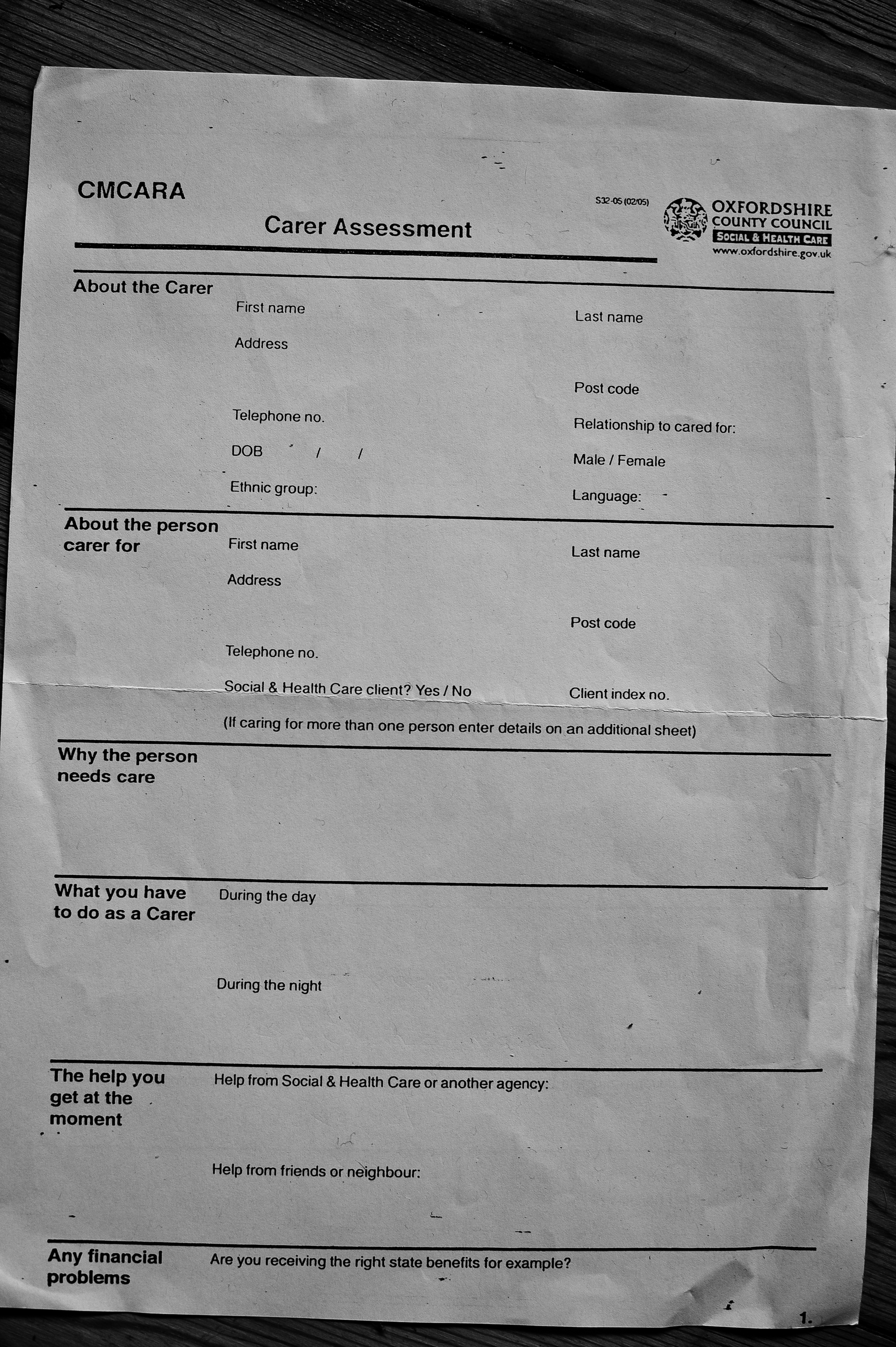
Carer Assessment

The long awaited Carer Assessment form turned up recently. Regular blog readers will know that I’ve been a bit confused about this assessment, and wasn’t really sure if I’d had one or not. Given that LB is 17 and it was introduced over five years ago, I thought I probably had really [must have surely…?], but I hadn’t.

So. A Carer Assessment turns out to be an A4 piece of paper with statements and prompts on both sides. No instruction, no guidance, just a piece of paper. Not sure I need to say much really. It kind of speaks for itself. I’ll just flag up the bottom of the page (pictured) ‘Any financial problems‘ section, which has got no space to write anything other than ‘yes’ or ‘no’ but includes the helpful prompt; ‘Are you receiving the right state benefits for example?‘ Er, you tell me matey,  And mention my favourite prompt under the ‘How you feel about continuing to care’ section on page 2; What would happen if you couldn’t care any longer?‘ Er, you tell me matey.

Not sure which dozy bunch came up with this ‘assessment’ but if I was marking it as a student assignment, it would get a big, fat fail.


Choice and control

LB gets direct payments to cover the cost of four hours care a week. Direct payments were introduced to enable “service users” [people] to buy their own care support and services. It’s all about giving service users choice and control in creating a “care package” [support] that is tailored to their needs. So far so good…

The local “care provider” [company] that is somehow hooked into the local authority contacted me to say that LB was down on their list for a residential holiday.  When his case had gone to “panel” [no idea] a few months ago, his care package was increased to 4 hours a week plus a residential holiday. Oh. Ok. What kind of holiday? Five days at an activity centre in Swindon. I wrote the cheque.

Choice? Now that’s a funny one. Choice really means a choice of two or more things. If you’ve only got the choice of one thing and nothing, it ain’t really a choice. It’s a yes or no thank you. I’d already googled and failed to find any available holiday for LB, so, residential holiday in Swindon or no residential holiday? Yes please. But lets not pretend there’s a choice involved here.

The holiday starts today. The company have been in touch a few times about arrangements, LB turned down the meet and greet opportunity and he’s being picked up this afternoon. Between 1.30-3.30pm according to the paperwork. Then a call late yesterday afternoon;

“Hi Sara, just to let you know, I should be with you around 5pm tomorrow to pick up LB…”
5pm? Eh?  Why so late? What if we’d made plans? Why cut corners?
“Oh, great! Thanks!!! LB is really looking forward to it. See you then. Bye!!!”

Control? Not really. Not when you are handing over your dude to their care for four nights and five days. And what about LB? Does he have any choice in all of this? Not really. He’s been muttering but ain’t called in his legal team yet. I suspect he’s just hoping for a few Stobarts on the M4.


Winterbourne

I’m keeping this short.  I find it so upsetting I get that lump in the back of the throat thing and then tears, comparable to the recent downpours we’ve been having, start chucking it down my cheeks. Coverage of the recent independent report into the abuse of learning disabled people living at Winterbourne View care home institution by Margaret  Flynn* can be found here. We now know that there was a raft of factors (big surprise) detailed in the report that contributed to the barbaric and inhumane treatment of people who are pretty much defenceless. I won’t rehash them here, but just  quote this;

Andrew Havers, medical director of NHS Bristol, North Somerset and South Gloucestershire Primary Care Trusts, said: “Many of the systems that could have prevented the shocking abuse of patients at Winterbourne View hospital failed.

Yep. The systems failed. As they always do. And nothing changes. There will be hundreds more Winterbourne’s. Happening now and in the future. Our children, your children, future children, will be beaten, humiliated, abused, exploited, overlooked, neglected, teased, tortured and toyed with. Through systemic failure. On so many levels.

I tweeted a comment this afternoon about the fuss that was caused by the cat being chucked in the wheelie bin that time. I didn’t mean to compare human with animal abuse at all. I just wish that cases like Winterbourne produced the same level of outrage among people because until they do, I can’t see much changing.

Anyway. That’s all really. Other than I’m really learning the meaning of a heavy heart.

*Contrast this with Louise Casey’s tripe if you can be bothered.

Remploy and “loss making”

I’m in favour of inclusive work places. Of course I am. But in terms of inclusive work practices developing in the UK, I’d say we were at a similar stage really (ignoring the unsustainable fluff introduced every now and again) to 30 years ago. Nothing has really changed.  Yes, there has been a shift away from institutionalisation but there is plenty of evidence that despite living ‘in’ the community, learning disabled people remain outside of the community, isolated, often victims of hate crime and not in, or even close to, employment.

And employment, or work, is one of the central features of our lives.  Something this pig ignorant coalition government wilfully misunderstand, misinterpret and use as a political tool for their own purposes.

Today Remploy employees are striking against the proposed closure of 27 “loss making” factories putting 1421 people at risk redundancy.

Remploy provides employment opportunities for learning disabled people (and so much more).  Remploy employees go to work, work and earn money. Ok, it’s an exclusive setting, but, for the time being, the rest of the UK workplaces are exclusive too.  Exclusive to people without learning disabilities. Until these workspaces become inclusive, closing Remploy is going to leave most, if not all, of the current employees unemployed.

Many or most Remploy employees will no longer go to work. Structured everyday life, use of space outside of the  homes, journey to and from work and social experiences gained on a daily basis will be removed.  Many employees will be left with the option of day centres, staying at home or using direct payments to pay someone to take them out somewhere. We all like going out, but as a part of our lives, not as a sole feature.  There are also implications for family members who will have to readjust their own lives accordingly.

Many or most Remploy employees will no longer work. The benefits of working are documented in a ton of evidence gathered over decades. I won’t bother to list them here, but the health consequences of not being able to gain employment are also documented. The lack of structure and activity, and the emotional distress caused by the removal of  working lives, may have serious health implications.

Most or many Remploy employees will no longer ‘earn’ money. Yes, there will be some financial support but it ain’t the same thing. And no doubt there will be some shenannigens about placing Remploy employees in an inappropriate work category, leading to more punitive sanctions in line with current changes to the benefits system.

So what is going on here? Is the government closing these factories because they subscribe to the vision of an inclusive society in which learning disabled people are supported, welcomed and sustained in paid employment?

Bollocks. It’s all about money. The worth and value of learning disabled people is so low, that keeping (financially) unprofitable factories open, even if they offer some people employment and everything that comes with that, is not an option.  But “loss making” in this situation, cannot and should not be measured financially.

The DWP commissioned report into the viability of Remploy opens with the statement;

The views expressed in this report have been based on discussion with Central Management only.

Sums it up really.

Bonsai trees in the Marriott lobby

One thing led to another, this afternoon, in the Marriott Denver-Tech-Center hotel lobby.  A baking hot afternoon. A war between suburban hotel shuttle services. I was left waiting for about 45 minutes to get from the conference hotel (on the edge of a 12 lane motorway), to the hotel I was staying at (in the middle of nowhere). A hell hole industrial wasteland of nowhere. I ain’t joking.

I hung out in the lobby which was the size of a small football pitch. Chatting to the ‘bell/concierge’ person every now and again. She was working her socks off trying to negotiate ways out of the hotel for a constant stream of large and small groups of people who wanted to go somewhere.

I watched delegates from the Vision of the American West Bonsai Convention carefully wheel their trees away on luggage trollies, and vaguely regretted not spending more time at their exhibition. Various delegates from the disability conference I was attending, milled around, on foot, in chairs, on scooters, chatting, signing, discussing where to eat that evening. There was a lively, end of the day conference buzz. I met a delegate from Witney who had emailed me months ago. Funny old world and all that.

Three young men came through the revolving doors dressed in US naval uniform. They visibly responded, seeing a small group of conference delegates standing by the entrance. One of them stopped, momentarily and stared. He was given a brief hand squeeze on the shoulder by his colleague. There were the tiniest of half grins, a small cough, then faces were rearranged into studied disinterest.

All in the Marriott lobby. On a baking hot afternoon. That’s all.

A succession of sick notes

Dear Iain Duncan Smith,

I’m writing about ESA and my seventeen year old son, LB. I know the process and procedures around claiming ESA are framed by a ‘scrounger’ rhetoric. Underpinned by the constant questioning of the integrity of those who are unable to work. I also know this is a spurious position; under-claims are greater than over-claims or fraud. We have so far had to provide two sick notes over six months (well three really because we had to get one to cover the 3 month backdated period). I think then an ‘indefinite’ sick note will do. I have tried hard to understand why this is necessary. What is underpinning the blanket need for a succession of sick notes? Is it simply a tool of attrition? The ‘scroungers’ will be worn down by having to return to their GP three times? GPs, in turn, will surveil their patients more closely for signs of cheating or trickery? I don’t know.

I didn’t want to get a sick note for LB. I didn’t want to because he isn’t sick. I didn’t want to because we have a ton of official paperwork highlighting and poring over his ‘deficits’ in micro detail from a gaggle of professionals; geneticists, ed psychs, paediatricians, teachers, social workers, psychiatrists…the list is endless.

I didn’t want to because it made me feel sad.

I found it more upsetting when I found out, through the allowance stopping as soon as it started, that I needed to go back for a second note. And then, again, after the reinstated allowance stopped, a third note. Perhaps if you had made it clear that three notes would be needed at the start, it would have been easier. But then I suspect my GP would have written the three on the spot, negating the need to return to the surgery (and take up his time). You may have been trying to close that loophole by deliberately making the process opaque.

Oh. I should probably add that I went to the surgery. Not LB. His GP doesn’t need to see him to know that he has learning difficulties. I wasn’t going to put him through the experience of being given a ‘sick note’ by the GP. He wouldn’t really understand that and he can get anxious going to the doctors. So it’s all a charade really. With a touch of farce.

I’m writing really to ask if you could try to get over your fixation with (fictitious) ‘scroungers’ and, instead, gain some understanding of how the process is experienced by disabled people, or their carers. And maybe shift the money invested into such a clunky, laborious and inefficient system into supported employment programmes that actually work in practice. LB wants to work. He is hoping to become an assistant caretaker.

Yours sincerely,

Sarasiobhan


Language, careless statements and exclusion

During today’s Prime Minister’s Question Time, Cameron made the statement; “We know that through the phonics scheme that my right hon. Friend the Secretary of State for Education (eh? who?) is leading on, that we can teach reading so that no child is left behind.”

No child? No child? Eh? What about all the kids that will never be able to read Dave? Wow. Excluded. Totally written out of the picture. A whole section of the population. In a statement recorded in Hansard.

I got to thinking. Does that mean that those children who will never be able to read are a different sort of child? Not ‘children’ at all. As we know it (Jim)? How could he make such a statement, particularly having had a disabled child himself?

Mmm.

My thoughts led me to this position; Cameron talks an awful lot of crap all the time, but in this instance, he is probably making a statement that would be received, uncritically or even unreflectively, by many. He is making a statement that would probably not raise an eyebrow if you didn’t have a disabled child, or be disabled yourself.

For parents of disabled children, and others, the exclusionary dimension to statements like this, are regular reminders of how narrow accepted types of children are. Statements like this, whether by an authority figure, next door neighbour, best mate or the person sitting next to you on the bus, happen all the time. There are children. And there are children who are erased from mainstream consideration. It comes back, in part, to Mary Douglas and festering. 

This leads to all sorts of emotions – anger, distress, rage, depression, fury – relating to the consistent, collective, careless dismissal of our children. Our children, just like any other children. Only different. It’s hard to put into words,  but it’s like not only being regularly told that your child is crap in various ways, over the years, but also  to turn round, when you ain’t expecting it, and see that once again, they have figuratively been tossed onto the rubbish pile. I don’t think people are being insensitive really. Often it’s an unintentional act or response.

There was an interesting article in the Independent today about the proposed changes to educational provision for ‘SEN’ children. This was summarised (I’m guessing) in a title created by someone other than the author, Lisa Markwell;  It’s her needs that make my daughter special. For an article to be included in mainstream press about disabled children, I always get the sense that the editor, or sub-editor, tries to cuddle it up (or snuggle muffin* it) in some ‘expected’, ‘slightly sensationalist’ language that is crap. I can imagine that people who write these pieces weigh the benefits of getting something ‘out there’ to extend awareness and understanding with a shit title that, at the same time, reinforces existing understandings and awareness. It underlines the same dominant understanding of difference that needs to be coated with a saccharine pill to to be palatable.

Anyway, I’m going to keep making visibile these instances. Probably tediously to a lot of people. But in the hope that the odd person thinks ‘Hey, Dave, what about those kids who won’t be able to read?’ And reflect on what that means.

*Thanks to Molly for this expression.

Festering

Mary Douglas. An old favourite of mine. Author of Purity and Danger. Mary (I think I can call her that) argues we categorise things in order to create a sense of order. That we can’t categorise, is pushed to the margins. And becomes ‘other’, creating feelings of revulsion in “us”. Of matter out of place. Bit like walking round a cattle field then putting your wellies on the kitchen table. Or cleaning the kitchen sink with the toilet brush.

Ah. Why am I rambling on about this? Why indeedy. Because of two articles published today.

First, Ian Duncan Smith wrote about his determination to get rid of Disability Living Allowance; “I’m not too scared to light the fuse on disability reform” (now with inflammatory sections removed). Making a series of inaccurate statements, and drawing on made up statistics, he said;

“70% [of people on DLA] had lifetime awards, which meant that once they got it you never looked at them again. They were just allowed to fester.”

So here we have the Work and Pension Secretary suggesting that disabled people ‘putrefy and rot’ or ‘generate pus’. Pus. A perfect example of matter out of place. And one that engenders revulsion.  Not only that, but disabled people choose to fester and “we just let them”. The old us and them that is becoming the defining feature of this government.

Cristine Odone hot on Dunky’s toes, produced (in about 15 minutes by the look of it) a nasty, made up little piece; “Smith must not give in to the disability bullies.”

Now it’s not clear whether these disability bullies are part of the “truly disabled” she refers to (the blind who get less than the drug addicts and alcoholics), or the gang of “back ache fakers who stay off work, earning money to do so.”  Whatever, they are prepared to take extremist tactics to stop changes to benefits. These tactics? Marching in central London at the weekend.

Being labelled cruel and insensitive to the plight of others is a politician’s nightmare. The disability lobby includes politically-savvy activists who know this, and know just which buttons to press. Like PETA, the animal rights lobby, these campaigners are prepared to fight dirty in their effort to embarrass the authorities into doing a U-turn. Emotional manipulation and shock value are routine in their demonstrations; this will only increase if IDS stands his ground.

Well Odone is, like IDS, reinforcing Douglas’s work very nicely. She talks about playing dirty and compares disability campaigners to animal rights campaigners. I’m making no judgements about animal rights activists here, but I don’t think throwing fake blood on the pavement, or wearing gloves to symbolise cutting off hands, compares to some of the strategies employed by PETA and other organisations. Far from it.

Douglas suggests that ‘we’ can respond to ‘anomalies’ negatively or positively;  ignore or condemn them or effectively embrace them by creating a new reality that includes them.  Dunk/Odone’s position is clear. Condemnation.

Me? I’m left feeling revulsion. About a government who are increasingly matter out of place.


Signed off sick

Part 3 of the ESA drama kicked off this morning. (Earlier episodes can be found here and here.) As usual, the vile brown DWP envelope arrived on a Saturday when the helpline is shut.

A summary of the story so far;

I accidentally discovered LB was entitled to Education and Support Allowance (ESA), got a sick note (A) from the GP. He wrote ‘indefinite’ for the length of the illness. A second sick note was requested (B) to backdate the first sick note by 3 months. A 20 page questionnaire needed to be completed for some shitbag company called Atos. JobCentrePlus only keyed in the details on B (Nov 11 – Feb 12) and suspended his allowance almost as soon as it was paid.

At this point, I couldn’t disentangle what was incompetence from what is a cynical and deliberately obstructive process, designed to obscure people’s entitlements and make it as complicated as possible to claim. And as for ‘sick notes’? Anyway, it was sorted. I thought.

Until today’s letter stated;

I am writing to tell you that the medical certificate you sent us, which covers the period from 17/2/12 to 10/5/12 is about to run out. Please send us another medical certificate by 11th May if you are still sick and cannot work.

Whaaaa???? You gotta be kidding me?????

After some raging about JCP incompetence and vile, cynical obstructive systems, I googled ‘medical certificates and ESA’. On a handy forum, rightsnet, the relevant regulations were highlighted, stating that two three-month sick notes need to be produced by the GP before an indefinite one can be accepted. Ah. So now I know.

But what do I know? What’s the basis for these time regulations? Why so many hoops? And how much does it cost to administer such a clunky, overly-bureaucratic and obstructive process? A process that is not fit for purpose for learning disabled people.

I don’t want to be part of a society in which dudes like LB are issued with ‘sick notes’ to exempt them from the workplace. He is not sick. He could thrive in a particular environment in which his strengths and abilities were encouraged, developed and valued. Instead his future, his potential and possibilities are constrained before he’s even finished school. By a system in which he’s already signed off sick. Indefinitely.