Clients. And the learning disability fug

Some people may think I’m disproportionately enraged by what I’m about to recount. They may raise their eyes to the ceiling and think ‘What a bligey old fuss about nothing. Get over yourself lady’.* Well sorry, but I think they are wrong. It is important. And the mundane context makes it all the more important because of what it reveals.

So. I went to collect LB from his after school club this evening. This is now run by the Guidepost Trust, a registered charity that supports a range of people. On their website they state;

In all our projects and services we start from the view point that every person is special and deserving of dignity and choice and this ethos runs through the Trust.

Now, I don’t have a particular beef with the Guidepost Trust at all. I don’t think (or I don’t know if) they are any better or any worse than any of the numerous charities that provide similar services. They all spout the same sort of stuff, about person centred planning, choice, autonomy, and so on. They all have the same sort of websites, leaflets and so on. It all becomes a bit interchangeable really.

But anyway, back to today. I rang through on the internal phone for someone to bring LB out. (Yep, you don’t get to go into the after school club to collect them, they are escorted out, but that’s another story). While I waited in the foyer, I looked at the new display that had gone up on the noticeboard, with various bits of information. The after school club laminated timetable stated;

3pm: Clients are brought across from the primary school.

Clients? Clients??? From the primary school??? I can’t convey how wrong, and crushingly depressing it was standing there, waiting for LB to appear, looking at that sentence.

Why am I so upset, angry, depressed, furious and outraged by such a tiny sentence? Because it demonstrates the shallow, meaningless, ultimately pointless attitude social care services (and broader) have towards learning disabled children and adults. It highlights the way in which disabled children are effectively institutionalised from such an early age. There have, on paper, been huge shifts in policy and provision since the 1970’s and the move from residential to ‘community care’. The introduction of the concept of person centred care, direct payments, Valuing People, etc, etc, etc, etc, etc. But for the bulk of learning disabled people, life remains pretty much as constrained, managed, exploited, abused, and perceived as worthless, as it was before the likes of the late Jim Mansell, and others, started to instigate change.

Ten years ago, David Race, in the introduction to his book – Learning Disability: A Social Approach – wrote;

I am struck by how many of the themes covered by the thesis cited at the beginning of this chapter [his PhD thesis on the historical development of service provision from the 1970’s] still remain. Congregation, segregation and devaluation even in the midst of community life all remain. Public fear of the ‘otherness’ of learning disability, stoked up further by a public media that seems unable to take a broad view on any issue, has left people in probably as vulnerable a position as thirty years ago when the scene was dominated by institutions.

Well, that still stands as far as I can see. And with the introduction of the Welfare Reform Bill, things can only get worse. Underlined by structures and processes that are steeped in meaningless rhetoric with no authentic engagement with the lives of learning disabled people or children. That no one involved in producing the after school club timetable could actually see outside of the learning disability fug of prejudice, lack of awareness and a carelessness (possibly created by attendance on relentless ‘professional’ courses) to suggest that perhaps ‘clients’ should be replaced with children or kids speaks volumes to me.

*I’ve left swears out of this post, even though they are pinging around my head, because my old ma keeps telling me to send these posts on to our MP (and he would be a bit put off by the colourful language). 

Gervais, Derek and the dog ate my homework

It’s Easter Monday, and I was going to do some work but for two things that happened. One, LB lost the bus ticket from his earlier trip to the bus museum with his carer. Two, Ricky Gervais has defended his new show, Derek in an interview. The combination of a long and fruitless (torchlit) search for the missing ticket, and the distaste and discomfort created by Gervais’s careless defence of his show, have left me out of working sorts.

Instead, I’m going to write about Gervais and Derek. The show is based on the character, Derek Noakes, “a simple man working in an old people’s home”. There are only short trailers available*, so maybe I will be retracting this in a few days time, when it is aired in full. I sincerely hope so.

Of course, I’m writing from a particular position and, quite possibly, fifteen years or so, before I became intimately acquainted the world of dudes like LB, I may have found the show funny. I’ve re-watched various TV shows and films that I originally found hilarious and winced painfully. Just as I wince when I hear friends, colleagues or others making careless or derogatory statements about difference. I think it’s fair to say, mainstream life generally remains a long way off understanding disability, but in particular, learning disability.

The full interview with Gervais can be read on Nicky Clark’s blog, together with a link to the trailer. I thought I’d just have a little looky at one extract here.

Nicky Clark asks “Why does the belief Derek is learning disabled persist?”

Derek is a fictional character and is defined by his creator. Me. If I say I don’t mean him to be disabled then that’s it. A fictional doctor can’t come along and prove me wrong.
He’s different. But then so are a lot of people. He’s not the smartest tool in the box but he’s cleverer than Father Dougal, and not as different as Mr. Bean. He’s based on those people you meet who are on the margins of society. Nerds, loners, under achievers. If he had any specific and defined disability I would either get an actor with that disability to play the role or I would make sure I was an expert in that disability and the best person for the job.

So Gervais is the creator of Derek, and if he decides Derek ain’t disabled then he ain’t. And no fictional doctor is going to prove him wrong. Mmm. This is a funny old argument, that is easily dismantled, but it is important for Gervais to sustain, because it supports his premise that he ain’t “pretending” to play a learning disabled character.

Differentiating between disabled (diagnosed), non-disabled (undiagnosed), or “simple” as the BBC flags the character, is kind of meaningless. Gervais may be hiding behind a group of older people who have not been ‘officially’ diagnosed with learning disabilities, because these labels weren’t around when they were kids. Hence the BBC labelling of a “simple”man.  But this is sleight of hand and an unsustainable distinction. Gervais plays the character as if David Brent is pretending to be learning disabled, with shifting levels of articulation and a lot of gurning. I suspect this portrayal will spread speedily through secondary schools, and wider, inspiring a new generation of ‘Derek’ type impressions aimed at learning disabled people.  Gervais, the “intellectual comedian” as he defines himself, has gone for an obvious, stereotypical representation along the lines of the “mong face” images he recently tweeted. That he is ignorantly (at best), but more likely deceitfully, trying to argue otherwise, is pretty crap.

Going on to say “If [Derek] had any specific and defined disability, I would either get an actor with that disability to play the role or make sure I was an expert in that disability and the best person for that job” is meaningless guff. Learning disabilities are unspecific and often undefined, other than by the broad term; learning disability. Becoming an expert in a particular ‘disability’? Well you crack on matey, but it may take a while and probably requires a dose of personal experience.

I’m a big advocate of difference rather than deficit, and strongly argue for an inclusive society in which diversity is celebrated. I don’t think Gervais really is. He is just offering a lame defence for a show that is all about him. Ricky Gervais. “The creator”. The BBC ran the story of his defence of Derek today, and he has been tweeting the link to his followers, urging them to read and retweet the link to the interview. If he was hoping to present himself as some sensitive, aware, creatively original and intellectual writer, he’s failed badly for me. It’s on the level of the dog ate my homework.

* Turns out that all previous incarnations of Derek Noakes have been removed from the internet. I can imagine it is a task and a half to cover the far reaches of the web and erase past traces of video snippets.

Jobcentreplus (or what the fucketty-fuck?)

Well. Where to start with this baby? First, I am going to try not to swear (other than repeating any swears that happened during reported naturally occurring talk. Second, this story follows on from The Atos Questionnaire, so if you ain’t familiar with that sad and sorry tale, click here.

So LB is now in receipt of Employment and Support Allowance (despite a news blackout that he was actually entitled to it).

All good in the end then? Well maybe. If he actually received it.

Today I dredged deep (after a lovely, lovely day at an autism conference in London yesterday) and found the energy? resources? reserves? strength? I don’t know what I found really, just something (which is remarkable after about 14 years of consistently shite support/sevices) and called Jobcentreplus to ask why, after the initial back payment of three months, LB hadn’t received a bean.

“Hello,” said JCP blokey, “I need to speak to LB to go through some security questions first.”
“Mmm.. not being funny, but unless you want to ask some Darth Vader and the Death Star Canteen type security questions, you’re probably better off asking me.”
“I need to speak to LB. He is in receipt of the allowance.”
“He won’t be able to answer your questions. He has severe learning difficulties.”
“Ah.. Oh yes, I see now. I should have asked these questions in a different order, then I would have known. Then I could have avoided that embarrassing question.”
“Yeah.”
“So, let me try and work out what’s  happened here then. Oh yes, there is a stop on the account because the sick note provided is dated from 16 November to 16 February. You need to go to the GP and get a medical certificate to cover the period from 16 February.”
“Er, we originally provided an indefinite medical certificate in February and we were asked to get a second one covering November to February. We sent that ages ago.”

Let’s take a moment here to reflect on what I’ve just written.

  1. LB is given an indefinite sick note by the GP. What is an indefinite sick note?
  2. Despite having an ‘indefinite’ sick note, the GP had to produce a second sick note to cover the three months before the original sick note. Backdating an ‘indefinite’ sick note? What does that mean?
  3. [1] and [2] had to happen despite 14 plus years of medical, health and social care reports detailing in painfully minute detail, LB’s ‘deficits and shortcomings’ (in official eyes).
  4. Despite [1] and [2] (and even without [3]) we then get a 20 odd page Atos questionnaire to complete to provide evidence of the efficacy of the ‘indefinite’ sick note.

Well, the swear constraints can fuck right off. This system is beyond shite. And horrendous to experience.

So, back to JCP blokey.

“Oh, I see what’s happened. When they got the second medical certificate, they entered that, and overlooked the original certificate. That’s here but they’ve only entered the November to February dates. That’s why there’s a block on the account.”
“Oh.”
“Mmmm. I need to sort this out.”
“Bloody hell.”
“Well yes, I’d have probably said something similar myself in your shoes.”
“Bloody hell.”
“I’ll email them straightaway to sort this out. It will only take about 3 hours to change it. The account should then be unblocked.”
“When you say them, who do you mean?”
“Oh, the benefits people. That’s who has to sort this out. I’m just a contact person on the helpline.”
“Thank you. Goodbye.”

What else is there to say really?

Meeting Danny in the supermarket

I bumped into Danny in the supermarket, this evening.

“SARASIOBHAN!!!! WHAT.ARE.YOU.DOING.IN.HERE???” he shouted loudly,  laughing, phone pressed against his ear.
“Hi Danny!! How you doing???”
“OOOOH!!! Joan is on the phone. She wants to speak to you.”
“Sarasiobhan! WHAT ARE YOU DOING??? What are you doing in DANNY’S FLAT?????”
“Hi Joan! No, I’m not in Danny’s flat. We’re in the supermarket…”
“WHAT???”
“WE’RE IN THE SUPERMARKET. I’M.NOT.IN.DANNY’S.FLAT,” I shouted.
“Ahhhhhh!!!!”

We laughed. Had a chat. Then Danny disappeared.

I’ve done a bit of research about going out in public places. Probably not surprising to you loyal blog followers, given LBs open engagement with all things ‘out of order’ in his book. In one interview early on, a mother of a young learning disabled boy told me she always shopped in Tesco’s with him early on Saturday mornings. I remember thinking to myself “Sensible woman..”

I asked her at the end of the interview to explain why she did the early morning gig. Without hesitation, she explained that her son liked to touch people and say “Hiya”. If the supermarket was busy, people never responded. If it was empty, there was more of a chance someone would say “Hiya” back.

It was a lesson to me in assumptions. One I still use in teaching.

She went on to say that she liked the way in which being out in places like the supermarket, or on the bus, with her son, had reduced her inhibitions.  She enjoyed his random behaviour and interactions with other people. It made everyday life more fun and lively. “Oh blimey,” I remember thinking, “You totally lost me there…”

It took a few years, but I’m with her on that now.

Public space can be a dull, colourless, overly ordered, space.

It was good to see you, Danny. And to talk to you on the phone, Joan!

Benefit cheaters

The whole business of who should inform people of the benefits, support and services they may be entitled to has been playing on my mind for the last few weeks. In some work I’m doing, involving interviews with people with long term conditions, there are consistent reports of people not knowing. Not knowing they were entitled to x, y or z.

Similarly, I was surprised to be told by mates that LB has been entitled to Employment and Support Allowance since he was 16. Eh? Wha? Are you sure?? How do you know? (Other parents told them). How could I not know?

I cast my mind back over all the meetings I’ve had with various profs over the past year or so:

  • There was that DWP woman who travelled 100 miles to see for herself whether LB could manage his own finances.
  • Two annual reviews with a Connexion worker and a social worker in attendance, as well as school staff.
  • At least three meetings with a transition social worker (to increase LB’s care package (from 4 hours a month, to 4 hours a week and discuss the future).
  • The Direct Payments police.
  • School nurse, paediatric neurologist, adult neurologist, GP, local authority funded care agency… and so on.

Now I ain’t suggesting it is the responsibility of any one of the above to inform us of benefits. I’m just surprised that given the huge layers of bureaucracy and meetings that having a child like LB involves, we could get to him being over 17 without a mention of ESA.

On Twitter yesterday, a couple of people said there are welfare rights experts based in CABs (currently under threat from government cuts). But it boils down to the old saying; you don’t know what you don’t know. I didn’t know I should contact the CAB at this point (or a year ago). And, given the amount of time I have spent in meetings like the ones listed above, I suppose I didn’t think I needed to.

For me, there is an opaqueness to the benefit system in this country. So much information seems to be passed on from parent to parent, disabled person to disabled person, support group to members, rather than through ‘official’ channels.  I’ve had a shufty at the government website providing information about ESA and other benefits. Reading the information, it wouldn’t have crossed my mind that LB is eligible. A quick look at the other benefits/allowances left me as much in the dark. It took seconds to be told about ESA, by mates, and to be emailed the number I then rang to organise it. Seconds.

Makes me wonder, really, who is doing the cheating?

The Atos questionnaire

Many of you will be, luckily, unaware of Atos, a French IT company. Googling Atos will produce mountains of complaints and criticisms about Atos Healthcare, a divison of Atos, that has been awarded the contract to assess scroungers’* ability to work on behalf of the Dept of Work and Pensions (DWP). To save you the task, here is a good overview of the Atos crapness. Well this company is raking in the casheroony in a big way. Bit like A4e (Action for Employment) and the infamous Emma Harrison, until recently, Cameron’s families *cough* *cough* *cough* tzar.

So, back to Atos. And LB. Well, as I’ve mentioned here before, I recently found out, through mates (rather than the enormous machinery of health, education and social care services) that LB has been entitled to Employment and Support Allowance since he turned 16 over a year ago. We can backdate claims by three months.

To start the claim, I did a phone interview with JobCentre Plus (JCP) which lasted about 40 minutes and included mind boggling questions like “Who is the head of your household?” The next step was to get a sick note (???) from the GP.  He sensibly gave LB an indefinite sick note. This was returned by JCP as it needed to be backdated by three months. Back to the GP for second sick note. Indefinitely sick since November 2011.

So a medical practitioner has authorised LB’s removal from job seeking indefinitely. But that’s no longer enough. There is a Limited capability to work questionnaire to fill in, so that experts (undefined) from Atos can judge whether or not LB has legitimate access to allowances in place of paid employment.

Well. Where to start? It’s 20 pages long, covering questions about medical condition, treatment/medication, physical and ‘mental, cognitive and intellectual functions’.

Questionnaires are always flawed but this one is legendary in its crapness. I feel strongly that if someone can’t fill in the questionnaire themselves, because they have severe learning disabilities, then it’s a done deal. Bin the questionnaire, it’s pretty obvious that this person is going to have a limited capability for work. I’m not suggesting at all that people with severe learning disabilities are not ever capable of paid employment, but that some limiting parameters are in place in terms of the engagement with the process. And if they can’t engage with the process, some other poor buggar (often parent) will have to instead to fill it in on their behalf.

Compounding this, the content of the questionnaire is baffling and ultimately meaningless. For example;

Can you learn how to do a simple task like setting an alarm clock or a more complicated task like using a washing machine?

How is setting an alarm clock a simple task? You’ve got to be able to tell the time for starters, before you even turn to the clock. Just a small consideration I suppose in the experts at Atos’ eyes.  Teaching LB the time has been an ongoing process for the last 2/3 years and no, the boy ain’t cracked it yet. Let’s park that (minor) detail for now. Do Atos mean a manual alarm clock, where you have to scooby round some second set of hands to the time you want the alarm to go off? Never an easy task. Or a digital alarm clock??? It is ill-thought out nonsense.

The next question is “Initiating actions” and asks; Can you manage to plan, start and finish daily tasks? Possible answers – never, sometimes or it varies. Again, gaping holes here. Do they mean unaided, or with prompts/support? Do they mean ‘sensible’ plans/tasks, like ‘today I’m going to buy some bread and milk’, or less ‘sensible’ plans, like ‘today I’m going to stay in bed and play with my willy all day’? Atos would possibly argue that the text box below each question enables the more nuanced details to be thrashed out, but how is that text going to be measured, counted or made sense of?

Well here is how; an outline of the way in which the questions are awarded points. So, for example, points for the simple task question;

Cannot learn or understand how to successfully complete a simple task, such as setting an alarm clock, at all. (15 points)

Needs to witness a demonstration, given more than once on the same occasion, of how to carry out a simple task before the claimant is able to learn or understand how to complete the task successfully, but would be unable to successfully complete the task the following day without receiving a further demonstration of how to complete it. (15 points)

Needs to witness a demonstration of how to carry out a simple task, before the claimant is able to learn or understand how to complete the task successfully, but would be unable to successfully complete the task the following day without receiving a verbal prompt from another person. (9 points)

Points mean prizes. Luckily, the details of the point scoring are available on various sites/blogs if you have access to the internet. A lot of people don’t. One of the strong criticisms raised in recent debates around the ‘abuse’ of Disability Living Allowance was that people sought advice, or even paid people, to help them fill in the forms. What the government fail to see, or choose to ignore, is that these forms are so overly complicated, and with hidden agendas, that most people would not qualify for the allowance without the help of people who understand the system and process. Not because they are scamming the system.

By page 15, I gave up with the game.  I started to write ‘LB has severe learning disabilities’ in each box. I don’t know how many points that will produce, but I’m willing to take it up with Atos or JCP. It’s a nasty, underhand, thoughtless and ultimately meaningless process designed purely for economic reasons; to reduce costs. The human costs are racking up of course. But hey ho.

*In case you didn’t know, benefit claimants are all scroungers until proved otherwise.

Update: 20 July.

Got DWP letter today. LB’s met the eligibility criteria for Support Group. “Success”.

What do we know? The case of Ashley X

There has been a lot of controversy around the  Ashley X story (see here). About whether or not the various ‘keep small’ procedures (hysterectomy, breast bud removal, high dose oestrogen) performed on the six year old, profoundly disabled, child were ethical. I’ve been thinking a lot about the case after hearing  feminist philosopher, Eva Kittay, talk about it at a symposium I was at this week.

EK (would call her Eva but it seems a bit familiar…) began her talk asking who can criticise the decisions of the parents? Well if anyone can, arguably she can. She has a disabled daughter, Sesha, who is in her forties. There are similarities between the two girls.

To summarise her talk, EK carefully went through the arguments raised by Ashley’s parents in support of their desire for the treatment. Basically, the parents wanted their “pillow angel” (hold the shudders for now, eh?) to remain portable so she could still go on holidays and live at home, avoid the discomforts associated with periods, etc and not be sexually attractive (or fertile) to unscrupulous men who may come her way. Those in favour of this treatment argue that the ability of the parents to care for their daughter trumps their daughter’s rights. The child isn’t cognitively aware, won’t ‘need’ her womb, will be vulnerable to abuse, and so on.

EK drew on her experiences with her daughter. She talked about ‘moving through time’ with Sesha. How Sesha developed over the years. Not in ways that fit any recognisable prescribed developmental patterns, but a maturation in her own way. This reminded me of the meal, Rich, LB and I had in a Chinese restaurant last week. It happened that LB was the only kidlet at home that evening, and the option was stay in (with him) or go out (with him). It was a sort of funny, sort of haunting experience. I tried to deflect the flashes of the future that pinged into my thoughts. Rich, LB and me. Out and about.

Chatting about this meal out (together but ‘with’) led to reflections from a few other parents of disabled children. They too had thought about being out and about with their ‘toddler like’ but adult children.

I used to think of it that way too but in reality, LB was nothing like he was when he was younger. He has moved through time too. He is still demonstrably crazily unusual, but he has grown and matured. When I turned up straight from work, he said “How was work, Mum?” That was a jaw dropping moment, that I thought I’d misheard at first. After that, he chattered to himself, ignored us,  stuffed his crispy duck and pancakes and became increasingly obsessed about the cleanliness of the tables. The journey home involved a shedload of repetitive hygiene discussion.

But it was different to taking a younger LB out.

EK described how Ashley’s treatment removed her ability to grow older and kept her frozen in time. She provocatively asked why, if her parents wanted her kept smaller, did they not cut off her legs? She argued that support should be provided to enable Ashley’s parents to care for her at home, protect her from evil and enable her live across a life course. She argued, convincingly, that ‘we don’t understand the contours of our choices’.

And we don’t of course. Though it is often more convenient to ignore that. Especially in the case of profoundly disabled children/adults when we know so little about their lives. Unfortunately, assumptions pervade. The personhood or even humanness of  children/adults with profound learning/physical impairments is under persistent threat.  Frightening when they pretty much comprise the most vulnerable, marginal group in society.

It was a moving, powerful, distressing presentation. A technical hitch meant that the notes were missing for the last few slides. This led to some fragmentation of the prepared talk. EK ended up returning to the question (asked of the parents, medical professionals and others who support the treatment); ‘Why do they insist they know, when they don’t know?’ I’m not sure how much this question featured in her missing script but, for me, it is a question that goes to the core of this debate.

The bedroom tax

The proposed bedroom tax in the Welfare Reform Bill will see people in social housing docked £14.00 a week if they are thought to be under-occupying their property.

“Get a lodger”, suggested Lord Freud in the House of Lord’s yesterday. Well, the truly noble Lord’s and Baroness’s did a cracking job of pointing out why this was such an unsustainable and destructive idea, so I won’t rehash all their arguments here. (They are handily transcribed here…)

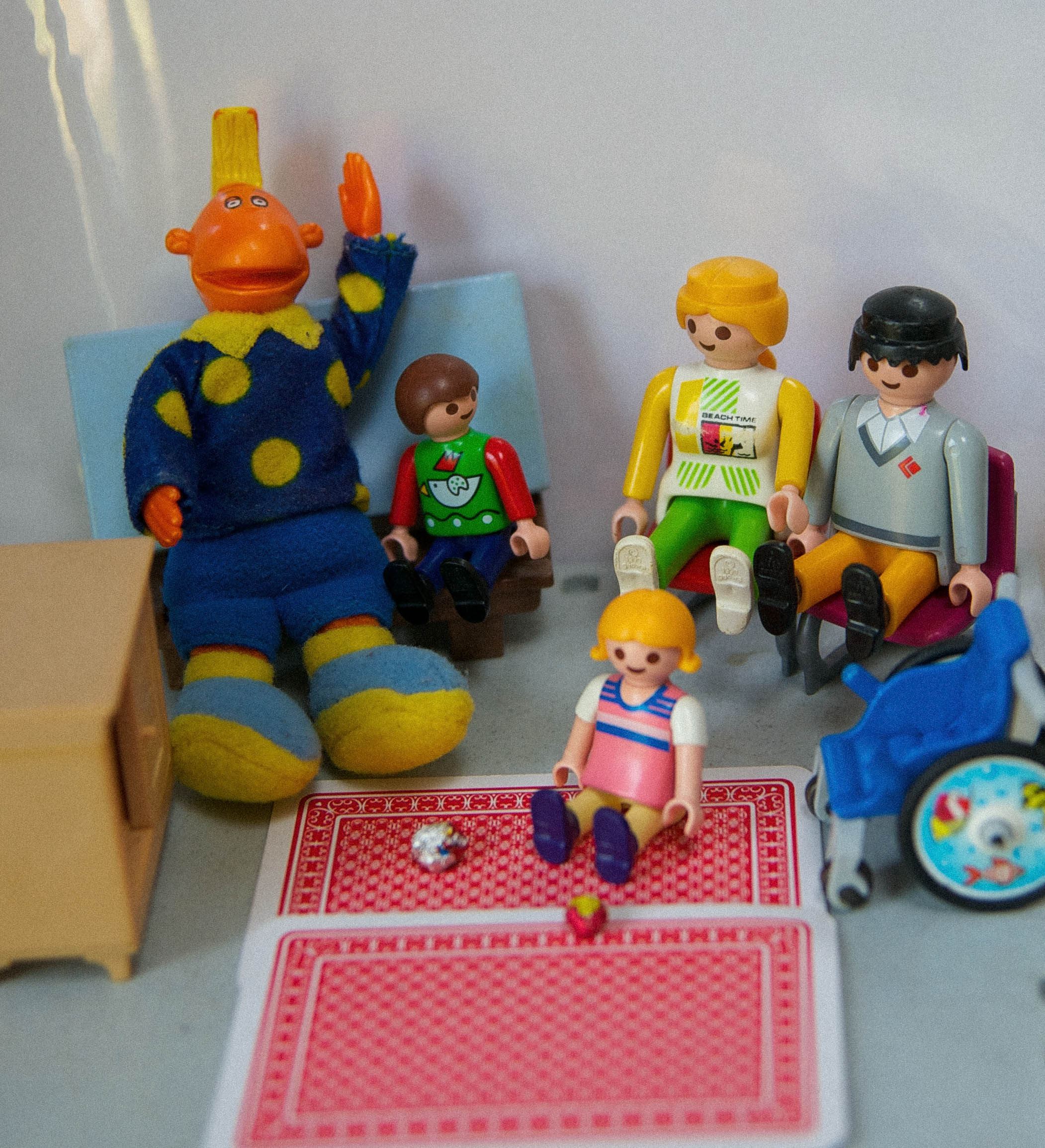
I’ll just leave you with one example* of what this new type of household might look like.

Happy families.

* Apologies for complete lack of diversity… Playmobile really ain’t caught up with contemporary UK life.

The Truly Disabled and the fakers

There’s been a right old push recently to present disabled people as a smallish group of The Truly Disabled (TTDs) and the rest, a bunch of scrounging bastards (BSBs).  The proposed Welfare Reform Bill is currently being deliberated in the Lords. In response to measured, well informed authoritative arguments by several Lords and Baronesses, the Welfare Minister, Lord Freud, mumbles and fumbles his way through a load of ill informed guff. This guff is underpinned by a version of the ‘biopsychosocial model of health and illness’. I can’t be bothered to unpack this pseudo scientific model  but basically, the government seem to be arguing that a lot of disabled people/people with long term conditions think (or pretend) they’re sick/disabled but they ain’t really. They just need a bit of a push to get ‘em off their backsides and back into the workplace. The ideal push is to overhaul the benefits system, remove the large numbers of people (BSBs) receiving lower rate of benefits and give TTDs a (slightly) bigger slice of the pie.

Sadly, it seems like a lot of the great British public are more than happy to swallow the ‘country is being dragged to its knees by this army of work-shy, thieving bastards’ line. Why that is, isn’t clear to me. But I bet anyone £1.20 that they’ve heard a version of the story “My next door neighbour is off sick… sick my arse” or “That toe rag from round the corner just got an enormous plasma tv and she ain’t worked for years” type stories on the bus, in the pub, at work, or pretty much anywhere. Any sign of flagging support for this thesis is quickly dealt with by sensational stories, such as Liddle’s ‘Pretend disabled really ARE sick’ (26/1/12, The Sun) or Dellingpole’s ‘The fake disabled are crippling our economy’ (Daily Telegraph blog, 26/1/12).

I’m sure some people do claim benefits/allowances when they shouldn’t. But I think it’s a very small number of people. We are social beings, after all. Work (whether paid or unpaid) is of central importance to our everyday lives. Not being able to work, through ill health or lack of jobs, is demoralising, depressing, frustrating, dissatisfying and can lead to feelings of meaningless.  Here’s an extract from an interview with a man diagnosed with Asperger syndrome*;

What do you with your days now then?

Waste time. I feel that I am wasting time. Make things to do really. I make things to do. There is no structure in my life. There is no structure. I don’t have to do anything, you know. It is not laziness I mean people could think it is laziness but it is to do with… I walk around in a sort of state of muddle, muddlement, you know, I am very often muddled… It sort of paralyses you. I don’t know if there is a better way to put it…. it is a lack of clarity, lack of clarity of thought. It is like a lack of perspicacity in my thought even…. You know I manage to fill my days. I fill my days in bloody Tesco’s and wandering around and reading bits and not reading anything properly in depth but just reading bits of this and bits of that you know. As I said, I have got the French and German newspapers and that. But it is all bits here and bits there. It is not, there is nothing constructive about it. Nothing structured about it. Nothing, you know, it is just filling in time.


I could go on and on, chucking out stats, referencing the Spartacus report (funded, researched and written by disabled people)  that lays bare the deceitful spin operated by the government in relation to the Welfare Reform Bill,  ask how the BSBs will be distinguished from TTDs in practice, demand to know how a cabinet made up of 23 millionaires (and probably 3 ‘pretty damn rich too’ ministers) can possibly have any understanding of the lives of  disabled/ill people, etc etc etc. But I won’t. I’ll just have a little thinky about how this will all pan out in the end.

According to Freud, getting back into the workplace (cough cough.. I know, I know… but let’s just pretend there are jobs for now, eh?) will ‘cure’ this group (AND help them bring up less feral children AND maintain their relationships). In practice of course, it will lead to (even more?) grinding, heartless, miserable, impoverished lives for a lot of people (and their families) and increasing health, social and economic inequalities between the rich and the poor.

And what about TTD? This gleamingly innocent, honest, worthy, hugely dependent group who will get a (well deserved) rise in their benefits? Well as far as I can see, they will be on a fast track to being patronised and pushed even further to the edges of society. After a few sensational, pathetic, heart wrenching stories are splashed across the media to make everyone feel better, of course.

*Interview extract from the Life on the Autism Spectrum section on Healthtalkonline.

The Club of the Lesser Valued

I’ve been thinking about ‘diagnosis’ a lot recently (see here for reflections on LB’s diagnosis) and, in particular, the process by which parents are given their children’s diagnosis of some form of impairment when the impairment ain’t obvious. This is partly because of a project I was tangentially involved with which explored the experiences of mothers of children with cerebral palsy.  One of the main findings of that study was that participants were angry and upset when they found out that the diagnosis of CP was discussed among medical professionals several months (or longer) before it was disclosed to them.

In discussion, the paediatrician on the research team said that diagnosis was probably delayed because CP can be difficult to diagnose and health profs didn’t want to unnecessarily alarm those parents of children who turned out not to have CP. Apparently around 20% of children, in her experience, would turn out not to have CP after presenting some possible symptoms.

Now, I ain’t no scientist, but I couldn’t help thinking that this meant that the feelings of 80% of parents were being sidelined in favour of the 20% of parents who, presumably, would be pretty chuffed to bits that their children didn’t have CP after all*. I couldn’t understand why the emphasis was on not upsetting the smaller number of parents.

I got to thinking that maybe it was to protect the health profession against some form of legal action for mis-diagnosis, but this doesn’t really hold as an explanation.  Paediatricians don’t have to authoritatively diagnose children at that early stage, but could, instead, suggest that one of the conditions they want to rule out is CP. Emphasising that this is a very tentative ‘could be’ at this stage.

An email exchange with fellow twitteree, @lizith, a PhD student, involved speculation that health professionals may feel a need to protect some parents from a diagnosis.  Some parents may not ready to accept a diagnosis. This argument has always struck me as a form of paternalism and doesn’t have much substance based on the accounts of parents I’ve interviewed in the past who have largely been very keen to know.

So I can only conclude that this focus on the feelings of the minority is a reflection of broader responses to disability and impairment. The 80% of parents of children with CP have joined a new club.  The Club of the Lesser Valued.  The complexity, depth and reach of the negativity associated with membership of this club continues to surprise and depress me.

*I can remember before LB was diagnosed, but once the health visitor had identified serious concerns with his development, I was told to take him to an interaction type group called something like Learn to Play. There were about six kids at the weekly group and a pre-school teacher counsellor. I think we were all in a pre-diagnosis liminal state, so the atmosphere was pretty weird.  Apart from one little dude, Elliot, the kids tended to do their own thing.  The parents sat awkwardly talking about anything other than what we were doing there. One week, Elliot’s dad turned up with a bag from the Early Learning Centre. At the end of the session, he gave each child a little wooden Brio train.It turned out that Elliot had been released back into the mainstream and wouldn’t be returning to the group. Still makes me feel weepy, remembering that moment. Suspect Elliot’s parents don’t give it an awful lot of thought.