Winterbourne, Lamb and inertia

revised timeline

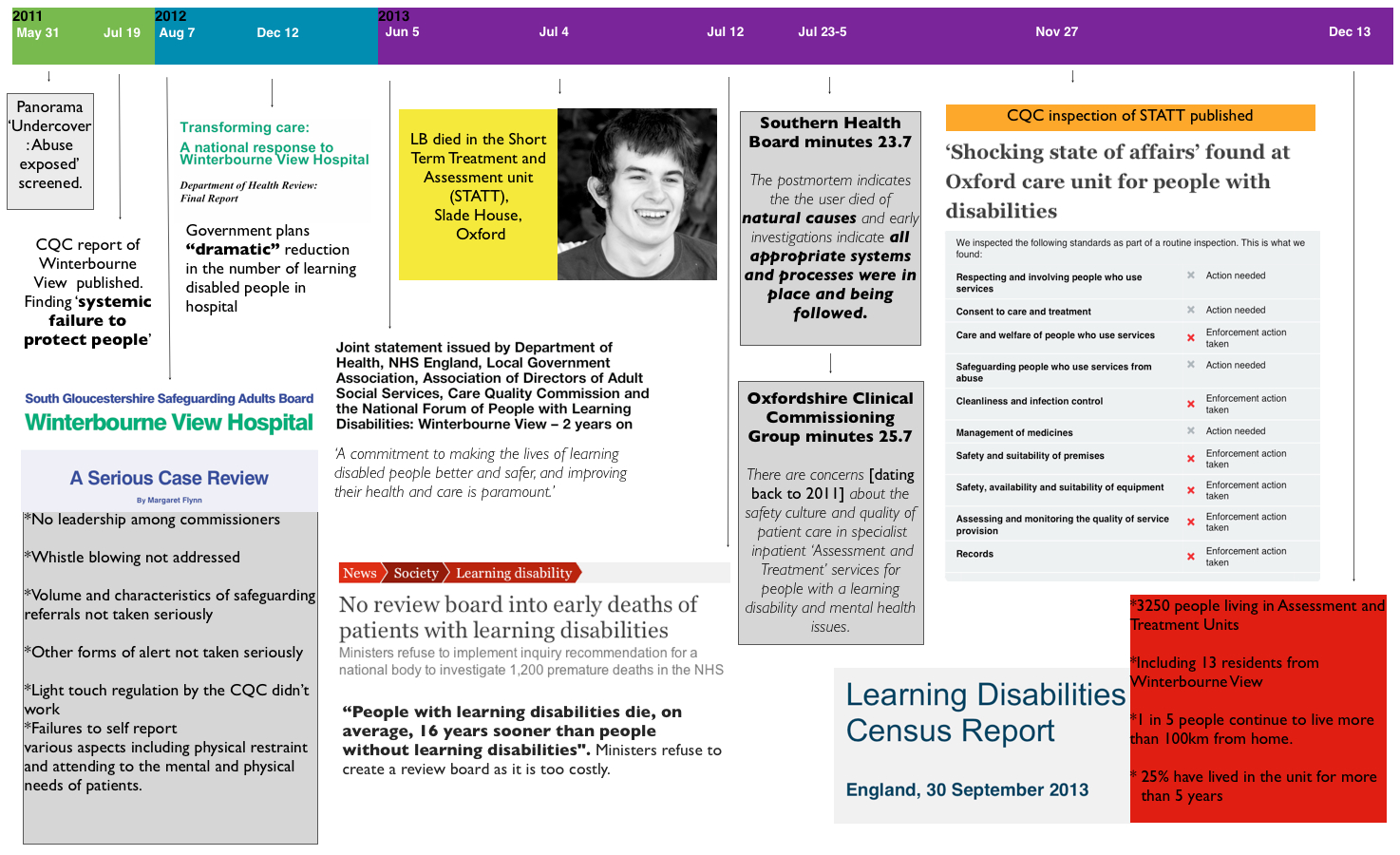
I’ve revised the (now snapshot) Timeline of Shame. Only a couple of weeks after I posted the original. It needs to be viewed in full screen. And needs to be viewed really.  To put things in context. The aim of this is to illustrate how this isn’t just about what happened to the 48 people who were patients at Winterbourne View. And it isn’t just about LB. It’s about how learning disabled people are treated like shite in this country. Particularly those incarcerated in these holding pens of hell. [Thanks to Sam Sly, Rich Watts, Jo Pyrah and Chris Hatton* for reminding me of the broader context; Ely Hospital 1967, Longacre 1994, Budock 2006… known about cases.]

A census of learning disabled people living in Assessment and Treatment units was published yesterday. This contained shocking/horrifying statistics. It took a snapshot on September 30 2013. Over two years after the abuse at Winterbourne View. Nearly a year after the government planned a “dramatic reduction” in the number of people in these units.

The Department of Health also published  Winterbourne View: One Year On. I’ve only glanced through this report but, other than put into place a few processes [Have ‘Winterbourne Concordat’ jokes started circulating yet? How long does it take to put a process in place…?], nothing really has happened. All talk and no action. And there’s a naive emphasis on Winterbourne View and the people who lived there. As if they’re the only people who experienced abuse in this setting.

Abuse covers a range of practices and it’s clear from the CQC report of STATT that neglect and institutional abuse was occurring there. I don’t suppose these two units are the only two assessment and treatment units in which vile practice is operating**. They just happened to have been uncovered through a) a whistleblower and responsive actions of Panorama journalists, and b) the unexpected death in harrowing circumstances of an otherwise fit and healthy young man.

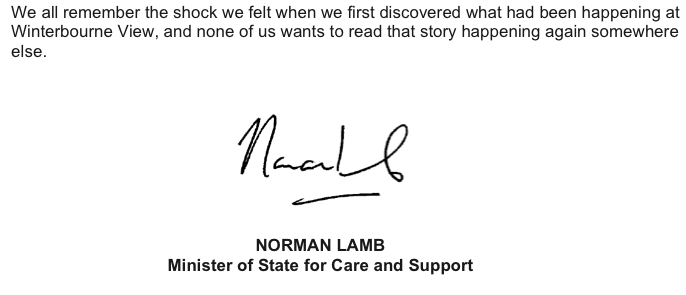
Norman Lamb, who seems genuinely committed to getting people out of these units, is forced to try and re-mobilise the outrage, revulsion and sadness people felt when Panorama was aired in his foreword to the report. It’s clear this wasn’t enough to sustain an effective commitment to change.

16

It isn’t just about the people in these units, of course, but the pain and distress their families and carers experience. You can hear some examples of this on You and Yours (around 45 minutes in). It’s a brutalising and dehumanising system.

And it’s not just a timeline of shame (national shame). It’s a timeline of consistent inhumanity, weakness, stupidity or deliberate dis-engagement, and inaction. The people incarcerated in these units are, arguably, among the most vulnerable in society. And should get the most protection.

No sniff of that. Forty six years after the Ely Hospital scandal.

*@SamSly2 @rich_w @jopyrah @CHRISHATTONCEDR

**A good friend’s son, James, was abused by staff in an out of county unit when he was 16.

Dambusters and the damned

I was getting on with responding to reviewers comments for a funding application earlier when the postie arrived. Bringing a letter from the (actual as opposed to acting) Chief Exec of Southern Health.  This included an invitation to meet with her to discuss what’s happened. Ok. We’ll think about this.

The rest of the letter was a lesson in how not to write an ‘apology’ letter. There’s a PhD to be done in a discourse analysis of the content of NHS fake apology letters if it hasn’t been done already.

Here’s a whizzle through it, with key tips in bold…

An obvious starting point and easy win is to (1) get the person’s name right. (For the record, I ain’t, and never have been, ‘Mrs Ryan’).

(2) ditch the fake apologies. Today’s ‘apology’ (letterofcondolence/version3/additionaladjectives) is a variation on the Acting Chief’s offering I quoted in Being open and saying sorry.

May I begin this letter by offering my personal and sincere condolences on the death of your son, LB. I acknowledge this must be an incredibly sad and difficult time for you and your family.

In addition to the crapness of the meaningless (non) apology, I feel a bit uncomfortable having someone ‘acknowledge’ what a sad and difficult time we’re having in this way. Particularly when the organisation they lead has actively contributed to our sadness and distress. (3) Ditch the platitudes. 

But then there’s quite a lot to feel uncomfortable about in this letter. Take the following section;

“I am aware my colleagues have endeavoured  to assure you that the investigation will be thorough and transparent, and the findings will be openly shared with you [cue a blast of Dambuster music]. I understand you remain reticent (?) about whether this will in fact materialise [cue a blast of Paranoid Android].”

We’re positioned as a force of negativity and the staff, heroic in their battle to do good. Breathtaking spin. Given the recent surprise expressed by the Chief Exec over the findings of the CQC inspection of the unit, you’d think she’d task herself with better information gathering. (4) Get your facts right.  It’s evident that the collective ‘endeavour’ of our solicitor, family, friends, colleagues and wider social media support played a significant part in the appointment of an external reviewer. (5) Ditch the spin. And since this reviewer was appointed, we’ve had no concerns whatsoever about the materialisation of a thorough and transparent investigation. Disingenuous to suggest otherwise.

And finally (and in no particular order) it’s probably best to remain mindful of the context and recipient when writing these apology letters. You don’t need to state you’ve “returned to the Trust from a period of maternity leave” in a letter to a bereaved mother (6) avoid insensitivity. I know. Small things that are kind of obvious but clearly need highlighting.

Now I need to get back to the reviewers comments. Later than I planned.

Cemetery news

The things we now think about and do. That we never thought about before. Have to say, I was not a cemetery type woman. The handful of funerals I’d been to were crematorium jobs. Fleeting, discrete events. Very sad, very strange, slightly awkward, out of place and unanchored. That’s all changed.

Got a grave to tend now. A woodland one so minimum work really. We had a few months of watering. And some autumn planting for a spring display of wildflowers, organised by my mum and dad. Now it’s all about fallen leaves and changing colours.

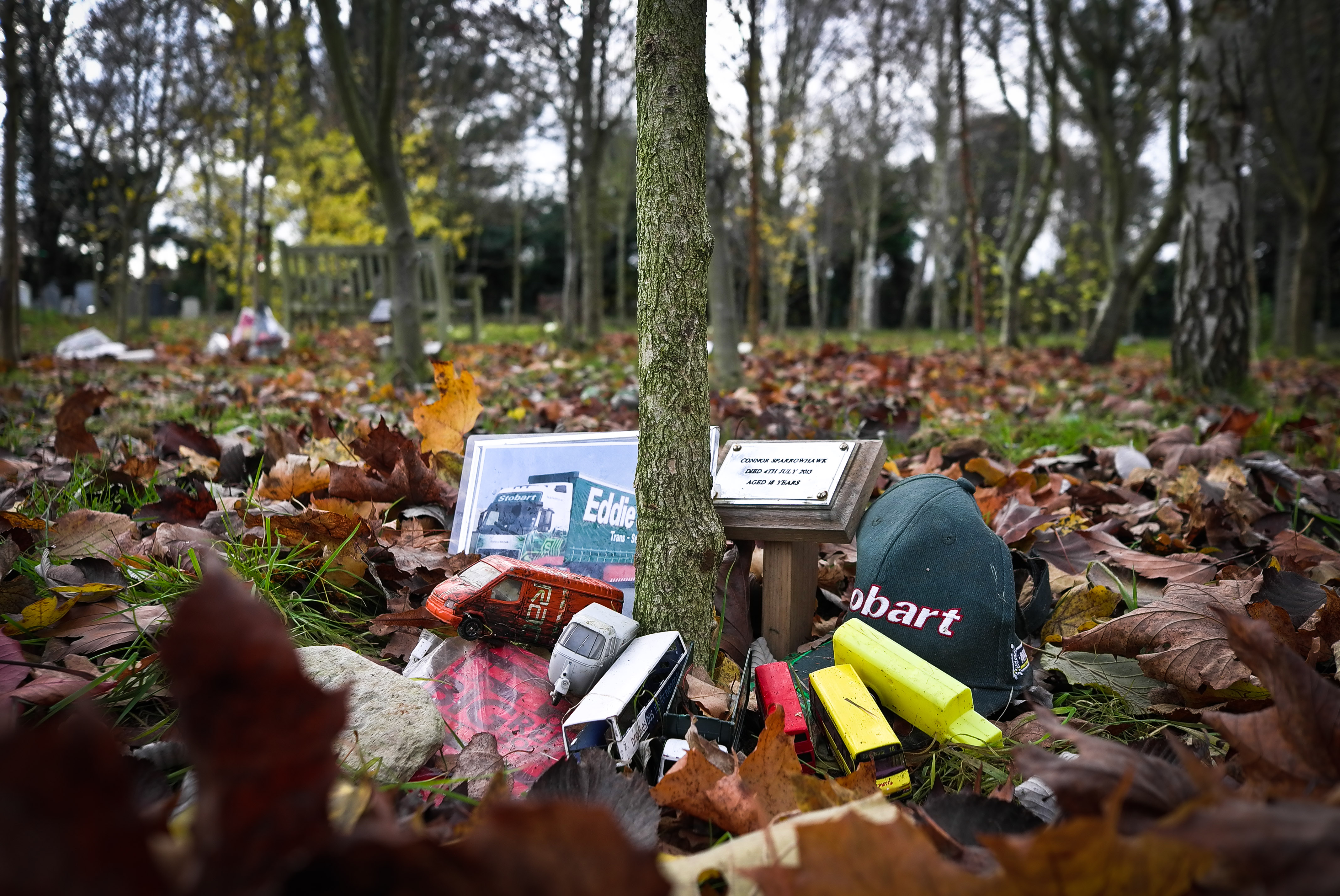
The big news in cemetery world (I suspect it’s a fairly low key news space generally) is LB has a tree. The cemetery staff planted it so carefully we wondered if it had been there all along. We’d just not noticed it. They also carefully replaced his collection of lorries,buses and Eddie Stobart memorabilia around it. You’re not really supposed to have stuff in this section of the cemetery but I think the cemetery staff pretend not to notice. He was only 18.

LB is in good company. J.R. Tolkien is buried a hundred metres away, drawing a steady set of visitors from around the world. Co-founder of Healthtalkonline, Ann McPherson is close by. And local author, and husband of a friend/colleague, Tim Griggs, sadly joined LB under the trees only a few weeks ago.

Odd, but weirdly comforting, space.

ryan5-493

Being open and saying sorry

I woke very early this morning. As I always do now. And grazing the internet (amongst Twitter and Candycrush) I came across the NHS Being Open policy. This was a revelation. A thoughtful (readable) policy for when things go wrong. Underpinned by insight and understanding. The benefits of Being open are laid out. These include, for the organisation, a reputation of respect and trust. For the professional, confidence in communicating effectively. For the patient, a reduction in the trauma felt.

being open

There are 10 principles of Being open, the first three of which are’ acknowledgement’, ‘truthfulness, timeliness and clarity of communication’ and ‘apology’. Let’s take these babies one at a time.

Acknowledgement

When LB died, Rich was called by the A&E department and told very clearly to make his way to hospital straightaway, without passing go. The unit doctor who called me failed on this gig, saying at one point LB’s key nurse was with him and he would call me if there was any change. It doesn’t take a medical genius to know that there was going to be no change.  

Timeliness and clarity of communication

I don’t need to rehash the complete bollocks the Trust made of this. It’s detailed on these pages. A sample lowlight can be found here. As for timeliness, the internal investigation properly started on November 6th when an independent organisation was appointed to lead it. Attempts to get an appropriate chair had failed up to this point. This was 125 days after LB died. The Trust said they had to wait for the police investigation to finish (around day 82). A position which apparently prevented them getting everything (anything?) organised, ready to start.

Apology

Eh? Wha? Apo…what?

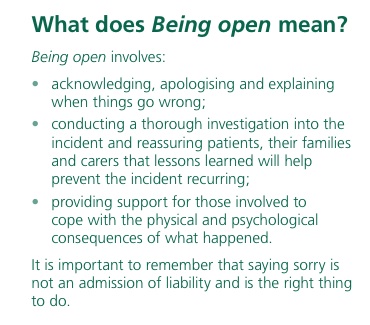
Let’s have a look at what Being open says about apology…

being open 2

Pretty straightforward really. Kind of what you’d do in any situation when something catastrophic has happened on your watch.

The morning LB died, the consultant (exceptional guy) said three staff from the unit were in A&E and wanted to see us. He’d (already) told them it wasn’t appropriate. We were huddled in the relatives room in utter shock. Around twelve hours earlier Rich had been watching Andy Murray reach the semi-finals of Wimbledon with LB. In a hospital setting. Now he was dead. We didn’t want to see the unit staff.

A week later I received a letter from the Acting Chief Executive of the Trust.

Dear Sara,

I was deeply saddened and sorry to hear of the death of your son, LB on Thursday 4th July. I want to express my sincere condolences, both personally and on behalf of the organisation. My thoughts are with you and your family at this difficult time. I also wanted to offer any support you may feel you need at this time.

This isn’t a meaningful apology. Well it’s not an apology at all. A thousand people have said similar to us since LB died.

They clearly ain’t rocking the Being open policy in the Trust. Perhaps one of the learning points to come out of this terrible tale. Eh? What’s that? The process after LB died maybe isn’t covered in the investigation... Oh. Of course not. Another job for PALS then? Howl. 

I can’t speak for the Trust or the staff as to the implications of this most definitely not Being open approach.

For us, the trauma has been made so much worse. As always, stay classy Southern Health.

A bloody brilliant celebration

Today we went to the farm where LB and his classmates worked every Monday and Friday. For a celebration. LB loved working at the farm. He loved being outdoors and was very much an attention to detail/grafter type dude – an ideal combination in that environment. He also loved the homemade pasty and hot chocolate at the end.

Sue and Tina, two of the Charlie’s Angels, had been planning this celebration for weeks. We knew they’d organised a bench in LB’s memory but had no idea they’d organised such a fab do. Meticulous planning, thoughtfulness and love for LB shone through.

And the sun shone too.

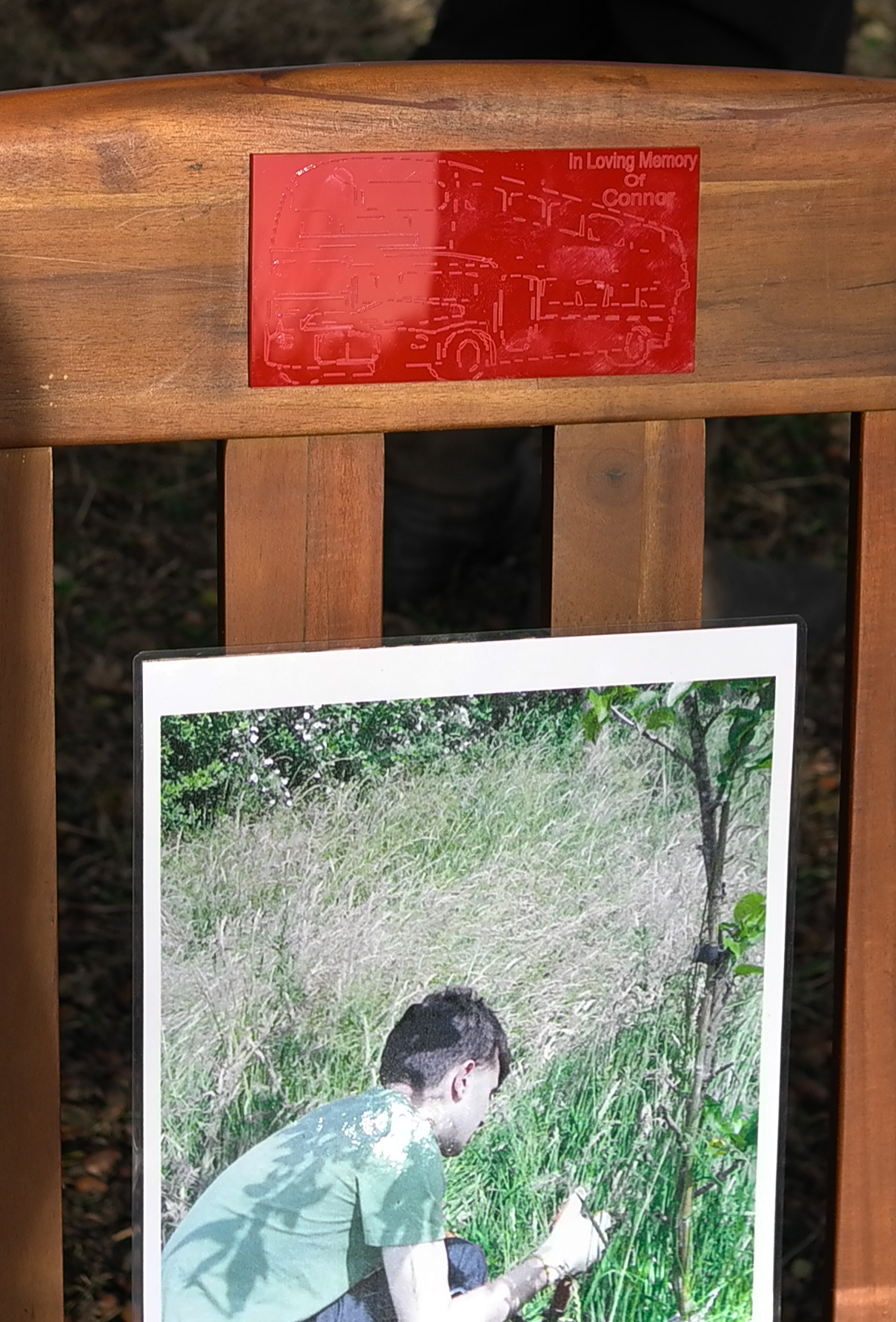
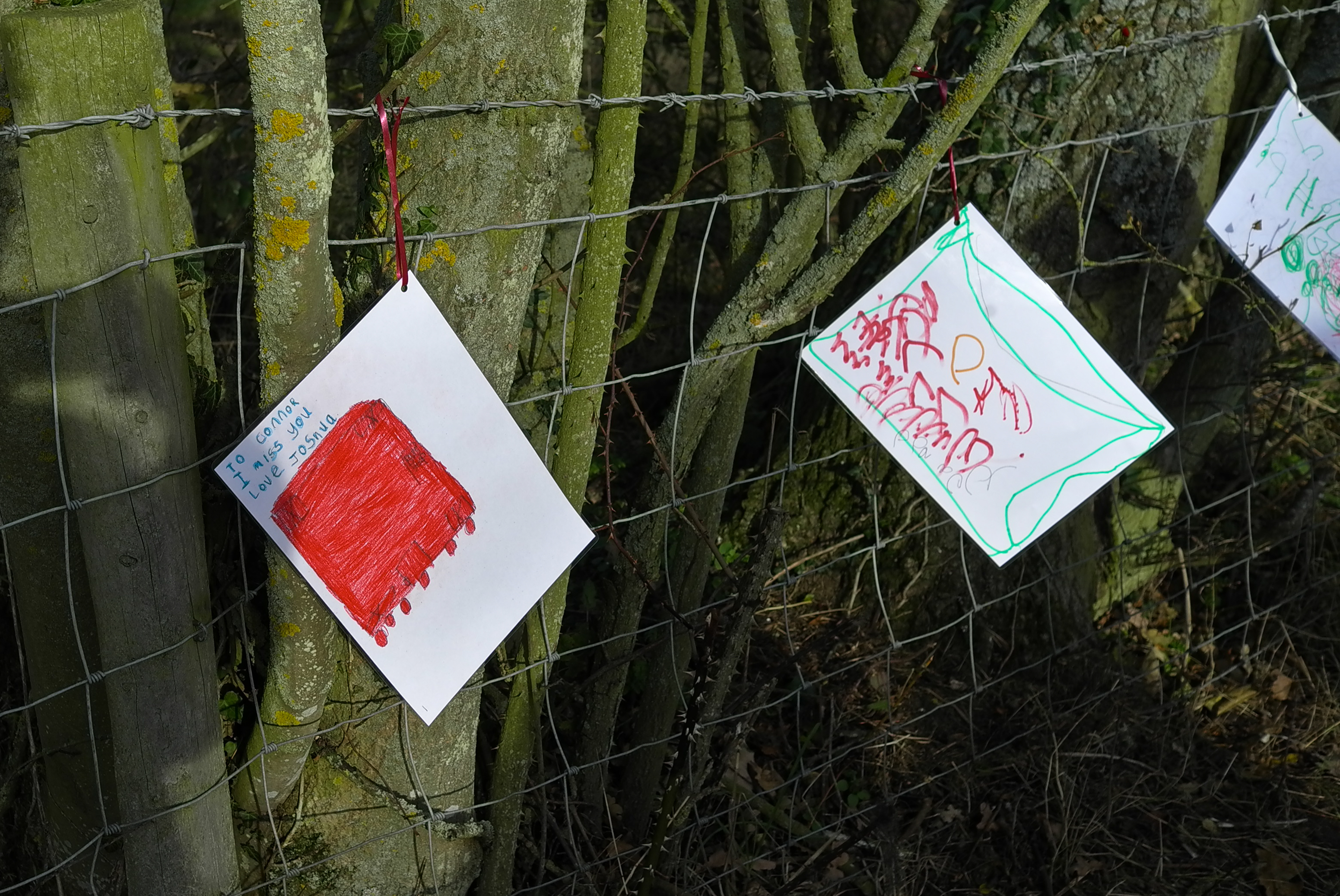
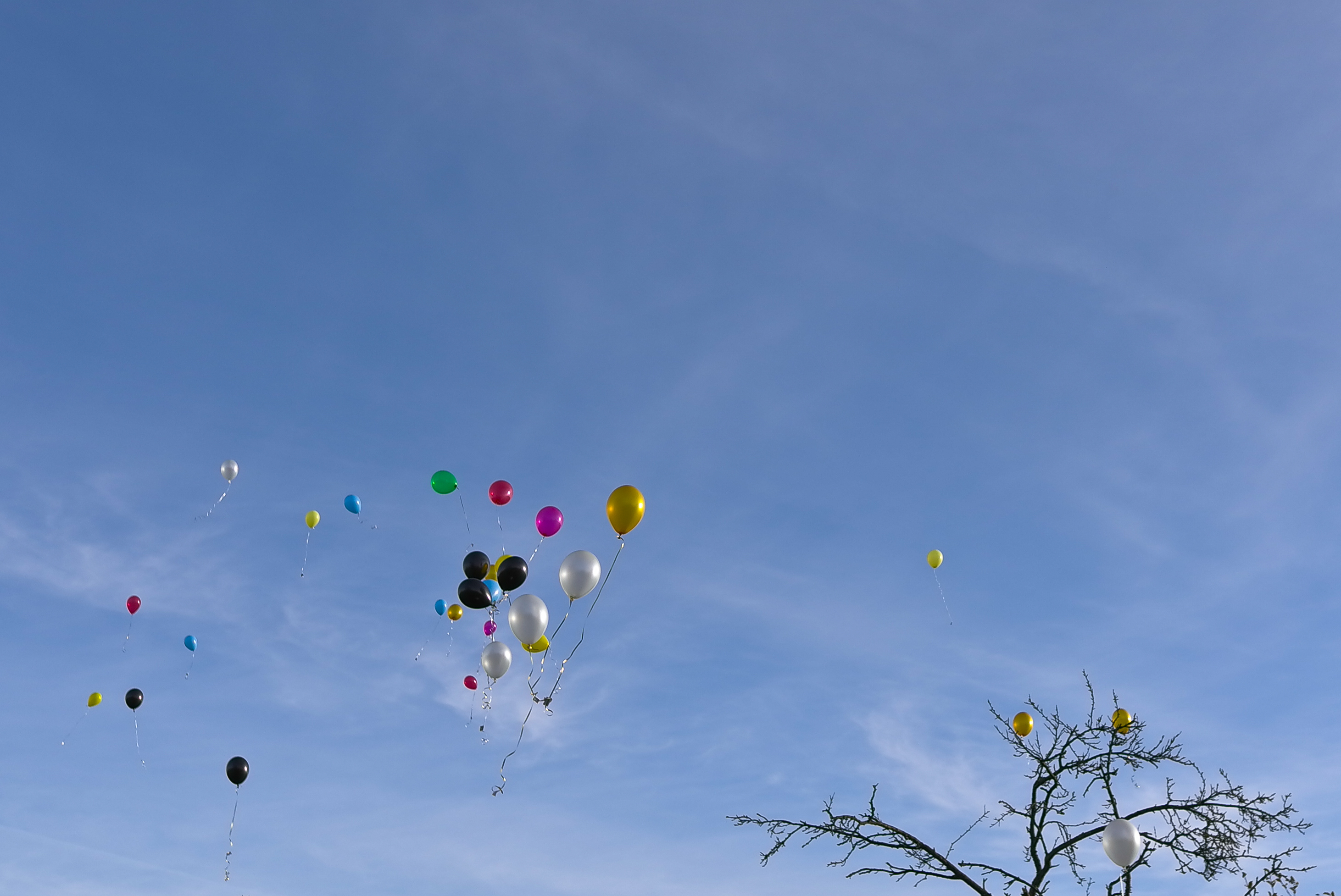
The beautiful bench was in the small orchard where LB often worked. A bus plaque had been made by Wheatley Park school and a lovely collection of photos of LB working at the farm were on display. Including a picture of him gardening there three days before he died (pic below the plaque). His classmates had all drawn pictures for him (several with buses) that were displayed along the fence. Tina said a few words and read a message from a classmate who couldn’t be there. He said how he missed LB and how quiet it was without him, love him. Then we released brightly coloured balloons with tiny pictures of LB (eating a pasty at the farm) attached to the strings. Moving and lovely.

ryan5-467

ryan5-465 ryan5-464
ryan5-461

We walked back to the farm and had pasties and hot chocolate in the sunshine. They’d even arranged vegetarian pasties.

LB would have loved it. And I’m beginning to think Charlie’s Angels should take over running the country.

ryan5-468

ryan5-463

I’ve cut the heads off the bench photo but will include them if people are happy to be shown. 

STATT; one week on

I thought it was about time we reduced time frames. The press release by the ‘Post’ cough cough Winterbourne concordat was two years on. Too long. I also feel a bit of alarm about any body/group with such a grand title. A hasty response/performance to the horrific abuse uncovered by the (in my eyes) remarkable journalists. Without tools, thought or a clear plan about what to actually do. A concordat without backbone or bite. More concustard. And the press release said nothing.

What’s happened since Panorama aired back in May 2011? Well the unit shut. Good but doesn’t resolve the issue of the other 3000 or so learning disabled people in other units. Some people went to prison. Good. But I don’t think any managers/healthcare professionals were punished (or even lost their jobs – brain melt). And really, if this unit had been effectively managed/commissioned, abuse wouldn’t have happened. The patients are now scattered, many in other unsatisfactory, or unknown, settings.

There was some solid contextual research by the Improving Health and Lives Learning Disabilities Observatory. And meetings. A lot of talk, huff and puff. Mencap, clearly frustrated at the inaction, are focusing their efforts on the 40 or so patients who were in Winterbourne View. Understandable focus in a way. But possibly a bit simplistic. Winterbourne wasn’t some random, outlying occurrence. The CQC report of the Short Term Assessment and Treatment Unit, Slade House, published a week ago (yep, lets keep this baby moving) identified potential abuse happening in full view of the inspection team. Institutional abuse and neglect.

And the screaming question that will haunt me forever (one of several); if it happened in front of the inspectors what was happening when they weren’t around?

There are so many layers of wrongness here that it’s hard to keep tabs on them all. Details like the missing battery in the defibrillator. How you can remove a battery from such a piece of equipment and not replace it is beyond comprehension. How you can then tick a form to say it’s been checked is the point at which I’m almost ready to chuck the towel in. Not a single interaction between the nurse and person they were looking after in a 35 minute observation?? And this wasn’t an understaffed ward. This was a cushy number with 4/5 patients and a minimum of 4 staff on duty 24 hours a day. Backed up by an army of psychiatrists, doctors, OTs, essential lifestyle planners and so on. What were they all doing? The unit was overstaffed, cost around £3,500 per week per patient and provided care that was at pond feeder level.

But no jobs will be lost said the awkwardly nervous Southern Health representative on the news. What sort of gig do the NHS/social care run? A catalogue of beyond damning, and ultimately catastrophic, failure. With no apparent reflection on what it is like to experience living in such hell holes.

I have so many questions but I’ll stick to a few here. Just to keep you updated, the CEO of Southern Health hasn’t responded to my letter yet. Bit tardy. But I’m not sure that these questions relate only to Southern Health.

  • Who is going to do something about how such appalling provision could exist? And I don’t mean what are we going to learn from this failure. We went through the whole hand wringing, serious case review, Concordat development and lessons learned bullshit with Winterbourne View.
  • Who is going to hold the various agencies that were complicit in what was happening at STATT to account? Southern Health, Oxfordshire Clinical Commissioning Group, Oxfordshire County Council. All aware. All breezing over obvious failures because clearly these people aren’t important. Not human enough to bother about. (Note to all of the above; filing learning disabled people away as other is clearly a recipe for disaster.)
  • And when are we going to say enough? LB died. He died. I know he’s our son, our dude. But with a different throw of the dice it could have been your child. Your brother, grandchild, nephew, niece. Your friend, your pupil, your dude. When are we going to collectively say “Enough. Things must change”? With backbone and bite.

A letter to the Chief Executive of Southern Health

Dear Chief Executive of Southern Health,

In response to the CQC report into the two units at Slade House, Oxford you issued a statement yesterday, reported here. You are quoted as saying “we were most concerned to learn of the issues brought to light by the CQC‘. The press release on the Trust website states; We are concerned the points raised in the report did not come to light sooner and have launched our own internal investigation.

I’m a bit confused about this. You seem to be suggesting that someone should have pointed out these failures to you earlier? I suppose a robust and effective internal quality assurance process would have alerted you to these failings but we now know this was one of the failing areas in the unit. There were other, weighty, indications though.

Our son died unexpectedly in the unit. Around ten weeks before the inspection. A big flag, I would have thought, that some scrutiny was needed urgently. According to the Trust Board minutes (23.7.13) early investigations into LB’s death suggested that appropriate systems and processes were in place. That’s pretty puzzling. How did these early investigations fail to identify at least some of the concerns that leapt out at the inspection team only weeks later?

And then, again in July, only two days after the Trust Board meeting, the Clinical Commissioning Group (CCG) minuted ongoing concerns about the safety culture and quality of patient care in the unit. Apparently these concerns had been allowed to drag on since 2011 but the CCG were working with you to resolve them. Another fairly ‘in your face’ indication that there were issues in the unit.

I’m sure (hope) you understand that the findings of this inspection are harrowing for us. Our son drowned in the bath in an NHS setting which has been judged so poor it’s now effectively closed. It’s safer for patients not to be admitted.

So it would have been more appropriate if you hadn’t ended your statement; “We are pleased to see our actions and plans are already changing the services provided at Slade House and we look forward to welcoming the CQC back for a further inspection in the coming months.” Pretty uncomfortable reading.  A bit of humanity, thought and respect would have perhaps steered you from writing this as if you’re inviting a new mate back for a cup of tea. It’s not really that sort of gig.

LB was a much loved, adored and horribly missed son, brother, grandson, nephew and friend. He died. In a unit run by your organisation in which serious failures in care were identified.

And one last thing. You mention in your statement that staff are being supported through the review process. We hope that the patients were supported through the experience of LB dying on the unit (as well as the changes they’re now experiencing). It must have been an enormously traumatic experience for them.

Yours, sadly,

Sarasiobhan.

CQC Day and reflections

It’s been a long old day. So this will be short. With a photo or two. Probably the best sort of post. I can’t engage with the CQC report right now in any depth. I’m too worn out. Other than to comment on one dimension of it. The lack of ‘performance’ by the staff given they were being inspected. This leapt out at me. Probably tugging at my sociological roots. We all perform. Particularly when we’re being surveilled. I’ve sat in countless meetings with health and social care professionals over the years trying to perform being a ‘good mother’. An exhausting and pretty much thankless task. But one I tried to do (well, until I became jaded and lost patience, probably around 2/3 years ago).

The staff clearly weren’t ‘performing’ ‘good care’ during the inspection. The more senior staff kind of were in places. In their talk. Well they could describe models of care (or something). Whether or not staff knew how to perform basic first aid procedures, you’d kind of imagine they’d (any staff) perform hanging out and interacting with the patients. Because this is central isn’t it? Not the performance, but being social, being sociable, chatting, interacting. Engaging. Being with.

But they didn’t.

Does this (please say it doesn’t) indicate that they felt the ‘care’ they were demonstrating was ‘good enough’? That they didn’t feel any need to engage with the patients as people. People with something to contribute.

I hope not.

Anyway, twitter has been humming with outrage today. Tweets, retweets, despair, disbelief, rage and more. Good. Social media  possibly allows no hiding space, no get out clause for worn out, repetitive excuses when it comes to poor practice.

And keeping with a more positive focus here’s a couple of photos I came across today. One from a holiday in Instow, Devon. When it rained every day but we hunkered down and watched the Olympics. The other a trip to London Zoo. Possibly the same outing LB addressed the top floor of the Oxford Tube to London, asking any terrorists on board to make themselves known.

Happy times.

Image

Image

CQC: Selected high(low)lights

Whilst we were there, up to four staff mainly worked on administrative tasks within their office, with one member of staff out on the unit.

Over the course of two days, we saw few social or therapeutic nursing interactions with people who stayed there. There appeared to be an impoverished environment with little therapeutic intervention or meaningful activities to do.

Staff could describe many types of abuse but did not mention neglect or institutional abuse.

There was one person on JSH [John Sharich House] who belonged to an ethnic minority. They were unable to access any specialist food via the in-house food preparation. Staff told us “It is easier to buy ready made meals”.

We noted the two downstairs bathrooms on STATT had missing shower curtains. The nurse in charge told us that the torn shower curtain had been removed at the end of August and new ones ordered. A different member of staff told us they had been removed for cleaning, but they were not in the unit laundry.

A relative told us their son, who was a voluntary patient, had frequently requested to leave. He had been told he many not do so unless he attended specific workshops at STATT which he did not wish to do so. This meant he was illegally deprived of his liberty and had his use of consent withdrawn.

None of the people we spoke with had a copy of their care plan. We asked why this was. Nursing staff told us the electronic care records did not neatly print into a useable document and was not available in an easy read format.

In a 35 minute period, we had not recorded a single interaction between a nurse and the person they were looking after. When the person left their room, the nurse followed behind with no eye contact, no physical contact and no therapeutic intervention.

They (patients) also said “There is a man here who just lies in his bed all day. All day, every day. Sometimes there are dvds to watch”.

We spoke with three nursing staff on STATT to try and understand how they assessed people, provided their care, and monitored progress towards a pre-determined goal. They were unable to describe how they assessed people’s individual needs within a structured framework.

There was also little evidence of imagination, planned purposeful activity or nursing support with a specific end point in sight. There was a lack of engagement and empathy with the people who used the service.

We asked the nursing staff what benefit they thought the STATT gave people who were being treated there. One person said that behaviour modification therapy was used. Another told us that medication regimes were started.  We discussed this further with staff and asked them to describe any appropriate social interactions or interventions, or productive  or appropriate activities for the people living there. They told us “If they don’t want to do something, we might just leave them as we do not want to challenge them.” We asked what would happen if someone chose to stay in bed all day. We did not get a reply.

We asked the nursing staff about their knowledge of physical illness. One person told us if a person had, for example, epilepsy, there was a regional nurse expert who helped them draw up their care plans. We looked at the care plan of a person with epilepsy but were unable to find any documentation relating specifically to the needs and requirements to effectively manage this disease.

We asked about bathing and observation routines of those who may have an epileptic fit on the unit. We heard from two nurses these had recently changed. The senior nurse in charge of the unit described that people with epilepsy were now “routinely observed discreetly” whilst bathing. This had been an organisational response put into place after a death on the unit this summer.

We discussed emergency life support training with nursing staff. They told us they had had  training in the last year. We viewed their training records and found that one third of them had not attended this basic training.

We noted that information regarding advocacy services was on the noticeboard, but was out of date and therefore not appropriate or accessible to those who may have required it.

During our inspection, we saw that this person was allowed to roam unchallenged through the female part of the house. We asked why the nurse did not prevent this from happening. The nurse told us the person may get very agitated, so they just followed him to ensure he was not physically aggressive. We observed no verbal interaction between this person and the nurse. This meant the person in the female part of the house was not kept safe from fear or harm.

A staff nurse told us that one person had not been able to have his family visit him because a more senior nurse had made the decision that it may not be “good” for that person. This senior nurse had told the other staff to always ask the person if they wanted visitors. The nurse said that the person was “given the choice” to say yes or no when relatives arrived, but the nurse could not confirm if the person had understood the implications of this choice as sometimes he had said no, then later asked where they were.This meant we could not be sure that people on the unit were not emotionally harmed by this type of ad hoc decision, as it potentially removed the comfort of a visit from their family and friends.

Whilst safeguarding processes were in place, there was a clear dis-connect between policy and practice. This meant that abuse and neglect was not prevented from taking place.

We found stuck to one medicines cupboard clinical guidelines published in 2005.

There were two fire points for extinguishers at the head of each staircase: this equipment and signage had been removed, and the only fire fighting equipment was locked behind a door at one end of the corridor at the opposite end of the corridor to the occupied bedroom.

The checks of the emergency equipment, such as the cardiac defibrillators and the fire extinguishers, were serially signed as being correct. Our inspection found that the battery was missing from the defibrillator on JSH, the oxygen was out of date on STATT unit.

The provider did not have an effective system in place to identify, assess and manage risks to the health, safety and welfare of people using the services, and others.

Staff described a culture of restrictive supervision practices and lack of support from one senior staff nurse who was “never on the ward, always at meetings somewhere.”

People were not protected from the risks of unsafe or inappropriate care because accurate and appropriate records were not consistently maintained or stored. This meant that people had been placed at risk of harm, because inaccurate or missing records gave false assurance to staff.