Waiting and missing

Nearly three months now. Our lives transformed into something we didn’t want. Didn’t anticipate. We’re in a space in which my/our worst fear has been realised. In horrific circumstances. LB died he died?, aged 18, in a place we assumed was safe. An NHS setting.  A locked ‘treatment’ and ‘assessment’ unit. Four staff on duty, including ‘specialist’ learning disability nurses, and five patients, 24 hours a day.  Current discussions/reviews around patient safety in NHS settings blown out of the water here. LB had (or should have had) pretty much one-to-one care around the clock.

How the hell could he die in the bath?

This question plays over and over in my mind. Relentless and exhausting. A colleague yesterday said to me “It’s impossible to make sense of something that’s totally senseless” and I think she’s right.  But it doesn’t stop me trying. Because it shouldn’t have happened. I don’t understand how it happened. And I miss him. We miss him.

Not only are we trying (and failing) to make any sense of the totally senseless but we’re also waiting. Waiting for answers. Waiting for some sort of accountability. Waiting (hoping) for effective commitment to change. Not pointless recommendations that mean crap-all. Our remarkable son died. He lost his life. We’ve lost the lives we had. We have differently coloured lives now. Differently textured. Coated with sadness.

I doubt if many professionals involved in what has happened, and what will happen, are waiting. Those who commissioned the ‘care’ LB received. Those who managed, organised and provided the ‘care’. I don’t suppose they’re waiting. If anything, I suspect they’d probably prefer to wait forever. To avoid confronting what happened. And why. The world of learning disability health and social care seems to operate a ‘hands over the ears, ignore ignore ignore and pretend none of this exists’ approach. Supported by commissioners and higher. Learning disabled people too easily sidelined, ignored and ultimately let down.

WHY???

I don’t suppose the various legal peeps representing the Trust and local authority are waiting either. It’s just a job to them. They probably don’t recognise LB as a young man who led a rich life, full of love and laughter. A dude who was so funny, so unusual, that the colour is washed out of life without him. He’s probably a ‘case’ now, a number or acronym. To be covered up or swept aside. A game. A salary.

Rich and I walked along the canal today to the cemetery. This is the sort of thing we do now, in our transformed lives. Walking, talking, rage, tears, despair, occasional laughter or hope, and utter sadness. Trying to make sense. Trying to find sense. And failing.

ryan5-507

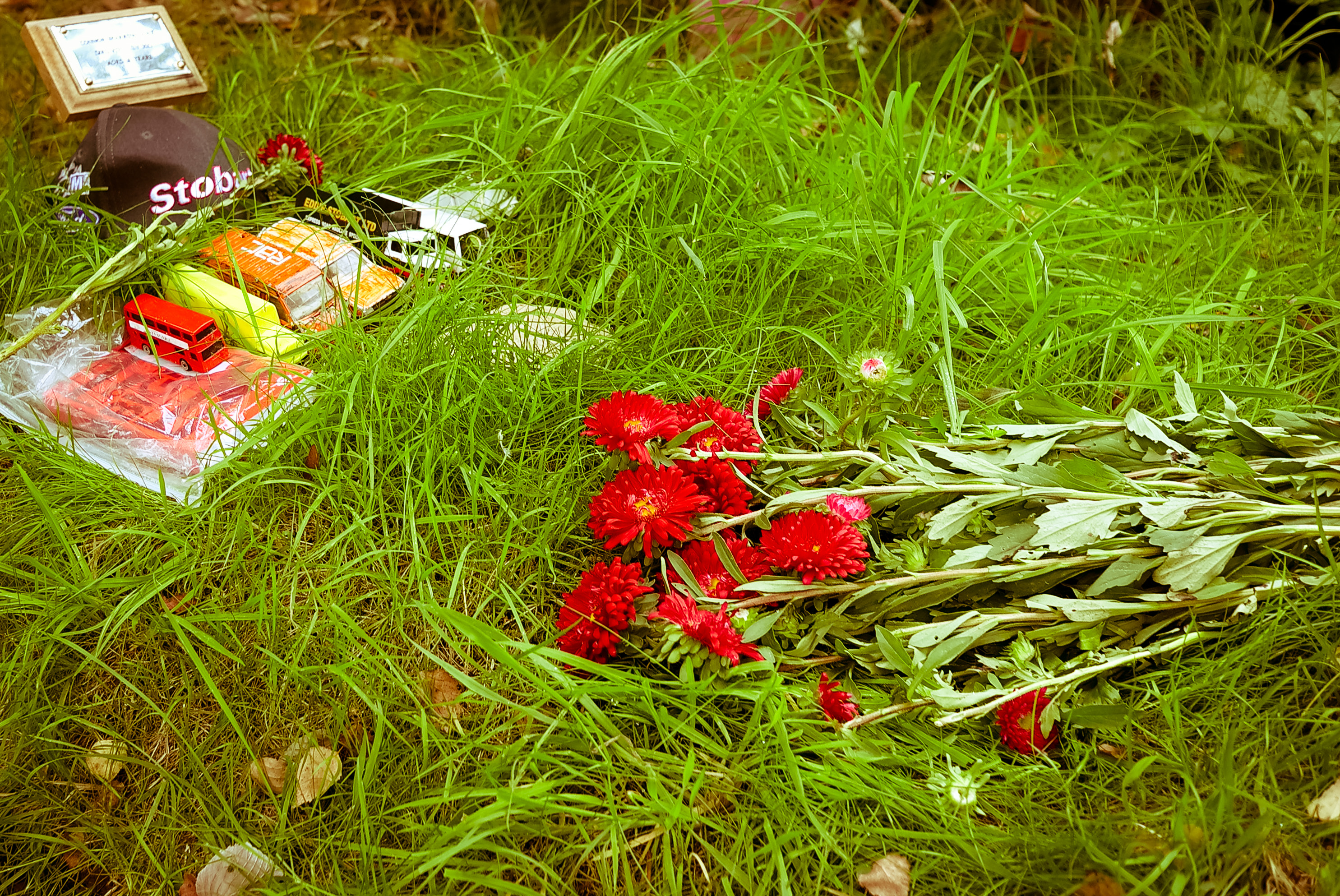
People are visiting LB’s grave.  A rock carved with ‘LB’, buses, flowers and a bus book carefully wrapped in a plastic bag. All left in the lush grass. Yep, I feel woodland grave pride. He has grass to be proud of. One of the few ways we can demonstrate our love and care for him.

Some of these visitors never met LB. But they care. And they feel outrage.

The response we’ve had to what has happened suggests a collective level of outrage and upset. It suggests that people aren’t prepared to put their hands over their ears and ignore ignore ignore. It suggests that people don’t need to be told, to be helped, to be nudged to think ‘What if this was your son or daughter? How would you feel?…’

So why do so many of those involved in health and social care?
ryan5-506

Meeting Sam again

Rich and I met up with Sam on the bus this morning. Nearly a year since I met him and Doreen on the same bus. At the same time of day. At a time when LB was a cheerful pup. With no sniff of what was to unfold, so quickly. So unexpectedly.

I was glad to see Sam. Meeting other young dudes is something I love. I miss the colour LB brought to our lives on an almost daily basis. So effortlessly. An old tweet reminded me of how, when I’d asked him what he wanted to drink last New Year’s Eve, he’d replied “The fountain of youth”.  Without missing a beat.

“Hey, Sam! Are you off to Brookes?”
“Brookes, yeah. The bus is going to be full of people in a minute. So many students. Arghh!”
“Oh, yeah, Freshers week starts today. I forgot.”
“Freshers week. Yes. Students can join Keen and Mencap Oxford.”
“Very cool. Keen is brilliant. LB loved Keen Teens.”
“Keen, yes. It’s on again soon.”
“Yeah it must be. In a week or so?”
“October 14th. For Keen adults. October 14th.” [chuckle]
“What do Mencap Oxford do?”
“Seven o’clock club.”
“Ah, when’s that?”
“Tonight.”
“What do you do at Seven o’clock club?”
“Bingo. And other stuff.”
“Ah. Sounds good. What you up today at work?”
“Doing the dishwasher.”

Rich cried when we got off the bus. I didn’t.  I couldn’t believe the activities Sam mentioned (and seemed to love) were both run by charities.

And since googling the Seven o’clock club, I can’t believe it has an age range of 14-95. Deep breath. Fourteen to ninety five… And is over-subscribed with a waiting list.

Accepting the unacceptable

An oddish thing has happened since LB died.

My bar of what is acceptable has taken a pounding.

‘Eh? What? Of course none of it was/is acceptable. Rage, rage, ragey rage… Whaddaya talking about silly?’

Mmm. If only.

The acceptance of the unacceptable is common when you’re a parent of a disabled child/adult. Well, and among commissioners, providers, health and social care professionals, support workers and so on. Particularly in the fabric of ‘learning disability provision’. The bar set so low that accepting mediocre becomes a default position. We’re almost socialised to create an ever present bag of excuses and rationalisations for non-existent, inappropriate or partial services.

Our bag steadily filled through grinding years of negativity, deficit/tragedy orientated thinking, assessments, meetings, input by (often ill informed) ‘professionals’. Through jargon laden discussions, unintelligible emails/letters/reports and of constantly being told, explicitly and implicitly, that resources were limited. There was never an imagined future for LB. The vague future bandied around was mealy mouthed, thoughtless, mediocre or worse, budget driven and set within silos of ‘available service provision’.

We didn’t accept the unacceptable without challenge.  The (implicit) response generally one of two along similar lines;

  1.  ‘A lot of families have less…’
  2. If you demand more, some poor other buggar will end up with less‘.

And challenging the unacceptable is a cracking way of earning a pushy mama badge. A fast track to being described in reports/notes as ‘difficult’, ‘hostile’, ‘in denial’, ‘over-protective’. When dudes turn 18, especially if they enter some hellhole like a ‘treatment and assessment’ unit (yep, they’re still open for biz despite the post-Winterbourne outrage/work/reform/recommendations) p-mamas can ‘legitimately’ be obstructed, diverted, shut out, repeatedly told they’re the problem. The choice/personalisation agenda, supported by the handy misuse of the Mental Capacity Act, becomes a stick to beat these jumped up p-mamas back. Away from the dudes they’ve loved and looked after for 18 years or longer.

But what about family love, encouragement, support and care? Surely that’s an important ingredient in people’s lives even after they reach the age of 18? Mmm. Well the (often) good old family input seems to be typically minimised, missing or deleted from official records. Effectively and neatly creating a medical model of families of disabled young people. Family members pathologised, labelled as ‘the problem’ and subject to ‘cure’ (distance/removal).

Things have changed for us suddenly. And devastatingly. Clarity gained through unimaginable horror. [Bit of an oxymoron, sorry, but as ever in trying to write about this, I’m left to kick over and use words that don’t fit, that don’t work, that can’t convey what is].  A tweet mate this morning commented “I could hug you until the end of time and it would never be enough”. Yep. That works. In perfect simplicity. ‘Enough’ has pretty much disappeared from my expectations which are hovering currently at a level of ‘shit’, ‘total shit’, ‘overwhelming shit’ and let’s ‘try and beat the shit back and try and regain some semblance of ‘normal’ life even if only for a second’. Exhausting.

But the grinding, wearing, ambiguity and ‘fear,’ generated by the relentless telling of the limited resource story, the wielding of the choice stick, is now meaningless. We can look at LB’s life from a health and social care perspective and recognise the unacceptability of what he/we experienced. Ending with the most devastating unacceptability possible.

We can also reflect on over seventeen years of joy, love, hilarity, warmth apart from service provision. We can chew over and laugh out loud at memories of LB with a remarkable group of different people, family and friends, who knew him well, loved him or just knew of him. We can draw on photos, video clips, weekend news accounts, pupil of the week sheets, DVDs of school trips, blog posts, and seemingly endless memories of a remarkable dude.

Time to transform what is ‘acceptable’.

AmbiAbi o(1)Abui (7)Abiz (2)

Work, telling and the taxi driver

I started writing this on Thursday night. In a student room in a hall of residence at York University. At a medical sociology conference:

Work. My ‘career’ has been indelibly influenced and shaped by our family life. Rich, through his constant encouragement/engagement (and numerous camping trips with the kids to create space for study/work). And the kids for simply being and doing, in their different ways. These experiences are interwoven in everything I’ve done, everything I’ve researched and everything I’ve written. With LB leading the way. Love him. 

I fell asleep at that point. Probably sensibly. It had been a long day. Sort of slipping back to work (but with space to withdraw). Tears on the train at Derby (unexpectedly). A presentation about diagnosis of autism in adulthood (flakey but got to the end). Catching up with lovely, lovely people. And wine in the bar in the evening. Not bad really. Relief that I could be in a work space without howling, pummelling the floor or lobbing out random swears.

I talked to a couple of people I didn’t know about what had happened. People who, in some way or another, generated a telling space. Both coincidentally not had recently experienced intense family experiences/horrors. Both were quietly compassionate and knowing.

I also told the taxi driver on the way to the station the next morning. He chipped away cheerfully, interrogating me about my recent work/summer activity until I told him. This telling was probably related to breakfast with a delegate who chatted about her research with bereaved parents of children/adults with a degenerative condition. Her enthusiastic chat was piercingly uncomfortable. But I said nothing.

‘Eurgh’, I thought as I walked away. ‘Why didn’t I say something?’ Awkward.

Not saying in that context creates a horrible, empty space. It makes interaction fake and meaningless for the non-teller. But what a conversation stopper? How to introduce such a brutal, such a shocking, horrifying, distressing happening? Most parents’ worst fear realised, in a setting commonly held to be life sustaining. A ‘safe’ space. (Yep. We now know what ‘jaw dropping’ looks like.)

Goffman would have a field day with this. I love the Goffmeister, as hardened readers know, but his recognition that ‘disrupters’ are obliged to try to minimise disruption to interaction means phoney smiles and small talk/phatic communication. Which is crap.

So, I told the taxi driver. He listened, and told me about his friend’s son who died unexpectedly a few years ago. We talked family. At the station he warmly wished me all the best. Small talk? It doesn’t have to be. There is a middle ground. We’ve just got to learn to negotiate it.

Sweet day sweets and sense making

Blimey. This is a right old tough gig. Just shite. The enormity is not getting any less enormous. I still blub at the oddest things. The (craphole) pub up the road closed the other week and is boarded up. That set me off as I thought ‘LB will never know the Quarry Gate shut…’ We only went in there once for a firework display about 10 years ago? Why would that matter to him? Then other things I’d expect to upset me, don’t.

I got to thinking about sweet day sweets today. Every Saturday morning the kids got 50p each to spend on their ‘sweet day sweets’. They bargained and bartered with each other to do deals and ‘sharesies’ to maximise the sweet to cost ratio (threefertwos always a hit). Discussions would sometimes open on Friday evenings and they would even roam further than the local Co-op in search of the best sweets. But not LB. He chose a packet of fruit pastilles every week.

One of the things I’m struggling with, is making sense of him no longer being here. I’ve read accounts where people say things like “X wouldn’t want me to spend my life mourning for her or him”. Our lovely minister woman sent through her suggested words before the do which included something about LB not wanting us to have any regrets. This caused me to weep for a couple of hours, as I ferociously tracked changes through the draft. LB wouldn’t think that. That’s threefertwo/shifting sweet source sort of thinking. Not fruit pastilles every week.

He loved us. He loved buses, lorries and septic tanks. He loved Chunky Stan. He couldn’t stand David Cameron and he found Simon Mayo boring. He believed the police protect people and catch criminals. He had complete faith in the legal system. Fruit pastilles. He didn’t have the ‘nuanced’ thinking that means I can ascribe abstract thoughts to him around what he would be thinking from afar (wherever that may be, if anywhere). He would be thinking about going to Trax tomorrow. Or whether buses were roadworthy.

I get to this point and it becomes too much to think about LB being failed so devastatingly by the crapshite system that is health and social care for dudes. He was better than the system.

And he’d probably have been better off if we’d taken him to the pub up the road in March. Rather than the unit.

There is no sense to this at all.

The top of the bus

One of the ‘Just you and me, Mum’ birthday gigs a few years ago was to do a ‘hop on and off’ Big Bus Tour of London. LB and I caught the Oxford bus to Marble Arch, nipped into Oxford Street to buy some lunch (LB chose a pasty and coke while I had bean salad and water) then boarded the tour bus. Blue route tickets. The extra long route. We sat upstairs in the open air. It was a brilliant, sunny November day. “This is exciting isn’t it?” I said to LB cheerfully.

After the first few stops at London landmarks, it became apparent that he didn’t want to hop on and off. Or do the free river tour included with the tickets. He wasn’t budging. Even the Tower of London didn’t tempt him off his seat. The sun dropped down behind the City buildings and it became grey and icy cold. Sitting on the top of the bus.

“Gotta huddle LB, it’s freezing!!!” I kept saying to him, trying to lean into his skinny bod for a bit of warmth. He just ignored me. “Wish I’d got soup and coffee… crappy old salad and water,” I grumbled. Silence. LB was the picture of contentment, soaking up the sights and sounds of his favourite city. He didn’t want to talk to me. And he didn’t pay attention to the commentator, who kept telling us to look in certain directions to see particular landmarks. After a few times of trying to get him to look in the ‘right’ direction (for whose benefit?), I gave up. We sat in silence.

By the time we got back to Marble Arch just under four hours later, I was a block of ice. It took until we arrived at the Park and Ride in Oxford before I started to warm up. And the Oxford buses are always snug, warm spaces. What a day, I thought at the time. Chewing over the idiosyncrasies of having a child like LB.

I’d sit on top of that bus in a snow storm now. I’d sit in torrential rain. A thunderstorm. Anything. Just to hang out with him again.

Enough.

There I was. Reflecting on grief, music and summer. When a mate bounced the CQC Review of Learning Disability Services into my inbox. The core gist cut and pasted below in italics.

About the inspections This review focused on services that provide care for people with learning disabilities and challenging behaviours. Our inspectors carried out 150 unannounced inspections that looked at two national standards. These standards related to:

  • care and welfare.
  • safeguarding (protecting people’s health and wellbeing, and enabling them to live free from harm).

The inspections took place at 71 NHS Trusts, 47 private services and 32 care homes. Our inspectors were supported by 51 professional advisors and 53 Experts by experience (people who receive care or carers).

Our findings

Five of the 150 inspections were pilots and were not included in the overall analysis. Therefore, of 145 inspections:

  • 35 met both standards.
  • 41 met both standards with minor concerns.
  • 69 failed to meet one or both standards.

Many failings are a direct result of care that is not centred on the individual or tailored to their needs. Our findings show that some assessment and treatment services are admitting people for long spells of time, and discharge arrangements are taking too long to arrange. Commissioners now need to review the care plans for people receiving this type of care so that people can move on to community-based services.

  • Almost 50 per cent of hospitals and care homes that were inspected did not meet national standards.
  • Staff needed to be given appropriate training in restraint techniques.
  • Safeguarding concerns were identified in 27 care services.

Follow up inspections

Our inspectors have returned to 34 services where we found most serious concerns. These services have provided us with action plans on how they will meet national standards. We have also followed up on all 27 concerns relating to people’s safety and have confirmed that these services have contacted their safeguarding team in their local authority.

Deep breath.

Please read (and re-read) the above carefully. And then take another deep breath.

How can such damning statistics, reporting on the lives of people, be so carelessly presented and, at the same time, dismissed?

35/145 services were doing what they should be doing. Eh? Less than 25%. People ‘accessing’ these services are those who typically need looking out for, care,  encouragement and, often (don’t shudder), protection. Society incorporates (or should incorporate) a diverse range of people with different abilities, capacities and capabilities but state organised services are failing to provide ‘good enough’ support in 75% services reviewed?

The CQC state that ‘Commissioners now need to review care plans for people’ so they can move on to effective services’. Wow. Can there be a greater exercise in blandness? Ineffectiveness?

Did you get that commissioners? You all busy at it? Reviewing these care plans?

As if.

What a load of billy bullshit. Learning disabled people are so off the radar when it comes to commissioners I don’t suppose many of them would have any idea this review exists. Total farce.

But from the CQC perspective, the ball has been chucked elsewhere. Into next door’s garden. Never to be retrieved. Doesn’t matter really. Because it doesn’t really matter. These are learning disabled people we’re talking about.

More damning statistics before the close of the statement; 50% of hospitals didn’t meet national standards, restraining training is lacking (sob) and 27 services had safeguarding issues.

Then the last bit that I’ve re-cut and pasted below. It’s such a masterpiece in billy bullshit and prevarication it deserves a second reading and highlighting:

Our inspectors have returned to 34 services where we found most serious concerns. [Eh? Not all 69? How was this whittled down? Geographical location of inspectors? Availability of inspectors? What was the criteria?]

These services have provided us with action plans on how they will meet national standards. [Er, what does this mean in practice? Is it going to be followed up? Are the action plans appropriate? How soon will these services be of an acceptable quality for the people receiving them?]

We have also followed up on all 27 concerns relating to people’s safety and have confirmed that these services have contacted their safeguarding team in their local authority. [Mmm. That’s a relief then. Are the safeguarding team any good? Is anyone going to check on what they do? Is there a timescale attached to this?]

People are ‘living’ in these settings. On the receiving end of the sub-standard practices identified (over and over again). Practices that no one with any power to effect change is going to do anything about. Harrowing. My heart is broken by what happened to LB in one of these hellholes. I can’t bear to think of those who are enduring similar treatment and misery, at the hands of a care-less system. Monitored by a gutless organisation with seemingly no power to effect any change.

I can’t understand how we can be in 2013 and this unacceptable practice continues. Nonsense reviews published, publicly, without outrage.

Surely someone is going to do something to stop it?

‘This Summer’

During hours spent outside, or awake at night, I’ve been listening to music. Trying to find music that fits. Ironically, in the early days of LB’s ‘diagnosis’, when he was a just a pup, Faure’s Requiem was the soundtrack to my sadness.  This shifted substantially over time and I can no longer listen to it. It didn’t fit. I was wrong. So much was wrong. LB wasn’t. And we certainly weren’t mourning him. Then*.

The weather’s been so unusual it’s created an almost film-like backdrop to our devastation. Consistently baking sunshine transforming mundane suburbia into a different world. I remark on this remarkable summer constantly. To pretty much everyone I talk to. It’s important that the sun has shone so unusually since LB died. It’s a summer that will be remembered. And the sunshine theme, with the ‘do’ soundtrack of summer songs, the late evenings sitting outside, the sunflowers, both shop bought and planted in our tatty garden, has a positive feel to it.

ryan5-451

The day of the ‘do’.

So. Where am I at with the sounds? Anthony and the Johnsons were a stalwart companion for the first couple of weeks. Capturing the sadness exquisitely. But then they became a tiny bit annoying. And irrelevant. I listen to ‘Toast‘ by Tori Amos. Written in memory of her brother who died. And ‘Coral Room‘ by Kate Bush. About the loss of a mother. But ‘This Summer’ is creeping in as an unexpected frontrunner. A song I used to listen to on my commute home from Royal Holloway where I led five seminars every Friday on a contemporary social theory module. A regularly fraught experience of scrabbling to understand and make sense of the favourite theorists of the course leader (a white male-centric bunch) probably inches ahead of the students.

I’d sit on the train from Reading to Oxford, early evening, frazzled by the full on intensity of the day and the speed reading that built up to it. And I’d listen to this song. It was sad, calming and peaceful. A kind of vicarious insight into loss experienced by others. Always others.

Until a moment, a split second, one sunny early July morning, when I became ‘one of the broken hearted’.  Without warning.

 *Trying hard to celebrate, not ‘mourn’ LB now. Tough gig.


Looping the loop

Gearing up for the inevitable/seemingly obligatory ‘x weeks ago…’ countdown. The screaming ‘If only…’ The relentless, grinding background loop of ‘Wha?? Eh???? LB??? How could this happen?..’

OLYMPUS DIGITAL CAMERAI feel an intense sadness that he had a visit to the Oxford Bus Company planned that day. A trip that Sue (Charlie’s Angel, pallbearer, mermaid facilitator, teaching assistant extraordinaire) had magicked months earlier. In the same way she managed to get lorry drivers/AA mechanics and the like to give LB a tour of their trucks/vans/equipment on the roadside. With accompanying photos. One of life’s understated, gold plated doers.

The Oxford Bus Company. An outing that never happened because we lazed around. Careless with the time we had. Time that was eaten up with nonsense (and ultimately pointless) meetings/interactions about (non) care, (non) support, non anything. With a dose of full time work and broader family life. We lost sight of what was important to LB. And then we lost the opportunity to make this happen.

I feel anger about the way in which families/carers are typically pitched into this space of opposition to any sniff of support and services because these services are so rationed/difficult to access/inappropriate/pointless/inaccessible or any one of a hundred other reasons. This becomes magnified once dudes turn 18 and family love, understanding, knowledge and interactive expertise is sidelined. This space is all consuming, exhausting and unnecessary.

So much energy, effort, emotion goes into ultimately nothing. A wearing dancing, prancing, phoney two step with services that hold the power, the key, the password, potential future and ever present sword of budget cuts. Chuck the nonsense of ‘choice’ into this mix and things become impossible to make any sense of. I don’t know of a single parent who is happy with (and no longer a major actor in, albeit not always a welcomed one from the perspective of ‘service’ providers) the life of their adult learning disabled dude. And I know quite a few.

How can this be? Such an enormous gap between policy and practice. The policy speak talking the talk of choice, autonomy, independence, leading in practice to the sidelining or dismissal of parental expertise and love. And parents/carers walking the walk. Beavering away in the background desperately trying to facilitate, fight for, negotiate and sustain a half decent existence for their dudes.

This is the 21st century? We have enough research, reports and recommendations around this area to fashion a papier mache replica of the Houses of Parliament. How can things still be so bad?

Nine weeks ago today, around this time, our beautiful, exceptional dude got into the bath. Probably up bright and breezy because of his long awaited trip. And there it goes again.

How could this happen?

The world of inquests

Warning. This is an information heavy post. Gotta be done as I’m telling this yarn over and over again. The world of inquests (heavily mugged from inquest.org.uk – a remarkable charity). Apologies if I’ve got anything wrong

As LB died suddenly, there will be an inquest. This is to establish ‘who’, ‘when’, ‘where’ and ‘how’.  Inquests are ‘fact finding missions’ rather than blame apportioning. There are two types of inquest; a ‘standard inquest’ (my interpretation) and an article 2 inquest. The coroner decides which type of inquest will be held. The a2 inquest is more in-depth and carries the power to be critical of the state. From the Inquest handbook;

In some circumstances article 2 of the European Convention on Human Rights, often referred to as the right to life, means that the state has a duty to carry out an effective investigation into a death. The inquest is normally the way which the state carries this out and inquests held in these circumstances are now referred to as article 2 inquests. They are required to be, in many ways, more thorough and far-reaching than inquests into deaths that do not engage this duty. 

Article 2 says that the state must not take someone’s life, except in very limited circumstances, and it imposes a duty on the state to protect life, so there must be a proper and thorough review of how someone died. Examples of article 2 inquests include where individuals died as a result of the use of lethal force by state agents (such as police officers) or while under the care or protection of the state (such as prisoners or other people known to authorities to be at real and immediate risk of harm).

The inquest is an open hearing and various witness will be called (or have statements read out). Sometimes there will be a jury. Families can choose to have legal representation or not. If the case is complicated, this is recommended. The inquest can take place months or sometimes years after the person has died, again depending on the complexity of the ‘case’.

Phew. There. The world of inquests in a few words. All new to us. Shocking that families have to wait so long for this process. Shocking that we have to pay for legal representation while the other interested parties can draw on their state funded legal teams. So hold on to your hats for some whacky ‘crowdsourcing’ fundraising gig. [Er, well, early days and all that, so don’t get too excited too soon].

For all the young dudes.