Benefit cheaters

The whole business of who should inform people of the benefits, support and services they may be entitled to has been playing on my mind for the last few weeks. In some work I’m doing, involving interviews with people with long term conditions, there are consistent reports of people not knowing. Not knowing they were entitled to x, y or z.

Similarly, I was surprised to be told by mates that LB has been entitled to Employment and Support Allowance since he was 16. Eh? Wha? Are you sure?? How do you know? (Other parents told them). How could I not know?

I cast my mind back over all the meetings I’ve had with various profs over the past year or so:

  • There was that DWP woman who travelled 100 miles to see for herself whether LB could manage his own finances.
  • Two annual reviews with a Connexion worker and a social worker in attendance, as well as school staff.
  • At least three meetings with a transition social worker (to increase LB’s care package (from 4 hours a month, to 4 hours a week and discuss the future).
  • The Direct Payments police.
  • School nurse, paediatric neurologist, adult neurologist, GP, local authority funded care agency… and so on.

Now I ain’t suggesting it is the responsibility of any one of the above to inform us of benefits. I’m just surprised that given the huge layers of bureaucracy and meetings that having a child like LB involves, we could get to him being over 17 without a mention of ESA.

On Twitter yesterday, a couple of people said there are welfare rights experts based in CABs (currently under threat from government cuts). But it boils down to the old saying; you don’t know what you don’t know. I didn’t know I should contact the CAB at this point (or a year ago). And, given the amount of time I have spent in meetings like the ones listed above, I suppose I didn’t think I needed to.

For me, there is an opaqueness to the benefit system in this country. So much information seems to be passed on from parent to parent, disabled person to disabled person, support group to members, rather than through ‘official’ channels.  I’ve had a shufty at the government website providing information about ESA and other benefits. Reading the information, it wouldn’t have crossed my mind that LB is eligible. A quick look at the other benefits/allowances left me as much in the dark. It took seconds to be told about ESA, by mates, and to be emailed the number I then rang to organise it. Seconds.

Makes me wonder, really, who is doing the cheating?

Meet the gang…

It’s difficult to buy Christmas/birthday presents for a boy who doesn’t really want any presents. And has very, very specific interests – die cast model buses/lorries and the emergency services – that have remained the same for a good fifteen years.  We decided to drop the Playmobil option a couple of years ago as it seemed a bit age inappropriate, but these guys are still played with regularly. I thought they deserved a group photo. Love em.

Twitter; what’s the point?

I love Twitter. But lots of people I know, don’t. They don’t get it. They hold onto facebook as a space for sharing stuff with chosen, monitored and policed others. Facebook is more intimate, apparently, and isn’t about stalking Scoph, Stephen Fry or Justin Beiber. Facebook doesn’t restrict status updates to 140 characters. What can you say in 140 characters for fuck’s sake? Well, I’ll come back to that..

I went to a social media talk recently by an expert from York University. He strongly cautioned against our increasing over reliance on social media, saying it would lead to us all creating very narrow social lives, funnelling down, bookmarking our favourite websites and increasingly closing ourselves off to broader social experiences. Facebook can do that. We select certain people that we allow into our circle and can even restrict levels of access to our personal lives. It is static, dated and restrictive.

Twitter smashes things wide open. Even though we choose who we follow, once we follow people, we can’t choose what they retweet to us. So if I was to follow 100 people, and they each followed a hundred people, and so on and so on (I ain’t no mathematician so I’m not even going to attempt to develop this equation/sum), that means I am potentially open to shedloads of information, in bite size pieces.

Yeah, yeah, yeah. I hear you twitter doubters say. What-effer. You can interact via email or facebook. Not as fast or as effectively. Increasingly, Twitter is part of media stories about particular events. Twitfeed is feeding into live tv and news coverage. It’s forcing governments, institutions, people to be more accountable. Through Twitter, a recent petition against proposed NHS reform has got over 170,000 signatures in a few days. Through Twitter a group of disabled people were able to raise funding, research, write up and disseminate their report into the proposed Welfare Reform Bill. Through Twitter (not through the BBC or other media channels) we know that Andrew Lansley’s recent trip to the Royal Free ended up with him being chased by a doc down the corridor to the words “Your bill is rubbish. And you know it!” Through Twitter, people are able to demonstrate and provide evidence of lies, deceit and cheating (largely by the current UK government at the mo’).

What can you tweet in 140 characters? Well, a lot. You’ve just got to be concise, pithy and cut out so much crap that we usually produce/circulate. It’s a liberating experience.

Twitter is what you make it. Depending on who you follow. It can be supportive, political, social, entertaining, funny, informative, creative and always fresh.

Finally, for mates that have shouted ‘help!, I don’t know how to use it’.. here are a few things that I’ve learnt in the last few months (or days;);

  • Use bit ly to shorten web links you want to tweet.
  • Don’t get overly hung up on what you tweet – just have fun
  • At first you are tweeting to yourself, but people will start to follow you
  • Don’t get hung up on numbers…
  • … but if your followers start to unfollow you en masse, you may want to revisit your tweet content 😉
  • #ff means follow Friday and is a way of sharing ‘good’ people to follow

Now, if someone wants to let me know the best way to manage lists, that would be great.

“A degree of autism” and Dr X

I’ve talked about LB’s broader diagnostic journey before. Today I’ve been thinking about the way he has been put on (and off) the autism spectrum. I had a shufty through his medical records (a source of bafflement, frustration and ‘what the fuck?’ moments) and traced autism through the various reports.  So, starting when LB was a toddler;

He became quieter and happier when he spotted the wheels on my mobile chair, and spent 10 minutes pushing the chair backwards and forwards with his eyes fixed on the wheels. (Speech and Language therapist, August, 1996)

Classic, stereotypical autistic behaviour flagged up, but the word autism doesn’t appear till the following year in a letter from the GP to the paediatrician;

Continue reading

Hazard Alley

LB went on a school trip to Hazard Alley today. A purpose built safety centre in Milton Keynes for ‘experiencing hazardous scenarios in safety’.

In his diary, his teacher had written “LB was on fire, answering all the questions.” Attaboy! Being known as ‘Health and Safety Sarasiobhan’ around here, this was a trip after my own heart. Risk reduction knowledge.

“How was Hazard Alley, LB?”
“Good Mum. It was good Mum.”
“What did you do there?”
“Looked at hazards, Mum.”
“Cool.. What sort of hazards?”
“Like roads, Mum. Roads are dangerous.”
“Ok. And what else?”
“Lorries, Mum. Lorries are dangerous.”
“Why?”
“Because they run you over, Mum.”
“And anything else?”
“Petrol stations, Mum. Petrol stations are dangerous.”
“That’s right. What about in the house? What hazards are there in the home?”
“Dunno, Mum.”
“Try and remember.. What is dangerous in the home?”
“Cookers, Mum. And fires. House fires, Mum. And everything, Mum. The home is full of hazards*, Mum.”
“That’s right. Hey, Vicki said you answered questions. What questions did you answer?”
“It’s very dangerous, Mum.”
“Oh. What was the question?”
“How dangerous is it, Mum?”
“….. What did you learn then, about avoiding danger?”
“Don’t go down dark alleys, Mum.”

*Yep, you’re right matey… spot on.

The Atos questionnaire

Many of you will be, luckily, unaware of Atos, a French IT company. Googling Atos will produce mountains of complaints and criticisms about Atos Healthcare, a divison of Atos, that has been awarded the contract to assess scroungers’* ability to work on behalf of the Dept of Work and Pensions (DWP). To save you the task, here is a good overview of the Atos crapness. Well this company is raking in the casheroony in a big way. Bit like A4e (Action for Employment) and the infamous Emma Harrison, until recently, Cameron’s families *cough* *cough* *cough* tzar.

So, back to Atos. And LB. Well, as I’ve mentioned here before, I recently found out, through mates (rather than the enormous machinery of health, education and social care services) that LB has been entitled to Employment and Support Allowance since he turned 16 over a year ago. We can backdate claims by three months.

To start the claim, I did a phone interview with JobCentre Plus (JCP) which lasted about 40 minutes and included mind boggling questions like “Who is the head of your household?” The next step was to get a sick note (???) from the GP.  He sensibly gave LB an indefinite sick note. This was returned by JCP as it needed to be backdated by three months. Back to the GP for second sick note. Indefinitely sick since November 2011.

So a medical practitioner has authorised LB’s removal from job seeking indefinitely. But that’s no longer enough. There is a Limited capability to work questionnaire to fill in, so that experts (undefined) from Atos can judge whether or not LB has legitimate access to allowances in place of paid employment.

Well. Where to start? It’s 20 pages long, covering questions about medical condition, treatment/medication, physical and ‘mental, cognitive and intellectual functions’.

Questionnaires are always flawed but this one is legendary in its crapness. I feel strongly that if someone can’t fill in the questionnaire themselves, because they have severe learning disabilities, then it’s a done deal. Bin the questionnaire, it’s pretty obvious that this person is going to have a limited capability for work. I’m not suggesting at all that people with severe learning disabilities are not ever capable of paid employment, but that some limiting parameters are in place in terms of the engagement with the process. And if they can’t engage with the process, some other poor buggar (often parent) will have to instead to fill it in on their behalf.

Compounding this, the content of the questionnaire is baffling and ultimately meaningless. For example;
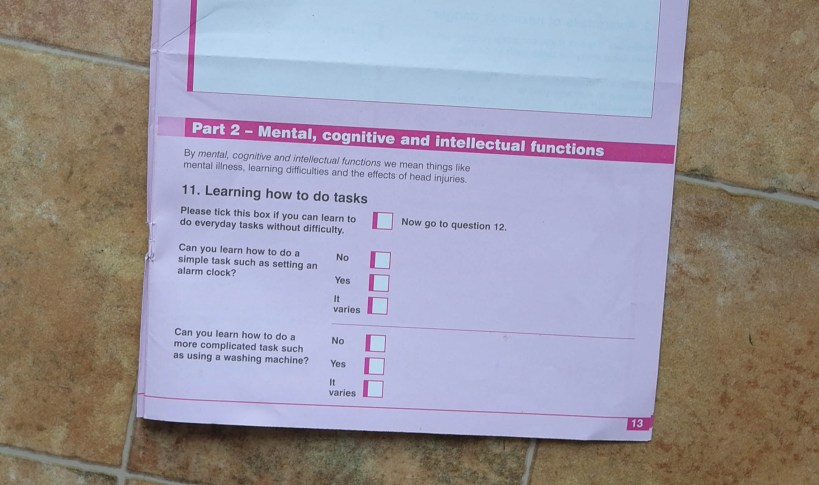
Can you learn how to do a simple task like setting an alarm clock or a more complicated task like using a washing machine?

How is setting an alarm clock a simple task? You’ve got to be able to tell the time for starters, before you even turn to the clock. Just a small consideration I suppose in the experts at Atos’ eyes.  Teaching LB the time has been an ongoing process for the last 2/3 years and no, the boy ain’t cracked it yet. Let’s park that (minor) detail for now. Do Atos mean a manual alarm clock, where you have to scooby round some second set of hands to the time you want the alarm to go off? Never an easy task. Or a digital alarm clock??? It is ill-thought out nonsense.

The next question is “Initiating actions” and asks; Can you manage to plan, start and finish daily tasks? Possible answers – never, sometimes or it varies. Again, gaping holes here. Do they mean unaided, or with prompts/support? Do they mean ‘sensible’ plans/tasks, like ‘today I’m going to buy some bread and milk’, or less ‘sensible’ plans, like ‘today I’m going to stay in bed and play with my willy all day’? Atos would possibly argue that the text box below each question enables the more nuanced details to be thrashed out, but how is that text going to be measured, counted or made sense of?

Well here is how; an outline of the way in which the questions are awarded points. So, for example, points for the simple task question;

Cannot learn or understand how to successfully complete a simple task, such as setting an alarm clock, at all. (15 points)

Needs to witness a demonstration, given more than once on the same occasion, of how to carry out a simple task before the claimant is able to learn or understand how to complete the task successfully, but would be unable to successfully complete the task the following day without receiving a further demonstration of how to complete it. (15 points)

Needs to witness a demonstration of how to carry out a simple task, before the claimant is able to learn or understand how to complete the task successfully, but would be unable to successfully complete the task the following day without receiving a verbal prompt from another person. (9 points)

Points mean prizes. Luckily, the details of the point scoring are available on various sites/blogs if you have access to the internet. A lot of people don’t. One of the strong criticisms raised in recent debates around the ‘abuse’ of Disability Living Allowance was that people sought advice, or even paid people, to help them fill in the forms. What the government fail to see, or choose to ignore, is that these forms are so overly complicated, and with hidden agendas, that most people would not qualify for the allowance without the help of people who understand the system and process. Not because they are scamming the system.

By page 15, I gave up with the game.  I started to write ‘LB has severe learning disabilities’ in each box. I don’t know how many points that will produce, but I’m willing to take it up with Atos or JCP. It’s a nasty, underhand, thoughtless and ultimately meaningless process designed purely for economic reasons; to reduce costs. The human costs are racking up of course. But hey ho.

*In case you didn’t know, benefit claimants are all scroungers until proved otherwise.

Update: 20 July.

Got DWP letter today. LB’s met the eligibility criteria for Support Group. “Success”.

Heavy haulage

“Mum?”
“Yes?”
“Mum, do you like heavy haulage, Mum?”
“Yep.”
“Mum, is heavy haulage roadworthy, Mum?”
“Yep.”
“Have they checked the oil, Mum?”
“Yep.”
“Have they checked the tyre pressure, Mum?”
“Yep.”
“Have they checked the bunks are bolted in, Mum?”
“Yep.”
“Have they checked the engine, Mum?”
“Yep.”
“Mum?”
“Yes?”
“Mum, do you like heavy haulage, Mum?”
“Yep.”
“Mum, is heavy haulage roadworthy, Mum?”
“Yep.”
“Have they checked the oil, Mum?”
“Yep.”
“Have they checked the tyre pressure, Mum?”
“Yep.”
“Have they….

……

The homework

LB came back from school with homework today. A questionnaire to fill in about sleep. Homework hasn’t really featured much in his life.

“I hate homework, Mum. I’m not doing it.”
“You’ve got to do it.”
“No. I’m not doing it, Mum. I’M.NOT.DOING.IT.MUM.”
“Don’t be silly, you’ve got to do it.”
“Why Mum? Why Mum? I HATE HOMEWORK MUM!!!
“Stop shouting. Why do you hate it?”
“I HATE IT.”
“Why?”
“BECAUSE… I HATE IT. I don’t have to fill it in, Mum. I’m not doing it. I don’t want to FILL IT IN!”
“Pack it in. Tom has to do homework and he doesn’t like it. Why don’t you think you have to do it?”
“BECAUSE I’VE DONE A LOT OF HOMEWORK, MUM. ALL THE TIME. My life has been spent doing homework. All my life! I hate it. I hate it AND I’m not doing it.”
“You don’t do a lot of homework, matey. You’ve got to do it. It’s good for you.”
“Why’s it good for me, Mum?”
“It helps you to learn more.”
“I already know more, Mum. I’m not doing it, Mum.”
“Ok, tell me what you know…”
“Sleep’s good for you, Mum.”
“……”
“Anyway, homework’s boring. It’s depressing actually [makes crying noise]. It’s depressing, Mum. I’m NOT doing it, Mum. I hate it….I’M NOT DOING IT. THAT’S ALL.”

Silence.

“Can I do it now, Mum? Get it over with, Mum?”

What do we know? The case of Ashley X

There has been a lot of controversy around the  Ashley X story (see here). About whether or not the various ‘keep small’ procedures (hysterectomy, breast bud removal, high dose oestrogen) performed on the six year old, profoundly disabled, child were ethical. I’ve been thinking a lot about the case after hearing  feminist philosopher, Eva Kittay, talk about it at a symposium I was at this week.

EK (would call her Eva but it seems a bit familiar…) began her talk asking who can criticise the decisions of the parents? Well if anyone can, arguably she can. She has a disabled daughter, Sesha, who is in her forties. There are similarities between the two girls.

To summarise her talk, EK carefully went through the arguments raised by Ashley’s parents in support of their desire for the treatment. Basically, the parents wanted their “pillow angel” (hold the shudders for now, eh?) to remain portable so she could still go on holidays and live at home, avoid the discomforts associated with periods, etc and not be sexually attractive (or fertile) to unscrupulous men who may come her way. Those in favour of this treatment argue that the ability of the parents to care for their daughter trumps their daughter’s rights. The child isn’t cognitively aware, won’t ‘need’ her womb, will be vulnerable to abuse, and so on.

EK drew on her experiences with her daughter. She talked about ‘moving through time’ with Sesha. How Sesha developed over the years. Not in ways that fit any recognisable prescribed developmental patterns, but a maturation in her own way. This reminded me of the meal, Rich, LB and I had in a Chinese restaurant last week. It happened that LB was the only kidlet at home that evening, and the option was stay in (with him) or go out (with him). It was a sort of funny, sort of haunting experience. I tried to deflect the flashes of the future that pinged into my thoughts. Rich, LB and me. Out and about.

Chatting about this meal out (together but ‘with’) led to reflections from a few other parents of disabled children. They too had thought about being out and about with their ‘toddler like’ but adult children.

I used to think of it that way too but in reality, LB was nothing like he was when he was younger. He has moved through time too. He is still demonstrably crazily unusual, but he has grown and matured. When I turned up straight from work, he said “How was work, Mum?” That was a jaw dropping moment, that I thought I’d misheard at first. After that, he chattered to himself, ignored us,  stuffed his crispy duck and pancakes and became increasingly obsessed about the cleanliness of the tables. The journey home involved a shedload of repetitive hygiene discussion.

But it was different to taking a younger LB out.

EK described how Ashley’s treatment removed her ability to grow older and kept her frozen in time. She provocatively asked why, if her parents wanted her kept smaller, did they not cut off her legs? She argued that support should be provided to enable Ashley’s parents to care for her at home, protect her from evil and enable her live across a life course. She argued, convincingly, that ‘we don’t understand the contours of our choices’.

And we don’t of course. Though it is often more convenient to ignore that. Especially in the case of profoundly disabled children/adults when we know so little about their lives. Unfortunately, assumptions pervade. The personhood or even humanness of  children/adults with profound learning/physical impairments is under persistent threat.  Frightening when they pretty much comprise the most vulnerable, marginal group in society.

It was a moving, powerful, distressing presentation. A technical hitch meant that the notes were missing for the last few slides. This led to some fragmentation of the prepared talk. EK ended up returning to the question (asked of the parents, medical professionals and others who support the treatment); ‘Why do they insist they know, when they don’t know?’ I’m not sure how much this question featured in her missing script but, for me, it is a question that goes to the core of this debate.

Sunrise, sunset.. up North

Had two days in Newcastle this week. Outside of work time, I had a walk along the quay at sunrise and sunset. There were hundreds of people taking pics in the evening. But this morning, it was just me, a lot of pigeons and the odd jogger. Now I know I ain’t no scientist, but I couldn’t work out how the sun was reflecting on the arch of the bridge.