Two local authority (LA) related stories bounced into my twitter feed yesterday morning. The first detailing a judgement in a family court hearing where the judge found an attempt by the LA to trump up a case against a father reprehensible:
To describe the social workers’ written and oral evidence as merely grudging when it comes to the care and security the father has given his children is too generous; Ms Wilkinson was certainly both grudging and defensive when giving oral evidence; their unprofessional attempts at case building are reprehensible. (47-52)
The second was about a social worker in Oldham who was wrongly dismissed after being blamed for the death of a man in his care. Here, the LA investigation was judged to be ‘seriously flawed’, setting out ‘with a mindset predisposed’ to find the social worker guilty. (The LA remain convinced they acted appropriately and with integrity despite this ruling). Shocking stuff. As Rich said ‘I don’t pay money for public bodies to fit up citizens…’
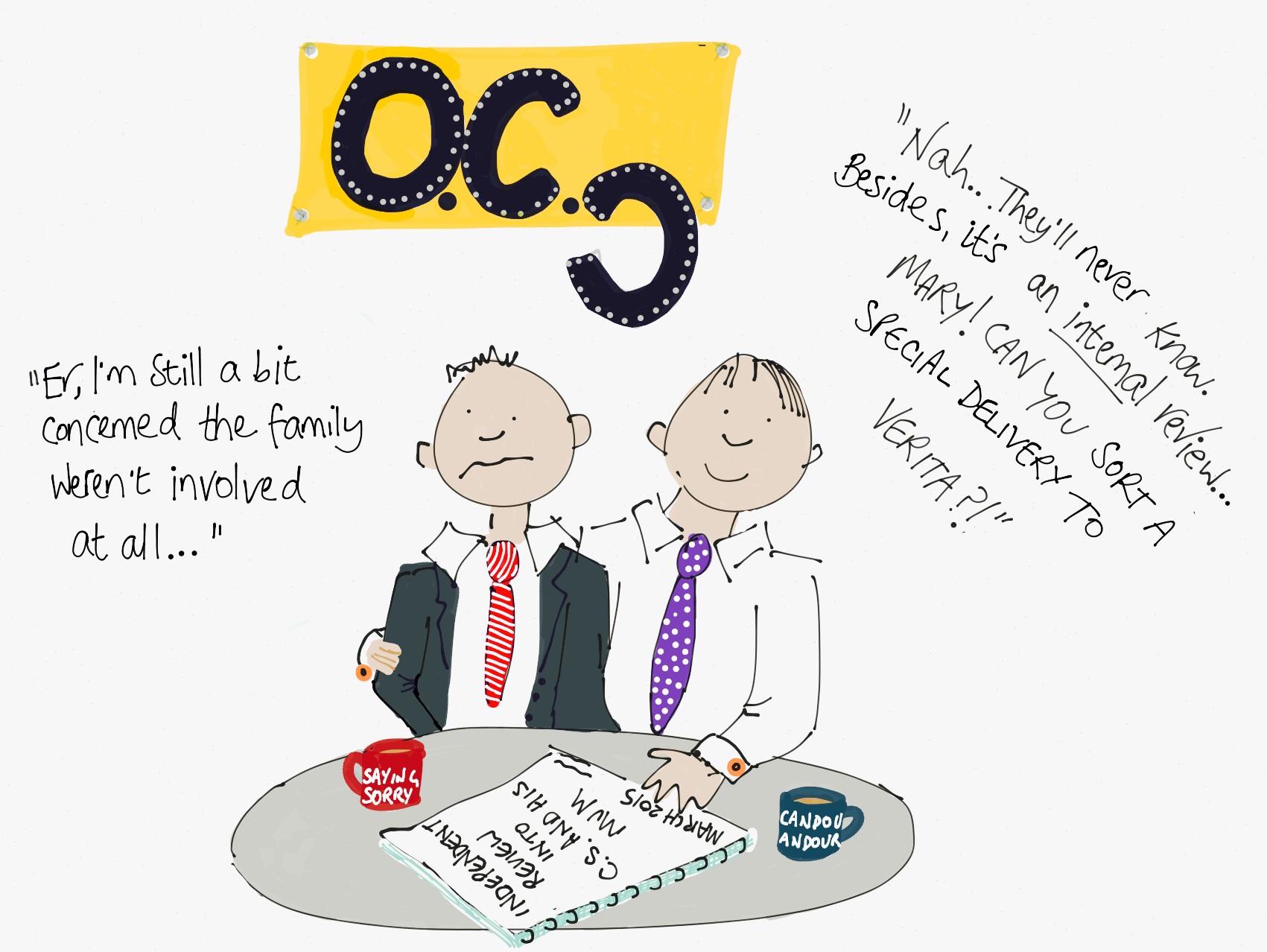
This took me back to the Oxfordshire County Council (OCC) ‘review’ (‘revised version’) and their response to my issues with the content (setting aside, momentarily, the issues around conducting a review secretly and then circulating it to various organisations before lobbing it at us with no warning). There are three overlapping areas I want to touch on here. With the odd swear or few.
‘Us’ and ‘them’
There are clearly marked differences in the framing of OCC staff actions and ours (mine) in both the review and response. It’s not hard to detect a ‘predisposed mindset’ in the way these different ‘parties’ (yes, parties) are discussed and levels of credibility/validity attached to the differing accounts of what actually happened. Any actions involving me are stripped starkly back in contrast to those of OCC staff which are typically dusted with mediating factors.
For example, the review originally reported I cancelled one meeting when I’d asked for it to be rescheduled (I write, waving a copy of the fucking email pointlessly in the direction of OCC towers). The review now states:
The records indicate that this was cancelled by the family but SR has advised that she asked for the meeting to be rescheduled which is not recorded on the file.
When OCC staff and a respite manager were a no show at a later meeting the response is; Records show that an appointment was offered and the care manager was hoping to visit with the respite care manager. There is no record that this took place or was later followed up by either party.
So I’m solely responsible for the non happening of the first meeting and jointly responsible for the second. With ‘hoping’ attributed to the actions of OCC staff. And a dismissal of the email exchange I have confirming the time and place of that second meeting.
This bias is an inevitable outcome of excluding us from the investigation. One sided investigations easily lead to a notoriety (in differing strengths/dilution) developing around the person who is the focus of the investigation. Fleshed out humans from OCC were able to talk about what happened. Our contribution was reduced to scant mention in ill kept ‘official’ records. Written about us.
A flaky and shifting ‘evidence’ base
The flaky and shifting ‘evidence’ base underpinning both the review and response is striking. Some of the points I raised were accepted (things like removing words like ‘although’, ‘however’ or ‘providing consultation’).
Several points were dismissed. ‘Not within the terms of reference’ or ‘I couldn’t possibly comment’ type responses sprinkled here and there. Other points I made are added in, quoted verbatim and/or sandwiched between ‘pwah, not according to our records…’ type statements. Making for a bizarrely unprofessional and odd document. [You really can’t conduct a review without involving relevant people, then invite comment after publication/circulation and try to fudge in/ignore the issues they inevitably raise. It doesn’t work].
Funnily enough, these same ‘official’ records can be teased, squeezed and transformed when it comes to interpreting OCC actions. I didn’t meet with a staff member on a particular date but the ‘signing of a support plan with SR’ noted in the records was (and remains) ‘assumed to be a meeting’. The (non) attendance of a staff member at another meeting is recast in the revised document as ‘SR has advised that the care manager did not attend this planning meeting, so it may be the case that there were two meetings that day’.
The no show I referred to earlier is presented as; ‘The reason is not confirmed by the record. SR has advised that she waited at home all day for the visit to take place, but there is no record of the services being informed of that’. [One of the many things I’ve learned over the last two years is that families have to record every happening. This, of course, is a sure fire way of being labelled even more vexatious than many parents of disabled children already are. But making decisions about what levels of crap service to shout about and what to suck up (leaving little space left to do much other than complain) is a shortsighted approach when something catastrophic happens.]
More leaps are made. Unsurprisingly always in OCC’s favour. ‘This was the impression given from the records’, ‘My view from the records and discussion was that x’s actions were satisfactory’. ‘This was my view of the relationship as reflected from the emails and my discussions with staff.’ ‘I am not making any judgment here on how plans were made, but it remains the case that discharge planning was moving forward at this point’. Ah. Yes, of course. If you’re looking through OCC tinted bins with more than a hint of eau de make it up when the evidence don’t quite fit splashed around your chops. LB was in the unit for 107 days and fuck all had actually been done to discharge him. [NB. Distinguishing action (that is stuff that is done) from talk about action is an essential exercise in evaluating provision/service].
Further evidence of bias (and that the review is really about my actions) can be seen in another meeting example. The original review stated I wasn’t present at a particular meeting with the school/OCC staff. ‘I.wasn’t.supposed.to.attend.’ I jabbed out on the keyboard that awful Sunday I spent pulling together the issue list. The amended ‘review’ now states; ‘SR was not required to be present on this occasion, the purpose of the meeting was to seek CS’s views and gather information from the school‘. Simply deleting ‘SR did not attend’ would be the obvious thing to do in a balanced, evidence based review. But of course this ain’t a balanced, evidence based review.
Power and destruction
Finally, I raised the point that LB’s death wasn’t tragic. It was preventable. A point that surely tramples over the process nonsense that the review is obsessed with. A young dude died. He died. Aged 18. He shouldn’t have. In circumstances in which state bodies, directly and indirectly responsible for keeping him safe from harm, clearly failed.
Nah. Instead of simply removing mention of ‘tragic’ from this ‘review’ (a fairly insubstantial amendment given that ‘second’ meetings on the same day were being trumped up) the (cruel and completely contradictory) response was ‘It is not part of my terms of reference to comment on the events surrounding CS’s death’. Four mentions of LB’s ‘tragic’ death remain in the revised ‘review.’
One of the terms of reference of this ‘review’ (lifted from the broader Verita review that it was always was designed to feed into, despite the re-storying of events by OCC lawyers) was to explore ‘the contact between adult social care, CS’s family and school’. Buckets galore needed to catch the dripping irony here. We can only really draw the conclusion that this review was never about reviewing, learning or trying to improve any aspect of OCC provision. Instead, like the family court case and Oldham social worker story, it was an attempt to discredit while trying to preserve the ‘self righteousness’ of the local authority. Because they can. Regardless of the impact their nasty actions have on the people they pretend to serve.
Surely it’s time for a rigorous and critical overhaul of these pernicious practices that suggest the public in ‘public’ sector have long since left the building?


 A full on few weeks. Writing witness statements for the coroner a hideous task. Reliving everything that happened. Again. He died? While having to discard what we now know [unit records/CQC inspections seared into my brain/eyelids]. So blinking painful. Then a week or so later, receiving Sloven witness statements. Piercingly painful, sometimes enraging reading.





 mydaftlife