
We did it. A historic judgement by Mr Justice Stuart-Smith on Monday morning which involved a £2m fine for Sloven Health. LB and TJ Colvin were treated with the respect they deserve. Justice was served. We had been prepared that the sum of money was not as important as the Judge’s comments would carry more weight. As it was Mr Justice smashed both. He carefully read out a judgement so drenched in sense and fairness it was extraordinary to listen to. In a court again packed with JusticeforLB campaigners including several members of My Life My Choice.
The sensitivity and commitment of the Judge, Bernard, the HSE team and the media who attended (many of whom have followed the campaign over the years) were also extraordinary. Kindnesses that will stay with us.
Our statement about the prosecution can be read here.
Michael Buchanan’s news film with beautiful video clips of LB is here.
A few thoughts and outstanding questions
We were surprised (and pleased) to hear Jeremy Corbyn raise LB, TJ and the campaign in Prime Minister’s Questions yesterday. May also praised the efforts of the families. This is good but serious questions remain about the failure of the various regulators/bodies to act on what the Judge described as ‘the dark years‘ of Sloven. Jeremy Hunt is captured in the Commons looking slightly uncomfortable. So he should. It’s not the job of bereaved families to ‘uncover the serious systemic problems‘ in health and social care.
Mr Justice describes ‘very grave concern‘ that endemic failures were allowed to arise at all and to persist for so long. I mean why was this? Do senior people leave sense on a middle rung of the ladder to success? Are critical scrutiny and self reflection dirty words in senior circles? Is the culture so dire that no one can offer challenge to unspeakable actions?
Many of the mountains of email exchanges we have through Freedom of Information requests include abysmal statements and the complete absence of challenge to these statements by numerous people. Norman Lamb stands out as someone who stood firm, recognised how wrong it was and acted. And made sure action happened.
We have in the Justice shed a long standing plan to hold an exhibition plastering this documentation around a cavernous space to allow people to wander around and read the levels of shite and what families are forced to endure. What is said and not said. Replicated in too many other cases.
Looking back across the five years there was a wilful refusal by NHS Improvement, NHS England, the CQC and Jeremy Hunt to act. One example. Two referrals (yes two) of Katrina Percy to the CQC’s Fitness to Practice panel in 2015 and 2016.
1. Mike Richards sent a ‘fuck off she’s fine’ letter months later (the referral had got lost). 2. After chasing we were told the fitness panel would wait for NHS Improvement’s trouble-shooting Chair Tim Smart’s exec board capability review. Smart bafflingly concluded the board were all fine. Percy again exonerated.
NHS Improvement and the rest continued to slumber.
Point 4 of the judgment states: ‘When the systemic problems were finally recognised, a welcome realism entered the Trust’s appreciation of what happened‘. This interpretation glosses over the crucial point that it was the replacement of ‘pay off Percy’ which enabled the (slow) recognition of failings. She and her turgid, complacent and arrogant board have got off scot free.
Unlike the MPTS panel which decided to include the ‘difficult field of learning disability’ as two mitigating factors in deciding to suspend Valerie Murphy, Mr Justice states ‘the fact that the Trust’s breaches were most likely to affect vulnerable patients is an aggravating factor‘. Of course it is. That he simply saw LB and TJ as human is at the heart of his narrative and judgement. And what has been largely lacking from the broader NHS related responses.
The sentence is here. The biggest Health and Safety related prosecution fine in the history of the NHS.
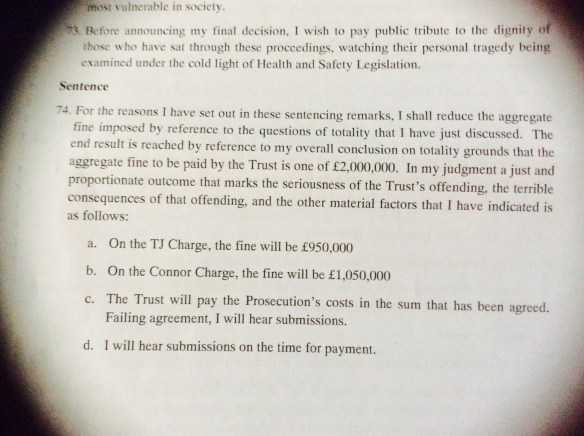
There has been some unsurprising meithering on social media about this fine. Yesterday we found out that Sloven quietly sold the Ridgeway Centre in High Wycombe last November. This was one of the spoils they took with them having lost the Oxford contract because they were so shite. A sale that netted them a tawdry sum of £2.3m. Dosh taken from Oxfordshire provision.
It’s a shame the £2m can’t be channelled into providing groundbreaking provision for LB’s peers some of whom continue to flounder without appropriate support in county. ‘A TJ and Connor centre of life, love, fun and brilliance’. But that’s out of our hands.
Mr Justice was spot on with his ‘just and proportionate outcome‘.
Finally
We’re pretty much done now. We did what we set out to do and whilst none of it will bring back our beautiful boy we collectively did a bloody good job. As Mark Neary reflected yesterday we may have changed the way campaigns are run.
One of the central features of the campaign has been the extraordinary live tweeting of the various hearings by George Julian. She is now looking into a more sustainable way of doing this for other families. Making dirty practices by public sector funded and instructed counsels visible in real time is priceless. If you can spare £1 a month (or more) please fill in the form on the post and let George know.
I hope a light will be shone on the persistent cover up of the ‘dark years’, the culpability of Percy and the board and that those more widely implicated will absorb some of Mr J’s sense, fairness and integrity and now speak out. Critical scrutiny, transparency and honesty is essential for safe, effective and inclusive health and social care.
I’m off to Spain tomorrow with various #JusticeforLB campaigners to walk the LB bus the last 170 miles to Santiago de Compostela*.
After that it’s back to work. And life.
Thanks, thanks and many more thanks – so many thanks – to everyone who did and kept doing what they could and so much more. We seriously smashed it.

*UK walks are also taking place. Rumour has it, in another magical twist, Mr Fortune, Winnie Betsva’s barrister from the inquest is doing the Devon walk.
 The sentencing hearing for the Health and Safety Executive (HSE) prosecution took place this week. The #JusticeforLB bus made a surprise appearance at Oxford Crown Court thanks to


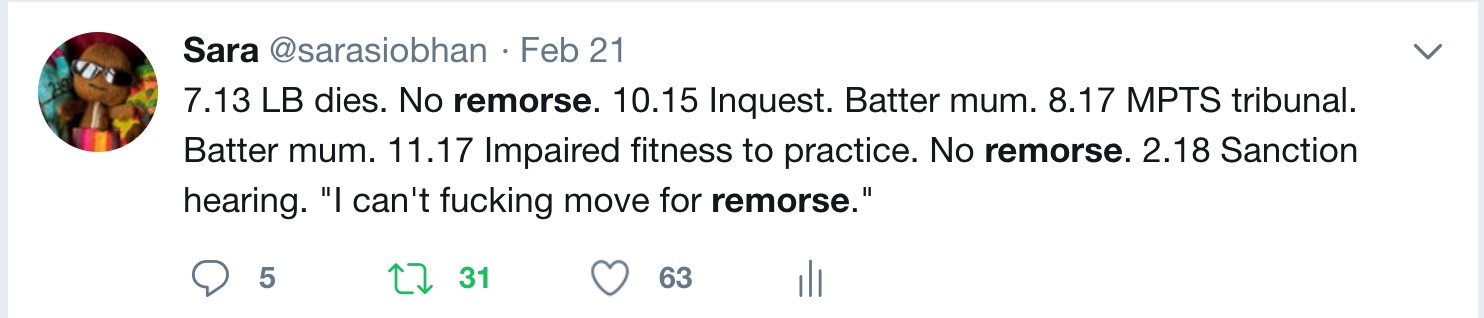
 We received copies of the MPTS tribunal hearing transcripts yesterday. I strangely felt some relief reading the finer detail of what unfolded that day last summer. While my brain and heart wept in inept tandem alongside a rage I’m kind of scared of, I could at least better understand why I ended up unwell. We all knew it was traumatic at the time – Rich and Rosie, Charlotte Haworth Hird, George Julian live tweeting – but my memory was hazy. Now I know.









 We remembered how Tristan became a regular fixture at ours after school typically wearing his Thunderbirds outfit. Virgil. Captain Tracey… The outfits.
 mydaftlife