A beautiful boy, a book, a play and an ink pad

Connor died. He should be alive.

The book

The book I wrote about what happened was launched at Doughty Street Chambers six years ago with a kick ass panel and audience. I wore a red scarfy thing knitted by the mum of one of Connor’s teaching assistants. My Life My Choice members including their President, Michael Edwards, sat in the front row and cheerfully chipped in.

Writing the book was an exercise in witnessing. I’d written this blog for years. Writing joy, love, laughter, critique, commentary (and devastation). The book was a way of trying to make sense of the responses to Connor’s death, documenting the brutality of the processes and bullshit (or worse) families face when someone dies in state ‘care’. It was written before some of these processes ended [they never end].

An ink pad

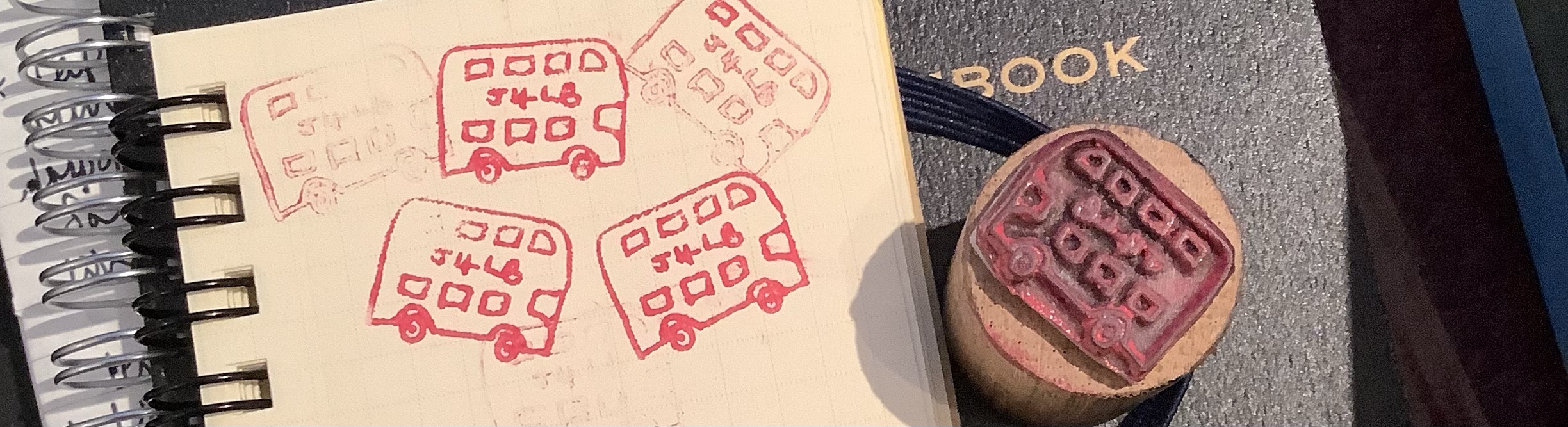
I was uncomfortable at the thought of being asked to sign copies (what do you write?) and made a stamp to avoid this. The tiny ink pad still works. I didn’t stamp or sign many copies in the end. Rich, Rosie, Will, Owen, Tom and George Julian had complimentary copies. I sent a copy to Michael’s sister down Dorset way. He persuaded the publisher to produce a talking book version at the launch.

The play

Steve Unwin began to talk about a play before lockdown. He loved the book and started work to bring it to the stage. We met in Oxford. There was further discussion, draft scripts, potential news, updates and undates. I approached this in the same way I dealt with the book. As a kind of interested bystander with a stamp and an ink pad. Vaguely surprised when the play was mentioned, passing on updates to family and friends with caveats. This may not happen.

A few months ago Steve shared the most recent version of the script (a corker) and news the play, Laughing Boy, is on next spring at Jermyn Street Theatre followed by a week at Bath. Wow. A meeting was held with Stella Powell-Jones and David Doyle (Artistic Director and Executive Producer) in a London pub to talk about the important stuff.

How to get this right. That was the discussion. With Thai curry.

Earlier this week, the copy and image was shared for comment. The reassurance I felt after the meeting was cemented. The image is inspired by a #JusticeforLB quilt patch and the text spot on.

The announcement was made on Thursday lunchtime. The Lonely Londoners in Feb/March followed by Laughing Boy in April/May. I was at a writing retreat at Gladstone’s Library distracted by the beauty of the mushrooms as details bounced around social media.

So many messages and posts. A buzz of action, excitement and anticipation despite everything else going on. Would it go up North? Highlight of next year! My Life My Choice are bussing to Bath. Brilliant said Norman Lamb. Becca got her clipboard back out to organise the life raft trip to London. Booked. Booked. Booked.

Someone prosaically tweeted, ‘Lots of time to do something remarkable’.

It’s already remarkable. A beautiful boy dismissed in life matters. His quirkiness, love of life and buses, humour, irreverence and courage to stick two fingers up at adversity count.

I’m setting aside my stamp and ink pad. There will be tears. So many tears, alongside laughter, bafflement and kick ass brilliance.

Thank you Steve Unwin.

Tickets are available here with relaxed and captioned performances.

Hauntings


Memories of going to Manchester with Rich and Tom in October the year Connor died. Visiting Rosie doing her maths degree. Who looked after Chunky Stan and Bess? Coming across a Goldfrapp installation at the Lowry Gallery. A song named Ulla. A mate who joyfully snaps at my heels while offering so much love. And a beautiful goddaughter.

A performance of Fiddler on the Roof was also on that day. Paul Michael Glaser, my first love (with Doyle from The Professionals who I thought was Blake in Blake’s 7). We were under the same roof as Starsky.

Tom spent a night with Rosie at her student home. We were in a budget hotel that made the most of every space including multi coloured fairy lights around the toilet area. Failing on cellophane wrapped shite for breakfast. A big name was playing at the Manchester Arena that night. Billy Joel. Another childhood figure. So many excited punters, a year or so before Ariana.

Four years later. Yep, four years… The Oxford Road GMC hearing into whether Connor’s irresponsible consultant was fit to practise. [Obviously not.] Rosie turned up at the drop of a strangled phone call the night before to sit with Rich and Charlotte Haworth Hird who represented us at Connor’s inquest in the public section. She came out of friendship.

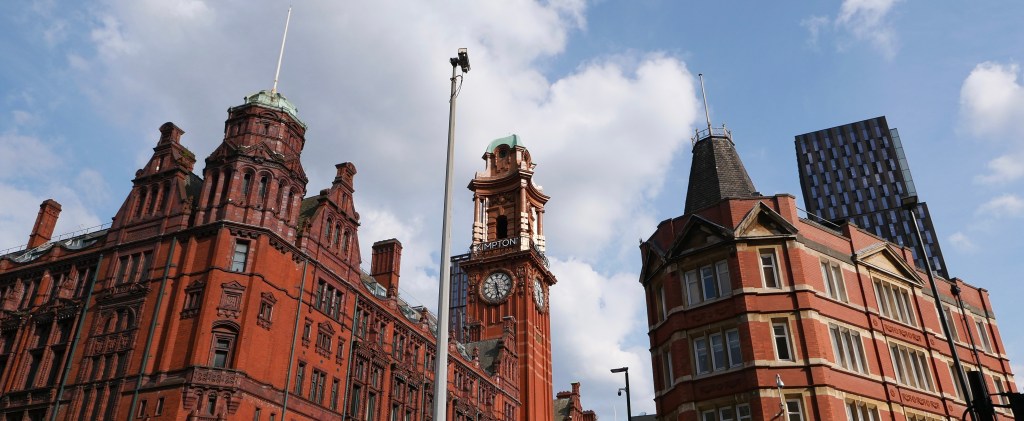
I shared details of the Kimpton Hotel yesterday with attendees of a workshop we’re holding today and tomorrow to pore over the findings of a research project exploring the experiences of making a referral to a fitness to practise hearing. The Witness to Harm project. The GMC put us up at the Kimpton the night before I gave evidence. Only to be taken apart by a barrister who had lost any sense of human and a panel that looked the other way. A posh hotel for a subsequent breakdown.

Ten years on and the slow wheels keep turning.

Sorry

Work.  

Family, friends, dog.

Threads. Life. 

Work.

A beautiful young man killed in an NHS hospital trust 10 years ago. A boy firmly placed in an outside ‘those who count’ zone across his lifetime.

A loose and disparate collective of largely white, entitled NHS/local authority execs and middle management meithering. Buck passing and blame with unchallenged self-importance, posturing, pettiness. Drawing on a well worn box of dirty tricks.

Connor got into the bath that morning knowing he was going to visit the Oxford Bus Company. A visit arranged by his teaching assistants come pallbearers.

I don’t know what he thought that morning. There’s no detail about what happened. No records. No ‘evidence’. No illicit notes taken home or bedroom photos with large soft toys.

The verdict in the Letby case has generated shock, revulsion. Horror. Devastated parents/families left to deal with the unspeakable. The unthinkable. Their futures immediately woven into a fabric of horror and disbelief.

And a similar grotesque stack of obfuscation and performative (non) action from layers of (some familiar) senior NHS and regulatory body figures.

‘We need to stop appointing crap people to NHS boards.’

‘We must change the toxic culture.’

We need to blah blah blah.

Billybullshite spouters who will continue to spout after the eventual publication of the possibly statutory public inquiry. Words that must slice through the families who didn’t know their beautiful babies were murdered. Before they could do any knowing. They, themselves catapulted into this space of dishonesty, self preservation, bullying and cruelty.

‘It’s like the Wild West’, said the wonderful Richard West who is working on our Witness to Harm project looking at the experiences of families who experience regulatory processes.

There is incredulity that the NHS famed for never saying sorry despite having a ‘Say sorry’ policy apologised to Letby and her parents. And gruelling familiarity as the then CEO wandered away from Chester to pick up other senior roles a week after her arrest. The rewards for mediocrity, ignorance and unwavering devotion just one red flag among many in this deeply flawed institution.

That never changes.

Work.

Family, friends, dog.

Threads. Life.

Repeat. 

10 years, 10 points, 10 minutes

Last night LDN Charity organised an event ‘Spotlight on the abuse of people with learning disabilities’ at the London Canal Museum. The panel, chaired by Simon Jarrett, consisted of Alexis Quinn, George Julian, Amanda Topps and me. Contributions from the audience were as powerful as the panel presentations and the sense of anger and commitment to change in the packed room was palpable. This is what I said:

Last week was the 10-year anniversary of our son Connor’s death in an NHS run ATU. He drowned in the bath while staff did an online Tesco order in the office next door. Ten years has allowed time to think about what unfolded and why, and in doing so different aspects have become more prominent. 

Given we each have 10 minutes to talk it seemed appropriate to produce 10 points of reflection about what happened to Connor (and others) and to think about what the lack of any real shift in the use of ATUs means.  

ONE. Connor was a beautiful, much loved, funny, talented and wonderfully complicated young man. He loved deeply and contributed so much to our family (and wider) that we are left with a chasm in our lives and hearts so full of love I can sometimes barely breathe.  

TWO. The day we had Connor admitted to the assessment and treatment unit (ATU) a mile or so from where we lived, I didn’t know Winterbourne View was an ATU. I didn’t know what an ATU was. I thought we were taking Connor to a specialist NHS hospital unit that would be staffed by uniformed and identifiable health professionals for a few weeks to understand why he had become so distressed and unpredictable. Connor had loved visiting his grandad at the JR hospital just weeks earlier. The locum medic who came to our home to assess Connor beforehand even said there would be a ward round that evening.  

I’m not sure what this not knowing, this ignorance means still. There was so much we didn’t know then. And so much people don’t know now.  

THREE. Connor was admitted on a Tuesday evening. The responsible clinician whose office was in a building across the car park from the unit, didn’t bother to walk across and see him the next day. Wednesday. Or on the Thursday or Friday. On Saturday, she went off on holiday for two weeks. Again, we had no idea. There was no ward round, no crisis specialist intervention, no urgency, information, interest. No nothing. Just our boy catapulted from his family home into a space that defies words. 

And this was apparently fine. 

FOUR. We met the lead paramedic who responded to the call that hot, sunny July morning before we moved from Oxford in May 2021. He was a friend of a friend of one of our children and asked to meet us. He said the ambulance overshot the turn for the unit that morning, There was no one outside directing it in. When they got to the unit, the door was locked and someone was painting the outside windows. He was bewildered by this lack of urgency and the absence of information from those present. He said his team had nothing to work with, nothing to base their treatment decisions on. The unit staff were literally clueless and said nothing. There is no pretence of healthcare, death care or any care in these places.  

And this is apparently fine. 

FIVE. After 2 years of health and local authority records being disclosed and 4 pre-inquest hearings Connor’s inquest was unexpectedly halted in the second week in October 2015. The responsible clinician’s barrister produced evidence that a patient, Henry, had died in the same bath a few years earlier. Photographs of the bathroom taken after Henry’s death were shared with us. Some of the same staff were on duty the day Henry died. The lack of disclosing Henry’s death for over two years is extraordinary. A second psychiatrist, present the day Connor died, looked at Henry and told the coroner by phone he died of natural causes. There was no postmortem and no inquest.  

When Connor’s inquest ended the coroner asked for Henry’s death to be investigated and the police took witness accounts from those present. The student nurse who was with Henry said he was told to leave the bathroom by professional X before the ambulance arrived. Professional X said he arrived at the unit after the ambulance. The coroner said it was long ago and there were bound to be contradictions. He dismissed Henry’s death again. 

And this is apparently fine. 

SIX. A death review commissioned by NHS England on our request was conducted by an international consultancy firm Mazars led by Marie Ann Bruce. It found only 2 out of 327 unexpected deaths of people with learning disabilities in the NHS Trust between 2011-2015 were investigated. Providing unassailable evidence you can punt human rights, regulatory procedures and processes off the nearest bridge when people with learning disabilities are involved. 

SEVEN. We don’t know how many people have died in assessment and treatment units. A Dispatches film by Alison Millar ‘Under Lock and Key’ shown in 2017 included the story of Bill who died in 2011. His parents then in their 70s were given what they called ‘blood money’ after an inquest found he died as an outcome of neglect.  

An early morning round table meeting was organised at Channel 4 the morning after the documentary was aired. An expectation that there would be an outcry Winterbourne View styley. No one really cared. We were coasting downwards by then, slowly and carefully unmaking scandals. I sat next to Bill’s parents who were pretty quiet. I wonder what they were thinking of this early morning shindig in central London that turned to nothing. Other than further evidence of bridge punting. 

EIGHT. There is no doubt that these places deprive people of their freedoms and rights. This deprivation manifests in myriad ways from being restrained, over medicated or secluded to being denied the basic opportunities to walk in nature, experience the wind on your face or have a drink with a mate.  Abuse, disrespect and devaluing profoundly erode wellbeing. We know this. Wiseman and Watson (2021) have written about the complex forms of violence experienced by people with learning disabilities and how these are critical to understanding the significant inequalities in health and wellbeing experienced by this group. And yet the numbers of those incarcerated in these places remain the same. 

NINE. The unmaking of this scandal, the greedy and self-interested actors that have jostled to drink at the fountain of self-serving opportunities and nosh on the plates of croissant crumbs, to line their pockets, seize media opportunities is grotesque. The stuffing of laminated photos of dead loved ones into the hands of bereaved and battered families… There has been no auditing of the money spent, contracts doshed out, time wasted, or individuals rewarded for no success.

We know these places are trauma generating and yet a paper published just this year found that just under 50% of 44 admissions and discharges from two ATUS from February 2019 to March 2022 were delayed. The most prevalent reasons for discharge delays were identification of a new placement, recruitment of care staff and building work (Gibson et al 2023). Two young men close to me have been in and out of ATUs over the past decade. One is currently back in an ATU while the other has been waiting years for the local authority to sort out a home for him. Both families have been the driving force at extraordinary emotional, financial and physical cost to try to get their boys a life worth living. 

This is apparently fine. 

TEN. I was struck by Simon Jarrett mentioning at a conference just yesterday that the exclusion of people with learning disabilities during the industrial revolution when enormous institutions were built was arbitrary, as many people could have worked in factories. There is a direct and remarkably enduring line from then to now where we have people formally incarcerated in ATUs, or in versions of ATUs dressed up as supported living or residential homes where people don’t even know their neighbours and their neighbours don’t know them.

All our lives are impoverished by the exclusion of a proportion of the population, and the way in which we, as a society, are failing people is something we should all take responsibility for. 

None of what we are talking about this evening is fine. None of it. Stop pretending it apparently is. 

Thank you. 
Labour, caring and baby sweetness

Babies of Rosie’s childhood friends are due. An anticipatory space rehearsed first, second, third hand. Labour. The stuff of fear, joy, anticipation, dread, sometimes devastation, pain, fear, joy. And happiness

I absorb updates, crochet. There’s always crochet.

Babies were a feature at the recent disability studies conference in Rekyavik. An unexpected and positive addition alongside the currently small number of self-advocates and family carers.

Sadness and such joy. New life, impossible sweetness, smells and the gentle warmth of the softness of the softest skin. 

I feel sad at how passively and comprehensively we were ejected from the baby manual/mainstream baby gig back in the day. An ignorance that led to us tumbling into a black hole of fear and bewilderment after our GP, lab technicians and others decided a sample of Connor’s blood was indicative of a problem that curtailed his right to be considered human. 

I walked him in his pushchair from the GP surgery across the park to the hospital that day to drop off the sample I’d pushed for. I didn’t know this was a first task in a role I was acquiring without realising. A role characterised by staunch advocacy and activism, contradiction, ambiguity, invisibility, blame and a consistent lack of anything outside of family life resembling the word ‘care’.

Connor was pronounced dead at the same hospital sixteen years later. I pitched up in a taxi from town that day. With Caroline, our administrator who had a daughter in her 50s with learning disabilities. Another carer.

Those sixteen years had led to a savviness of sorts, of finding safe spaces. A made up (fuck you) manual, family, bunch of mates and likeminded allies of teaching assistants, teachers, occasional social and healthcare professionals.

I wish now I’d said ‘Don’t fucking diss my beautiful boy’ and swiped away the doubters without a backwards look. We had a lifetime of joy, love and laughter despite the bleak terrain.

I think about our children and their partners. None of them met Connor. Jack almost did, house sharing with Rosie as students in Manchester before they got together. One of Rosie’s oldest mates Molly is expecting a baby any day with her partner she met at the same house in Manchester. H, born three weeks before Rosie and another lifelong friend had a baby today, hours before her younger sister M got married.

M and Connor pledged to marry if they were both single at 30.

New lives, joy and utter, utter sweetness. With the ever present, largely contained, sadness.

Nine years ago tomorrow

Nine years ago tomorrow. Eight versions of dealing with the day your child dies an unexpected and preventable death almost done now. I’m no longer flattened three, five, eight, twelve weeks before this day. Which is something. I was always baffled how Connor’s death day eclipsed his birthday.

I cook. That’s a constant. Cook and cry. I still can’t think about it though. That day. I just can’t. Or the day before. Nine years ago today.

This week I started to worry about churning the same static photo-based memories. About memories weakening. I notice his Shrek toy has been nibbled by moths. His clothes and other treasures so carefully packed away nine years ago look diminished, dated. Out of time. Once Lynx drenched t-shirts smell musty almost.

I think about our neighbour, Norah. In her 90s when we moved to our old house over twenty years ago. The first time I met her she told me about about her grandson who was 13 when he died. Picking his photo from a panoply of family photos on a side table to share and talk about. A school photo, cheeky face, uniform, promise, potential, life. I didn’t know how to think about or respond to what Norah told me. Then.

She was decades ahead of nine years. And still talking about him.

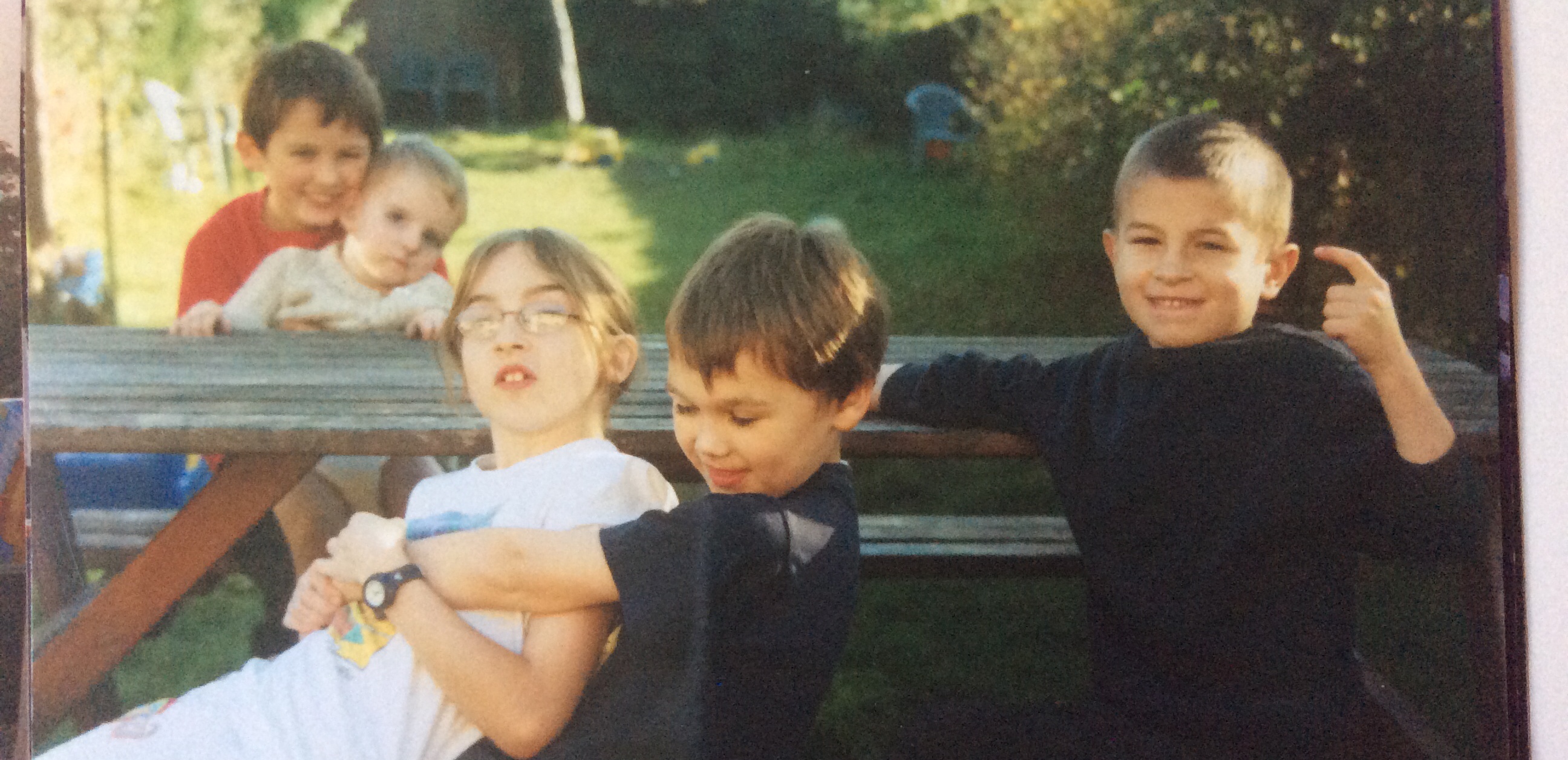
A mate mentions the closeness between Rosie, Will, Owen and Tom. And their partners. About the intensity of their love. Before and after Connor died. I look at photos. Including some from the lost day in London. A banger of a day in unexpected ways.

And breathe again.

“I’m Ruby’s mum.”

Got caught up in a strange situation this last week on twitter involving some parents of people with Down syndrome (and possibly their children) after saying I felt uncomfortable about a young man being directly quoted by his dad as saying something I didn’t think he’d say. I’ve seen him articulate his views brilliantly before, just not in an establishment, senior BBC official type way. [It turns out his dad was quoting from a press statement]. I got a bit of a dressing down by various parents and people with DS.

“How dare you say that?” “Have you ever met him?” “You’re being ableist.”

The conversation unravelled quickly as one father compared tweeting on behalf of his daughter to Boris Johnson having a scriptwriter for his speeches. And then a young person I thought I was talking to disappeared in a puff of fakery.

“I’m Ruby’s mum”, she [her mum, not Ruby] eventually tweeted. From Ruby’s account.

It’s always odd when people have a twitter account in which other people tweet as if they are them. Some accounts make a distinction in the biog stating who the account is run by, or tweets by the named person are tagged in a particular way to make it clear who is actually talking. Some parents simply tweet as if they are their children with DS. And tweet or retweet other stuff on the same account.

Ruby’s mum continued:

“And it’s really none of your business”.

The trouble is, it is our business. By creating a public persona of their children as articulate in normative ways, by erasing their children’s actual voice, they are denying them their personhood. This, in turn, suggests they see their children as problematic. I’ve had conversations with parents who say but it’s important to raise the profile of people with DS (and by extension people with learning disabilities). Yep. Just not by creating an imaginary (ableist) version of people.

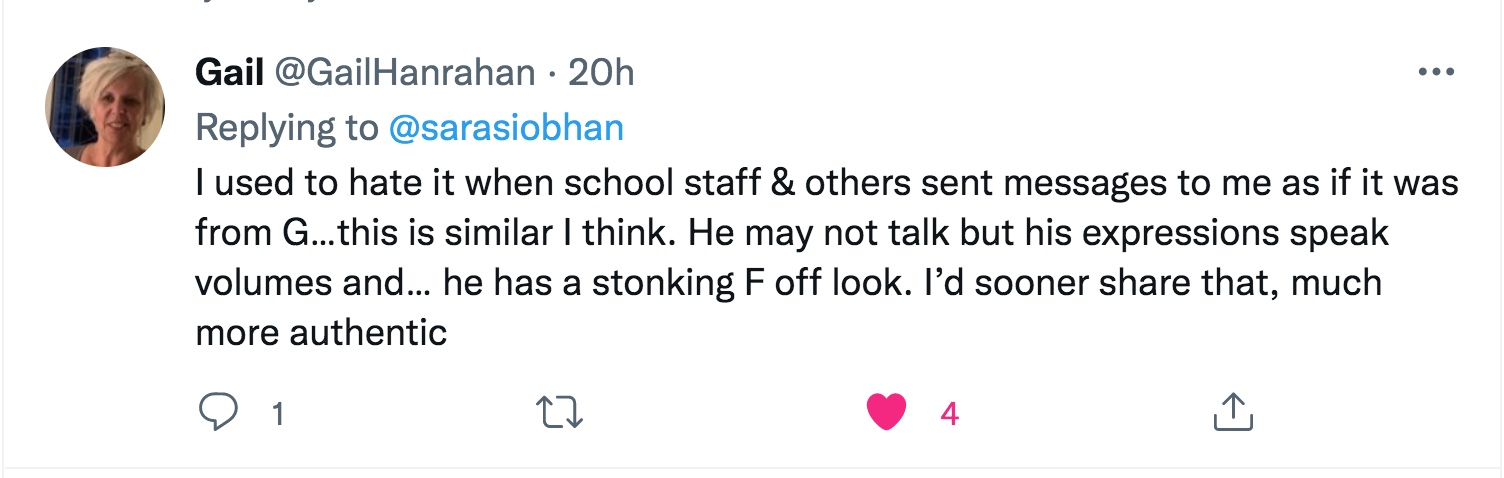
Gail captures this in her tweet:

This peculiar practice links to the Down Syndrome Act. A divisive and empty parliamentary Bill which singles out the 40,000 people with DS in England from the estimated 1.1m people with learning disabilities for special consideration. Why do people with DS demand special consideration? The short answer is, I don’t think they do.

The Down Syndrome Bill was fronted by a small group of people with DS who were presented as driving the bill forwards. They endured ‘hug a person with DS’ inappropriateness by countless MPs and certainly showed enthusiasm for the bill. I just wonder if anyone around them took the time to explain that the bill would only be relevant to 2 or 3 of their classmates and not the rest of the children they might have hung out with at school or extra-curricula activities growing up, their friends or siblings, and whether they might think that’s not right.

I don’t suppose they were shown that respect, sadly. It’s the heavily parent managed DS way or the highway.

Pulling lines and dirty diagnoses

A court of protection hearing has been taking place this week to determine whether it is in the best interests of 17 year old William Verden to have a kidney transplant. Without the operation he will die of a rare kidney disease in 12 months. William does not have the capacity to make this decision. The NHS Trust oppose the transplant. The court will decide if he can have the operation.

I want to chew over a few bits from the hearing here. Release rage through my fingertips. Give my old keyboard another pounding. I mean death really ain’t a decision you want someone to make for you. How could it not be in your best interests to have a potentially life saving operation?

[William is represented by Emma Sutton, Serjeants Inn. His mother Ami McLellan is represented by Tor Butler Cole, 39 Essex Chambers. George Julian is live tweeting the hearing. You can support George’s work here.]

The opposition to William having the transplant seems to be made up of a set of overlapping, baffling (non) areas/arguments:

Dirty diagnoses. Autism, learning disabilities and ADHD are inherently life shortening diagnoses. The ‘heady combination’ of William’s autism and ADHD ‘intertwined’ with his kidney condition generate layers of dodgy complication. He is very different ‘to me or you’.

Functioning age. William is the age of a 3 year old.

Control. William is out of control. He doesn’t respond to reason. He has a history of pulling out tubes. He would need to be sedated and ventilated for up to six weeks after the operation to allow the new kidney to graft. Two security guards are assigned to him in hospital.

Spiralling risks. The need for excessive sedation and ventilation brings new risks. While there is little evidence about the risks of more than 2 week sedation/ventilation for people ‘like William’ we can assume these will be worse than the risks for people not like him [anecdotally]. Intensive care is a terrifying place. William would either be restrained or drugged for so long he would ‘very likely’ end up with psychiatric harm.

Sleight of hand stuff. There is often dodgy dancing in these cases involving NHS trusts. A not so nimble flipping of arguments to score points. When discussion turned to adjustments that could be made in the process to support William, the trust counsel said it would be discrimination if he did not receive the same treatment as other patients. When the care plan which states his choices about things like the numbers of people present in the room was not followed, it was presented as helping William to learn to be more flexible. [‘Sleight of hand’ doesn’t capture these examples. When you think that the healthcare people with learning disabilities often receive is often poor, the suggestion that a trust is grabbing serendipitous opportunities in a dialysis suite to help a young man to learn to be more flexible is grotesque.]

Emma Sutton and Tor Butler Cole carefully dismantled the barricade of these nonsensical, ‘insane’ arguments over the last two days in court. For example, the fabled line pulling. [Which he didn’t do]:

He’s never actually pulled a line out but sometimes we need to do surgery quickly so it’s a problem if he did. 

No-one has seen him pulling it out but it’s unusual to go through as many lines as quickly and in a boy who tends to pick at dressings, I don’t think it’s unusual to think it might relate to the fact he’s had three lines in relatively short order.

From an autism point of view, his inability to tolerate rapid changes that will happen, so behavioural risk of pulling out lines and make treatments impossible to complete.

We learned how the things that get William’s goat (like being called the wrong name or having people too close) have been ignored and led to him being restrained. ‘Being restrained by two security guards is nothing like a prolonged period in paediatric intensive care,’ said one consultant. Underlining the ‘insanity’ of the arguments presented in a court of law.

‘Where did the evidence that William is functioning at the level of a 3 year old come from?’ asked Emma S. ‘Oh. I don’t know. From local expert records I think’.

The carelessness and casualness with which medics circulate empty, damaging statements is breathtaking. While ignoring William’s and his mother’s expertise. Despite limited evidence to draw on, the potential negative outcome of this operation for William was feasted on like a tabloid celeb secret.

A brighter picture emerged. Care has been taken to support William to understand his healthcare needs, the reason for his treatment and the transplant operation. He understands he needs the operation or will die [I know]. Tor BC and Emma S continued to deconstruct the illogical, baffling arguments of the Trust counsel that William was somehow so random, so off the scale of anything approaching healthcare, so inhuman that he should be denied the opportunity of a life saving operation.

When one witness said it was in William’s best interest that he have the transplant, she double checked he’d factored in the the 50% risk of recurrence. And took the opportunity to reiterate the pulling the line line. The clinicians and experts had got together to be creative about William’s care plan. A heart soaring moment that the trust counsel described as ‘quite unusual’ and ‘effectively a hot tubbing of all disciplines’. 

William had dealt with his shitty hospital treatment well and came across as stoic about having to have further medical treatment. When the chips are down and you’re facing death, people tend to. Dr Y dismissed William’s understanding of death in move of a breathtaking brutality.

I would like to know how William makes sense of death in comparison to Dr Y, the judge, or any other 17 year old. I suspect he’s got it as nailed as any of us. Particularly given it is closer to him right now.

The day ended on a kick ass note. Dr C finished his evidence reflecting on how impressive it is to see how much progress William has made: ‘not withstanding impact of environment on him and impact of his treatment… There’s something around everyone trying to give him the best chance.’

William’s mother was last to give evidence. I can barely imagine the horror of sitting through this shit show of ignorance, prejudice and assumption, with your child’s life at stake.

She described William as ‘very active, loves golf, any activity he can do, anyone has any jobs doing he’ll do it, he likes to be busy, and just full of life, he’s full of energy, he’s such a beautiful boy, beautiful inside and out. He definitely is a handful.’

Instead of pulling lines and dirty diagnoses, let’s focus on this point. Beautifully made.

Thinking photography. Again.

Image

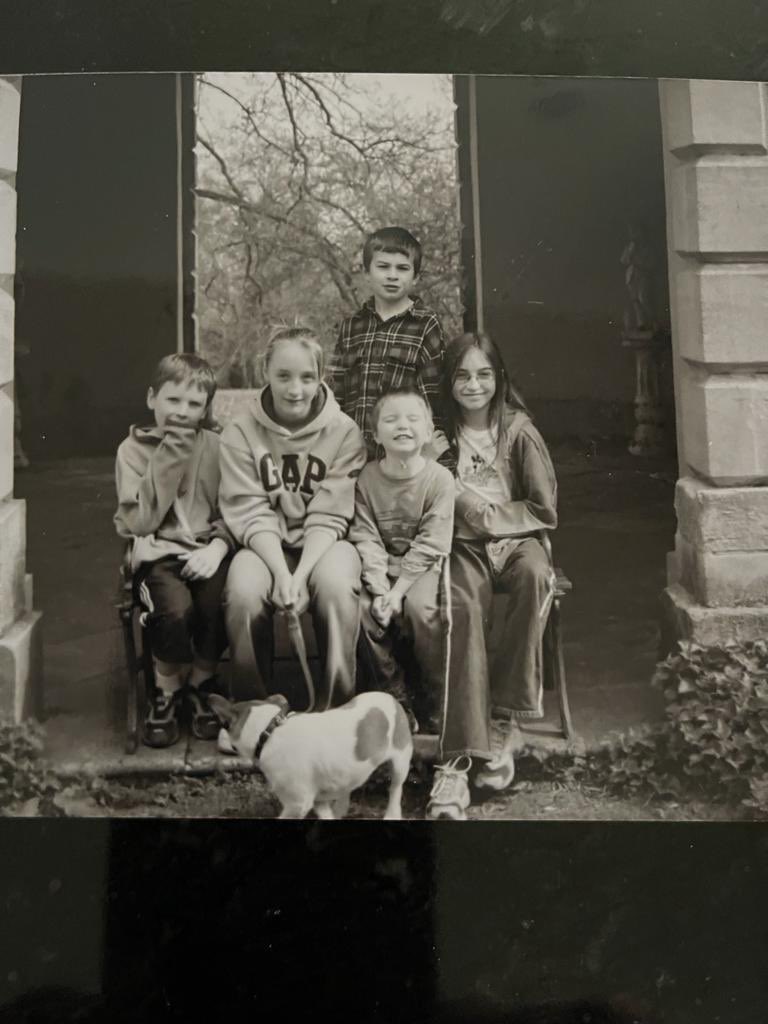
My mate Fran sent a copy of this photo taken on a walk just outside the ring road near Headington. A formal, staged, Victorian looking photo from days of old. Rosie, Mary, James and Tom arranged on a bench, Connor standing behind, framed by a dramatic doorway. A statue on a pedestal in a darkened corner. 

I think I must have taken it. Franny doesn’t do black and white.

I remember that day, the tromp through the publicly accessible grounds of some stack that sits alongside the A40. Before the public toilet and burger van layby. Spitting distance from James and Connor’s school. About 2 miles from where we lived. It was the only time we went there.

I study the photo. Repeatedly. You do when you receive treasure. An image so full of detail it creates space to remember forgotten stuff. I pore over the faces, expressions, bodies, positioning, closeness, haircuts (pre or post the nit years), clothing. And magic.

I think about the walk. Meeting up at Shotover, inconsequential jibber jabber, admonishing Stan, chivvying and chatter. Coming across the folly. And a photo opp…

‘Hey, on the bench!’

Pre-smart phone anti-spontaneity. A moment of orderliness and patience. Recognition that stillness was required.

Rosie holding Connor’s arm and hand with practiced and easy affection. Mary in charge of Chunky Stan, James nestled beside her, his sleeve in his mouth. Tom cheesing it. Connor with his characteristic quizzical expression, eyebrows down, a slight chew of his left cheek. He was growing into life still. Sense making and trying to make sense of the incomprehensible. Which would eventually kill him.

Stan was working up to his Mydaftlife cover photo paw fame.

A moment captured. Happiness on an afternoon out in the school holidays.

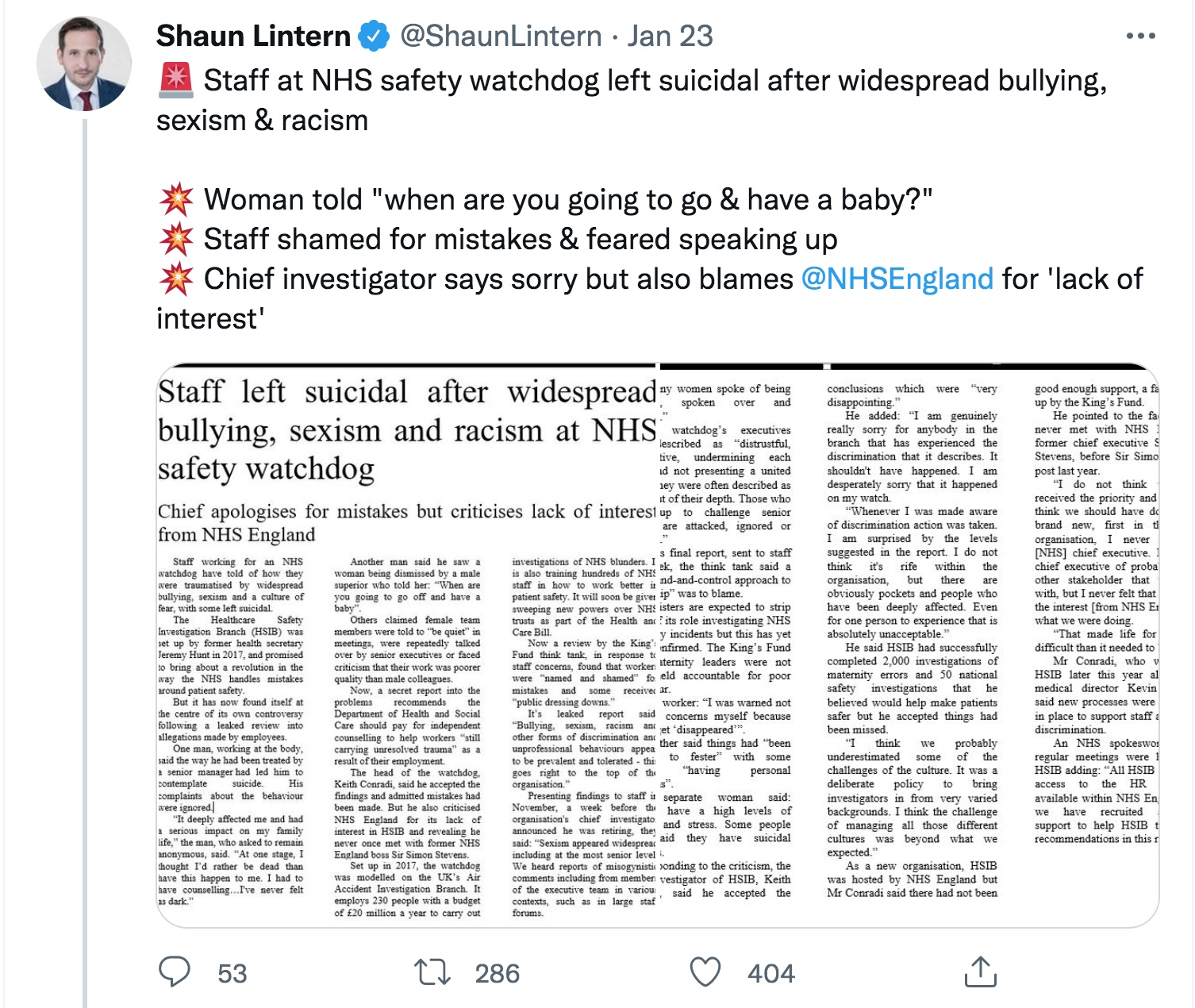
‘Don’t you be harsh, missy’ and the Branch investigation

I wake around 3am. Turn to my ipad for a cheeky scroll of happenings and see a link to an article posted a day or so ago about the Health Safety Investigation Branch. (Four words that should knock insomnia out of the sleepless park.)

Ex Health Minister Jeremy Hunt launched the Branch in 2016. In a speech (no longer available) he talked about mistakes made by good people and the need for a ‘proper study of environment and systems in which mistakes happen’. This was a patient safety first.

HSIB. An elite, ‘independent’ swat team of human factor dominated safety investigators proudly wearing no blame badges. Led by Keith Conradi. A human factors geezer plucked out of the aviation industry. A name oozing shaken not stirred gravitas and Branch profile referencing ‘fast’ jets, skiing and triathlons.

I squint at the ipad glare. What’s happened?

A Kings Fund report has found widespread bullying, sexism and a culture of fear in the organisation.

Conradi has resigned.

And with no apparent hint of irony blames the NHS England CEO. And unexpected challenges of managing diverse cultures within the organisation.

I find a post I wrote about HSIB in 2016. The Moon on a Dick. And feel a fleeting sense of blog title pride.

HSIB. Hunt. Blinkered by a human factors fascination, coaxed and coached by an ever ready, uncritical and largely white male chum club.

Hey! Don’t you be harsh missy, I was admonished at the time. [By people who should have known better.] HSIB is a groundbreaking body led by a serious man doing serious work you don’t understand. Let’s wait and see what this shit hot group achieve. We waited.

I try to go back to sleep. An hour, maybe two before a day of research meetings. Growing older with a learning disability. Living a flourishing life. Experiencing loneliness. Giving evidence at fitness to practice hearings. Experiencing inquests… Work that tumble-fills life with overspilling layers of graft, fear, reflection, doing stuff wrong, making right wrongs, fun, stumblings, work. And constant concern. Of not generating anything that makes a difference to someone.

And then I feel familiar anger and rage. Empty words, white noise, environments, systems, ‘good people’ and ‘mistakes’. Made up people channelled into made up jobs. Encouraged by self serving cheerleaders who collude in the erasure of sense. Rights. Integrity. Honesty. Humanity. Hypocrisy always waiting in the wings.

Nearly six years has passed since Hunt launched HSIB. Bereaved families continue to be brutalised by inadequate and punitive investigatory processes. And the world leading patient safety investigation organisation has generated its own brand of harm and trauma.

How long does this wait and see lark last?