A building with a snooker table

LB’s been off school a week now. Unmanageable distress associated with school, which manifests itself in violent outburst (towards himself and others), has led to a kind of informal home arrest. Home where he is largely a chill pill. Home which ain’t ideal when we both have full time jobs.

School are going to try to sort out some way of him returning part time. The plan was for him to stay at school until July 2014. A ‘mental health’ referral has been made with no one involved optimistic that this will happen within 4-6 weeks.  The care manager (who had discharged him after success at panel finger nail blackboard towards the end of last year) called today to sort out some sort of interim ‘care’ for him.

“Well he can go to respite pretty much straightaway…”
“What do you mean by respite?”
“He can go to Saxon Way. Into respite. I can get the manager to call you.”
“Sorry, I don’t understand. What is it exactly?”
“Well it’s a building.”
“Eh?”
“It’s a building with a snooker table and other stuff to do. He can stay there or maybe the staff will take him out into the community. Or if you prefer, some staff can come to your home and look after LB there. The advantage is, it’s pretty much an instant solution.”

So, after apparently huge shifts in the organisation of social care in the UK, the development of aspirational thinking around person centred care, and having spent 16 years in education, LB is consigned to a building with a snooker table. At the first hurdle.

I don’t get it. What about his future? His life? His capacity to be meaningfully productive in some way? He’s 18 years old and should be looking forward to the start of his adult life, some type of employment and everything that comes with that. Not written off and stuck in a day centre waiting for a half arsed referral to fictional mental health support. Seriously?

I must be missing something.

Surely.

‘That letter’ and non-standard mothering

So here’s the gig. LB is 18. Increasingly unhappy at school. Deteriorating in emotional well-being. The space for him to be happy seems to be steadily narrowing. Like those rooms on Tomb Raider with moving walls, or the ledge Batman stands on.

We work full time. Luckily with flexible employees/jobs that allow Rich to leave work at 1pm to collect LB from a residential school trip in Devon when it goes tits up, or one of us to be home at 3.15pm most of the week, with some help from family. This also means that we spend quite a lot of the weekend working.

We have a care manager. Or we did, briefly, until she organised the 2 hours of direct payments five days a week to cover after school ‘adult child care’ and discharged us indefinitely. ‘Successful at panel*’, she called it. Trouble is, ‘adult child care’ ain’t readily available. And two hours after school doesn’t solve the increasing problem LB has coping with school.

Things are not going well.

I met with a good friend this week who has a 25 year old daughter in a residential setting. She always amuses me with her refreshing, no nonsense, cut through bullshit, type approach to her and her daughter’s social care experiences (which have been up and down). This time she turned her focus onto LB. It was time to write ‘that letter’, she said, as we noshed on the early evening menu and glugged house white.

If we didn’t write ‘that letter’ to social services, saying we wanted LB to live independently when he finished school in summer 2014, he would get lost from the system. We needed to have ‘that letter’ on file. So it’s recorded. We didn’t want to be scrabbling around in crisis, in five years time, desperately trying to engage with social services and no space to be given any choice in his living arrangements.

This week I’m a respondent at a workshop on ‘Changing Models of Motherhood’. The session is about ‘non standard mothering’. I’m uncomfortable with that term for all sorts of reasons. I want to call it ‘different’, ‘hindered’, ‘frustrated’, ‘hampered’, ‘unsupported’ mothering. ‘Non standard’ implies a benign, though less valued, type mothering but one that is somehow still within the gift of the mother/child relationship.

LB’s current distress relates to external factors and is compounded (or created) by a lack of appropriate, timely, responsive rather than reactive support. I don’t want to write ‘that letter’. For me, it goes against what I consider to be ‘good mothering’, non standard or whatever. It seems harsh, punishing, unfair and I worry it will expel him to some, as yet unknown, space. A kind of containment.  Experiences of social care so far have been pretty mediocre to downright crap. For example, the council funded sessions of peer buddying to take LB out and about, and the care agency sent a man in his fifties because there were no other staff available. I know that the rhetoric around choice and personalisation is hollow. There ain’t a meaningful choice.

So, writing ‘that letter’ fills me with dread. I know its got to be done. But I still don’t know why it does. It shouldn’t be this crap.

*And I still don’t know what ‘panel’ is.

Transition (a steady descent)?

Here’s a photo I love of LB  at his last but one residential school trip in Devon. The one before last week when he had to be collected at a halfway point on the motorway, half way through the week. Because he was distressed, anxious and lashing out at a staff member.

OLYMPUS DIGITAL CAMERA

I’m not sure if I’m posting this photo to hold onto his obvious enjoyment/happiness during the trip, facilitated by school staff who consistently push the boundaries with the kids, or whether I’m posting it as a record of transition (which I’m increasingly interpreting as a steady descent) into ‘adult services’. It’s probably a mangled combination of both.

I don’t understand how we allow (stop? prevent?) this descent. This change from a reasonably happy dude to someone who finds themselves at odds with life. The circumstances around LB’s current anxieties are, at the same time, specific, random and seemingly  ‘irrational’. So difficult to understand and make sense of.

Lashing out at people, and demonstrating intense upset is hugely upsetting for everyone involved. It’s happened sporadically (but memorably) in the past, but it’s uncharacteristic for LB to be so consistently unhappy. He’s pretty much had a much loved role in our family. He’s happily bypassed years of bickering, fights, wanting to win, score, or just be heard. He’s always occupied his own space, peppered with youtube and Eddie Stobart (and, thankfully in the past, Keane). For the last couple of months, he’s been unreachable, different, anxious, unpredictable and unhappy. And fucking irritating.

I was kind of pleased the GP today resisted referring LB to mental health services. He said it was medicalising a problem that wasn’t medical. I agree with that. And appreciate his refreshing approach.

But how do we stop the descent. How we get the happy surfer dude back? And who will help. It shouldn’t be like this.

Carers Assessment? No. Groundhog day

This weekend is officially a catch up weekend. Beyond boring but necessary. I started this afternoon with a mountain of paperwork and a canny system of ‘bin it’, ‘deal with it’, ‘park it’. The ‘deal with it’ pile had the carers assessment form on the top. Oh dear. Regular readers will know that this (mythical???) assessment has been dragging on for years. The form in front of me was different to the version I failed to fill in before (because it was beyond inadequate). I sat at the kitchen table, determined to fill it in.

So ‘caring’ is divided into ‘practical tasks’, ‘personal tasks’, ‘mobility’, ‘getting around’, ‘health’, ‘communication’ and ‘other issues’ (including mood swings, anxiety, aggression and so on). Each section includes a list of things to tick (‘communication’ has support with socialising, advocating, and interpreting) and a section for ‘carer’s views’. I ticked all the relevant boxes (most of em) but wasn’t sure where to start with my views. What does it mean?

“I’d hoped LB would be able to go out and about by himself but now, but suspect he ain’t gonna be able to do that for the forseeable future.”

“I find it pretty rubbish supervising an 18 year old boy in the bath.”

“It’s all pretty fucking shit really but it could be so much better if I knew that adult services wasn’t a big hole of crap-all.”

Anyway, I left the ‘carer’s views’ sections and got to the end of the form. Only to find this little beauty:

This form is the first part of a Carer’s Needs Assessment. Would you like a full carer’s assessment to be undertaken?  Yes?  No?

Now I don’t know who is coming up with this crap, and I don’t know what the intention is behind it. It’s obstructive, ill thought out, insensitive, meaningless and time consuming. I don’t know how many meetings I’ve attended thinking I’m ‘doing’ a carers assessment. Or having a carers assessment done to me.

When I started sorting through paperwork today, I was struck by how LB had his own folder of paperwork bursting at the seams. No one else in the family has a file really. Just general stuff. Why is there so much paperwork around certain children/adults when the outcome is less than acceptable? A ‘special needs industry’ exists in the UK with a wasteful, usually ineffectual and pointless focus. But embedded within that industry is a level of tyranny. That these are hoops that parents, carers and disabled people have to jump through. Regardless of outcome.

Over 15 years into this gig now, I’m going to say now, I seriously hate it.

Can we have  transparency, honesty and realism about what is what? And what is likely to be what in the future?

LB’s support plan

So the dreaded visit from LB’s Care Manager passed off painlessly today.

LB sat very patiently while she gave information, apologised for using jargon and went through his support plan. Then she got to the big question:

“What three things are most important to you in your life?” [these can relate to any aspect of your life – aspirations, outcomes you wish to achieve or things you are keen to maintain or be able to do again.]
[silence]
“LB what things are important to you? …”
[silence]
“What is important to you? It can be anything at all… Have a think…Is it your mum and dad? Or your family?”
[silence]
“Can you think of one thing to start off with?”
“Bus spotting.”
“Ah. That’s good. Can you think of anything else that’s important to you?”
“Lorry spotting.”
“Brilliant. One more thing…”
“Coach spotting.”
“Fantastic.”

A fledgling plan

Ok. I’ve been thinking about this for a while now. But only in short bursts. I thought if I start to document these thoughts, it may a) give me a kick up the backside to explore it more fully b) contribute to discussion/different ways of engaging with young learning disabled people and c) maybe get some tips, experiences and links.

So, LB is 18 in a few weeks. He is very funny, hard working and sensible (in an unusual way) with some serious interests around transport, recycling and justice. “Transition” so far has been pretty shite as I’ve documented. The future is not looking bright.

The facts as I’ve gleaned them (not easy); He has one more full year at school after this one. After that, he will be entitled to direct payments to create support for him.  What this means is not clear. There’s a chance of a further year at a local college to learn (more) life skills. Given that his sixth form are currently doing a cracking full on job of teaching life skills, I’m not sure that there is much point in an additional year. Well other than to occupy his time. After that, it’s day centres (shudder) or a life of being taken into town to go to the cinema, bowling or hanging out at home with a paid carer.

The fledgling plan..

To set up a small social enterprise scheme; get a loan, buy a small van, a mobile industrial shredder, employ a co-ordinator and run an odd job business. The odd jobbers. The idea is to draw on the strengths of LB and other young people and celebrate diversity/eccentricity. LB is an attention to detail kind of dude when pointed in the right direction and encouraged to stay there. Other young people I know have an infectious joy in meeting people (though not always joyful to their parents) and interacting, strength, humour, an ability to hang out cheerfully and other skills. The plan is to create a community presence where the odd jobbers become known about locally. People, and local businesses, enjoy the service they offer on a social, as well as financial, level. Driving round, collecting shredding, or bits for the dump, small deliveries and so on. Creating employment (for however many hours a week) and the associated benefits (productivity, achievement, activity, purpose, structure, pay and a social life) which is priceless.

There are enterprises that are doing similar type work across the country. I was pointed in the direction of Props who offer brilliant opportunities for young people in the Bristol area. But there are layers of hoops and bureaucracy to negotiate as local authorities interpret what direct payments can be spent on very differently. We had a taste of this when LB went on a “summer holiday” with a few other young men, funded through direct payments, only to come back with an extensive learning log. Oxfordshire county council insist learning outcomes are attached to funding. Props have had to create an accredited course for their enterprise. Choice and autonomy within a personalisation agenda? Forget it in practice.

These are early thoughts. It may be a vague, unattainable, undoable daydream. [Like my decluttering intentions..cough cough]. I’ve no idea how it could work in practice. But it feels better to think in terms of action. And involvement. Rather than just letting things pass by.

The letter

So, we get back from a nice weekend away, with the sun still shining, and there’s a letter from LB’s Transition Care Manager (ASW).

I am writing to confirm that we have been successful at panel and that your indicative budget is xxx per week or xxxx for a full year. I understand you wish to receive the budget as a direct payment and manage the account yourself. I enclose a support plan that needs to be completed before any money is released. I’m happy to start the support plan for you as a draft and then we can arrange to meet to discuss any questions you may have.

Well, I have quite a few questions.

Kicking off with who is the we? Given ASW has never met LB*, I’m not sure who it refers to?  I’ve met ASW for about 20 minutes in total and she ain’t ever met LB, so seems a bit too familiar for my liking.

And why were we successful?  Was there ever a question mark over the need for an adult care package? I find it pretty offensive really, suggesting we somehow won something. Or is this a (waste) product of current government welfare reform. WE have been successful in the wider context of cuts. Great.

What is an indicative budget? If these terms are going to be used, they should have some sort of explanation or it is meaningless (and frustrating).

Is this budget for just the period while LB is still in full time education or indefinitely? If the latter, does that mean that LB will have his case closed once this care package (xxx a week) is in place?

And if yes, how the fuck are we supposed to manage our lives, with full time jobs, around the equivalent of 10 hours a care week?

That’s it really. I’m not going to bother repeating the way in which careless, jargon filled communications like this are experienced.

Transition really is shit.

*I know.

Carer Assessment

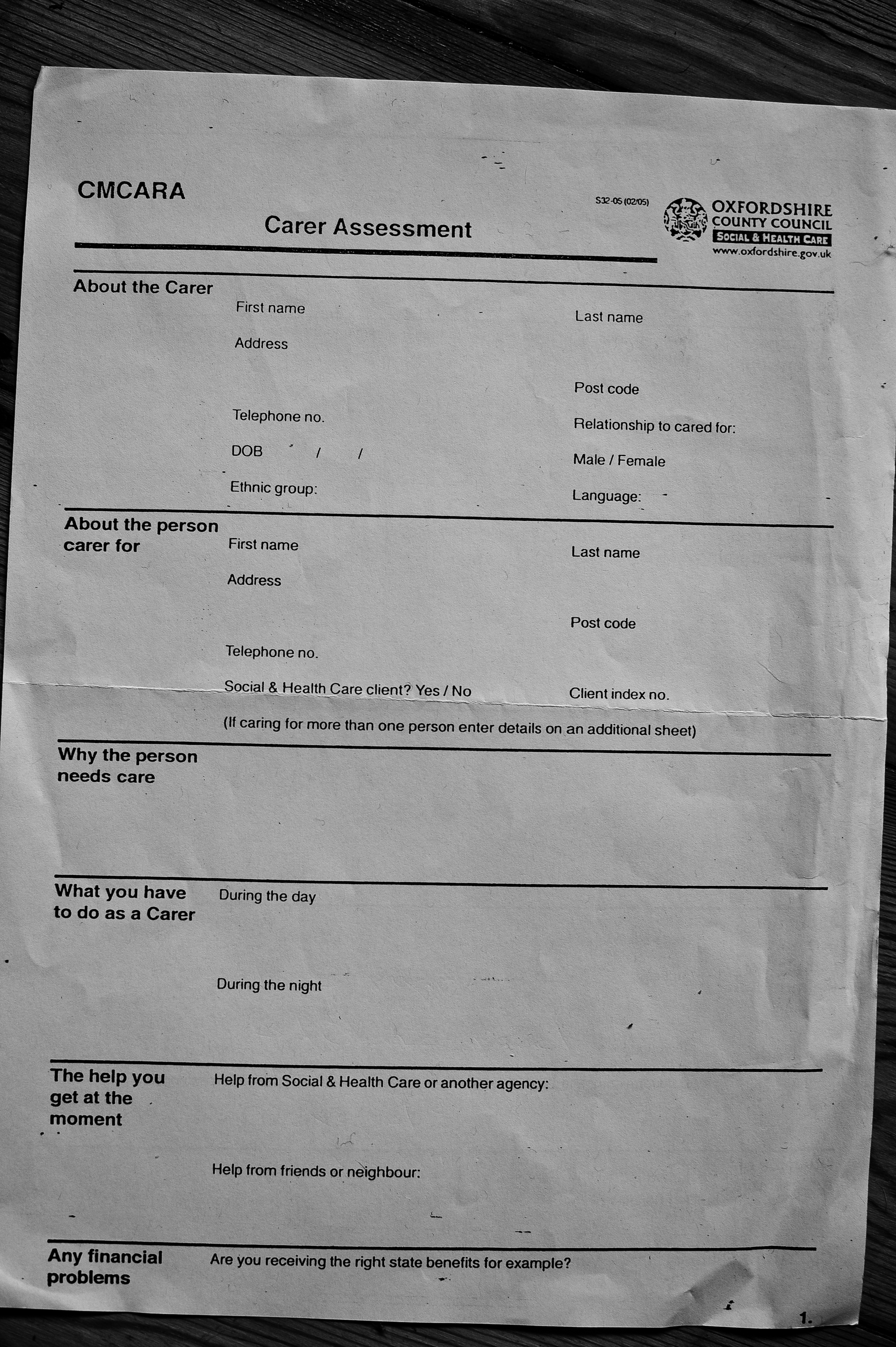
The long awaited Carer Assessment form turned up recently. Regular blog readers will know that I’ve been a bit confused about this assessment, and wasn’t really sure if I’d had one or not. Given that LB is 17 and it was introduced over five years ago, I thought I probably had really [must have surely…?], but I hadn’t.

So. A Carer Assessment turns out to be an A4 piece of paper with statements and prompts on both sides. No instruction, no guidance, just a piece of paper. Not sure I need to say much really. It kind of speaks for itself. I’ll just flag up the bottom of the page (pictured) ‘Any financial problems‘ section, which has got no space to write anything other than ‘yes’ or ‘no’ but includes the helpful prompt; ‘Are you receiving the right state benefits for example?‘ Er, you tell me matey,  And mention my favourite prompt under the ‘How you feel about continuing to care’ section on page 2; What would happen if you couldn’t care any longer?‘ Er, you tell me matey.

Not sure which dozy bunch came up with this ‘assessment’ but if I was marking it as a student assignment, it would get a big, fat fail.


Beyond shunned, trust and what?

LB’s now been back from his five day PGL adventure for three days. And all we know is that he was ‘shunned’ by the boy he shared a room with, he went abseiling and ate chips. He says he had a good time. He says his room mate scared him. He says he had to sleep with the light off, which also scares him. He says he doesn’t want to go again. But then he didn’t want to go in the first place.

Oh, and I also know there was a ‘staff change’ on the Saturday in the middle of the trip.

This was LB’s first ‘adult’ holiday. It was organised by a care provider company who seem to have a good reputation. As I wrote earlier, there was no choice involved. We haven’t been shown any evidence of the ‘quality’ of this company (or any other company for that matter). The local authority obviously use this company but that don’t mean diddly squat. The company has glossy brochures. A bouncy, cheerful worker does home visits and gets the forms signed. A cheerful woman picked him up and dropped him off. There is a cracking performance of bright, breezy and cheerful. But what do we really know? There’s that screaming question; Why should we trust you?

Maybe I’m being overly protective. Maybe LB went off, had a great time and loved every minute. I hope so, but that’s not the point. It just ain’t good enough. I know, historically, learning disabled people have had a crap deal, but the current context of Winterbourne, the crapheap that is the CQC, the increase in hate crime against disabled people, and so on, is hugely concerning. LB, like many other dudes like him, is vulnerable. He doesn’t have a malicious bone in his body, is loyal, loving and great company. But he doesn’t have any resources to defend himself.

I don’t like this discourse of ‘care providers’ when profit is often be the motivating factor in their operation. What ‘care’ are they providing? Are they ‘caring’ or is it more about containment? I have no personal issue with the particular company that was involved in this holiday. I have a broader issue with the way in which LB has already taken his first step into adult (almost) services and already the foundation of lack of information, choice and control is laid.

Oh, and a ‘staff change’ during a five day holiday with a group of young people like LB, in my book, is a complete fucking no no.

Sunshine, support and fluffy dogs

Old social worker: So I think if you are hoping that LB will eventually move into supported living, he needs to get used to staying away from family…

Adult social worker: Well there’s always respite at Saxon House.

Me: Mmm.. I’m not sure he’d want to go there for respite.

OSW: Oh no. Definitely not. [laughs] He hates ‘the disableds’ does LB [laughs]. He is hilarious. You haven’t met him yet but he comes out with the funniest things. [starts crying with laughter] He sat there, looking at me last time and came out with these one liners. He is totally comical…[wipes eyes]

ASW: Well there’s always Camden. That’s run more like a hotel than a respite centre. It’s like walking into a hotel and it’s all set up like a hotel. There’s a couple of them locally and I think there’s one at the seaside. And actually, you’d be surprised how many people don’t see themselves as disabled.

Me: Wow!!! Camden sounds amazing.

OSW: Oh yes. A hotel? That sounds right up LB’s street.

ASW: Well it’s all about choice these days. You know. Personalised budgets and choices.

Me: [floats off into some imaginary space full of sunshine, fluffy dogs, support and services]