Stupefying Bubb and the light fantastic

A while back, Simon Stevens, NHS England CEO, appointed/commissioned Stephen Bubb to chair a steering group looking into the provision of learning disability services/assessment and treatment units. I dunno if anyone understands why. Bubb’s final report was published earlier today. The report can be read here. I’ve not read it.

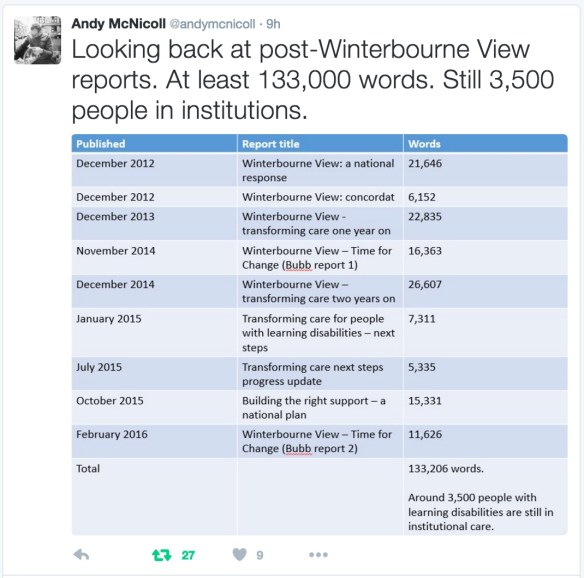
Andy McNicol did a cheeky bit of totting up earlier:
cc


His word count doesn’t quite capture the stampede of activity. Back in the day. The ill informed, knee jerk, caught on the hoof, government response to Panorama scenes of abuse. Flattened by a bunch of organisations (48 in total) scrambling to get piece of the sudden, unusual and unexpected funding.

Some years ago now, Tom got a Harry Potter game for Christmas that involved wand waving and repeated half whispering/hissing ‘stupefy’. I’ve not read Harry P nor seen the films but we did a lot of ‘stupefy’ hiss/whispering that year.

Dunno why but this word kept dancing around my brain when I read the responses to Bubb’s offering. I googled and learned what every Harry Potter fan knows. It’s a ‘stunning charm that renders people unconscious and halts moving objects’. And the more wizards aiming at the same target, the more the power is increased.

Ah. This may have legs. What trickery is being woven by the usual suspects around the latest (non) report? All firing at the same target [no real change].

  • That the abuse of learning disabled people only started with the Panorama expose. There is no pre-Winterbourne View.
  •  That “now is an opportunity to restore faith, where so far there has been repeated failure, and build the community support people with a learning disability and their families want and have been promised.” (Mencrap/Challenging Behaviour Fundation) Those of us not under a stupefy spell (and with access to the internet) can remember how back in November 2014 they were bleating on about welcoming “much of what is included in Sir Stephen Bubb’s report, but it must now lead to a clear plan and urgent action.” Same words. Different order.
  • National Autistic Society wizardry? The Bubb recommendations are “good and should be considered carefully by both the Government and NHS England”. Stupefy 
  • And the government response… A half arsed refrain of ‘there may be trouble ahead’ coated with super stupefy moments;  ‘”it is believed that…” “transforming care for thousands…”
  • Oh, and no mention of the Mazars review.

These made up responses to a made up report continue to erase history, erase life, erase hope and deny imagined futures. No one in any position to do so has the guts to call it for what it is. And the grotesque dance continues.

What a bunch of fucking losers.


Right Betfred, IPSIS and the ‘statement of hope’

L1017863

We’ve been racking up some toe curling and often parasitic meetings since LB died. Pretty much all involve travel (at our expense), time (unfunded) and no apparent change or tangible outcome. Two immediate lowlights stand out. The Monitor six minute jobby of course. And a shindig with other families at the House of Commons organised by Mencrap and the Challenging Behaviour Foundation. Our role; looking sad and waving A4 laminated photos of our kids (produced without discussion or permission) to order at the All Parliamentary Party Group on Learning Disability. Rich walked out. I didn’t. Shudder.

A ‘relatives day’ was organised by the Independent Patient Safety Investigation Service (IPSIS) Expert Advisory Panel (EAG) last November. IPSIS is another meaningless [not sure what to call it really] venture? Endeavour? Nah, too generous… Job creation/sustaining scheme?  Dunno. Thing. It was announced last July as part of the gov response to various reports into safety in the NHS.

Like the Winterbourne Joint Improvement Programme (JIP), IPSIS does nothing like it says on the tin. The Winterbourne JIP generated no improvement. IPSIS ain’t independent. It’s based in the Dept of Health and the Expert Advisory Group Chair is Mike Durkin, National Director of Patient Safety, NHS England. Hilarious really. Although it ain’t because there is a very clear need for independent scrutiny of deaths in NHS trusts.

Anyway, the IPSIS EAG [sorry] has met about 10 times so far in six months probably at enormous public expense. Meetings are held in London at the Royal Society. From what I can glean from meeting minutes it’s come up with a name change (something instantly forgettable), a promised final report and the decision to appoint a Chief Investigator by the launch of the service in April 2016.

I know I’m becoming sourer than a lemon sherbert but I suspect the final report and new Chief Investigator post were decided before the IPSIS EAG was convened. So this bunch have come up with a name change. And been battered by random decisions imposed from above. (Independent) investigations will apparently be limited to 30 cases a year (?) and will (apparently) focus on maternity related deaths in the first year (?) There will be a focus on learning, not ‘blame’ and disclosure of findings to families is to be determined on a case by case basis.

There is something I find pretty uncomfortable in all this IPSIS stuff which is deeply influenced by learning from the aviation industry (a human factors approach). Jeremy Hunt gave us a human factors speech when we met him and it always comes across a bit too evangelical and cult like to me. And it involves secrecy and prioritising staff wellbeing over families who want answers and accountability.


[New paragraph]

To be fair to the IPSIS Expert Advisory Group they have clearly been concerned about independence, although to little effect. This extract is from the December minutes:

eag1
eag2

A statement of hope. Christ. Trusting the NHS?  What a load of bollocks.

The ‘relatives day’, in November, was a variation of the laminated House of Commons photo waving gig. Bereaved families were asked to be filmed for the Department of Health to use in promotional materials for the launch of the (branch) service this spring. We’ve heard some families agreed to filming and then withdrew their permission after it became clear the whole day was a PR stunt. Just dire.

What really stinks about all of this is that families engage with these meetings because we want change. For what happened to our relatives not to happen to anyone else. Instead, we are engaged with (momentarily), at a time and place dictated by the NHS, or related organisation/charity, offered a fake whiff of change, have a bit more life sucked out of us and then spat out until the next time.

The IPSIS (Branch) EAG might just as well spend the expenses allocated for their final meeting/s in the nearest bookies they can find to the Royal Society [Betfred on Gerrard Street].

Or withdraw from the whole fake process.

But they won’t.

L1017826-3


Questions from the public

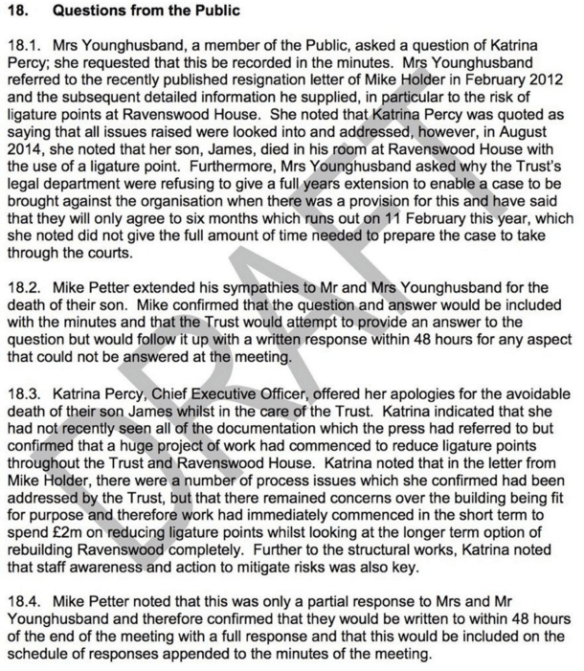
A short post. I read this extract from the latest Sloven board minute papers last night and had one of those moments when I couldn’t see the screen for tears. James should not have died. Mike Holder wrote to Katrina Percy in 2012 detailing the safety concerns he had. These concerns were ignored. The CEO and board didn’t care.

Mrs Younghusband should not have to go to a NHS Trust board meeting to say the unspeakable.

There is a clear and incontrovertible link here between corporate decision making and James’ death. And the slimy Sloven bastards tried to stop Mrs Y from taking civil action by limiting the time she has to act.

The lack of action by those who should be acting (Monitor, Department of Health, NHS England, CQC, yawn-di ya-di da) makes me wonder when most of the principles guiding the NHS were ditched? Southern Health NHS Foundation Trust is no part of a National Health Service I recognise or believe(d) in.

Board meeting

This ain’t going away

L1017467-3

Mid Feb. And no action about the Mazars review. Extraordinary. I watched a documentary last night from 1981. Silent Minority. By a filmmaker called Nigel Evans. (He died recently but there are several of his documentaries on youtube and I recommend dipping in. A remarkable archive.)

Earlier today someone asked me if I thought anything will happen with the Mazars review. A question I think we never thought would be asked, back in the summer of 2015, when early findings were shared with the review panel.  The findings evidenced a barbaric disregard for the human rights of certain people that could only be a matter of national importance. The leaking of the Mazars review, and subsequent debate in the House of Commons on December 10, supported this.

And then tumbleweed.  A cynically timed ‘offical’ publication date just before crimbo and crap all meaningful action by NHS England, Sloven, Monitor, CQC and Jeremy Hunt since has generated serious despair in the Justice shed.

This negativity was reinforced last week after listening to an update about the Learning Disability Mortality Review programme (LeDeR) based at Bristol University last week. A watered down version of a national mortality review board because the government (previous and current) thought premature deaths of learning disabled people weren’t worth proper funding.  A piecemeal programme with little independent scrutiny and rigour (and unfunded public involvement).

L1017464

Strangely, I started feel more positive today. Helped, in part, by various tweets, emails, facebook posts highlighting the obvious lack of fit between ‘official’ talk and people’s lives. And regular emails/messages relaying sometimes small changes and shifts. Unlike in 1981, social media allows a diverse range of different people to collectively come together, contribute, support and do stuff. #JusticeforLB is increasingly known about in a way we never imagined. In March a short play by Edana Minghella about LB will feature in Twelve Angry Women in Brighton. The Justice quilt will be on display at the Kings Fund next week. Plans are underway for a late evening choral event alongside the quilt in the Warwick University Arts Centre in the summer. 

The Mazars review clearly highlighted eugenic practices embedded within the structure and processes of at least part of the NHS and social care. This ain’t going away. And the non action by those who should be acting is starkly visible. The atrocities highlighted by Nigel Evans (among others) which continue today in different versions remain beyond wrong. We have options he could only have dreamed of back in the day when the content of his documentary was challenged. That his work is freely available on YouTube underlines the potential for social media to render these happenings visible and ensure they remain so.

L1017478-3
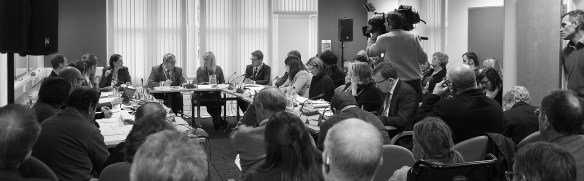
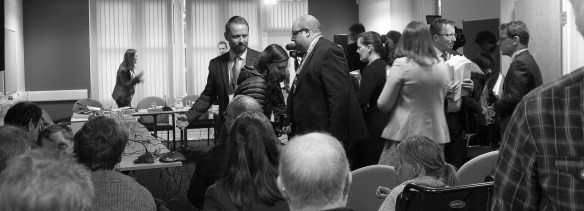
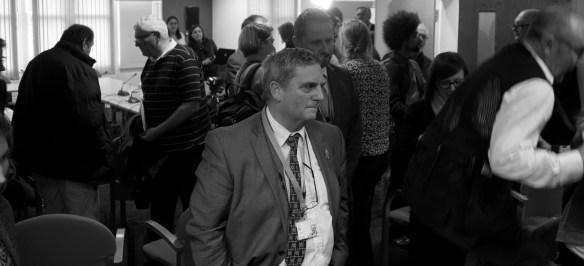
[Photos are from the recent extraordinary Sloven Board meeting. Thanks to Saskia Baron for the Nigel Evans link]

Postscript: Bizarrely, just a few hours after posting this, Rob Greig published this article in Community Care, saying similar.

Useless eaters, human ballast and empty husks…

L1017859-2

Bit of a convoluted ramble tonight. Sorry, but hopefully it makes some sense.

James Titcombe found out this week that Morecambe Bay hospital paid £42,123 in legal representation and attendance of communication staff at his son, Joshua’s, inquest. Early this year, My Life My Choice (and Michael Buchanan) found out that Sloven spent £318,121.20 on legal representation at LB’s inquest. It’s not clear if this figure includes preparation for the four pre-inquest review hearings. It doesn’t include the costs of Sloven staff attending the inquest. [It became a daily activity to spot Sloven (and Oxfordshire County Council, NHS England and Oxford Clinical Commissioning Group) bods loitering around the public gallery. Lacking the lanyards typically worn, they were identified by furtive awkwardness.]

This cost could only have been spent in an attempt to limit damage to Sloven’s reputation. What happened to LB is undisputed. Sloven said back in February 2014 they accepted the findings of the first Verita report which found that his death was preventable. Why would they need (external) legal representation at an inquest which is supposed to establish what happened rather than attribute blame?

How did we move from this (clearly fake) position in Feb 2014 to a space in which eight barristers (and accompanying solicitors) jostled for table space at the front of the courtroom? Sloven were culling staff (or ex-staff) from their legal umbrella pretty much up to the start of the inquest. But bizarrely included in the dosh spent is £90,000 on legal fees for staff they didn’t represent. Eh?

Total absurdity.

Sloven’s response was clearly to chuck unlimited dosh at trying to grab a genie that had well and truly left the bottle. A social media related genie.  Mike Petter, board chair and member of the Sloven leadership trinity, told My Life My Choice:

petter shite

Jaw dropping duplicity. Like most (all?) Foundation Trusts Sloven have an in house legal team. Unlike families who are catapulted into a space of abject horror and distress, usually with little or no legal knowledge or support. Petter doesn’t explain why Sloven brought in an external solicitor and barrister. Or why they contributed to the costs of staff members they didn’t represent. (Or why they didn’t make this clear at the beginning of the inquest when we were led to believe that there were six other independently represented Interested Persons…)

I bumped into a lovely neighbour earlier. She’s been a teaching assistant for over 30 years at the junior school Rosie and Tom went to and follows the campaign.

“All those hundreds of people”, she said. “And they didn’t know…”

I think ‘they’ did know. How could they not know? They knew but didn’t think it was important that (certain) people were dying prematurely. I’m reading Neurotribes at the mo. The go to book about autism by Steve Silberman. Earlier today I read this;

image (21)

Life unworthy of life... Nearly a 100 years ago Hoche and Binding produced a simple and effective framework for understanding contemporary provision of health and social care for learning disabled people in the UK.

Wow.

Just got to make sense of how a public body could squander over £300,000 on LB’s inquest now…

L1017831-2

What the foodles?

Rich sent me a link to this story this afternoon. The Star Wars production company, Foodles, is being prosecuted on four criminal charges by the HSE for an incident in which Harrison Ford broke his leg. A year after LB died. He died.

[Howl].

Meeting Jeremy Hunt

Struggled a bit with the thought/context/rational for meeting Jeremy Hunt today, especially after reading Imogen Tyler’s powerful JusticeforLB post this week. The administrative grotesque. Highlighting how rituals like meetings and emails may expose the ridicule of people in power but perversely strengthen the legitimacy of the power holder. Shudder.

Disquiet in the Justice shed.

To meet or not to meet? How many meetings have we attended? What has actually happened? Other than ticking the ‘met the bereaved family/campaigners’ box. Reinforcing the the power of the meeting host while sucking the life out of #JusticeforLB?

Why have none of these NHS/social care meetings happened in spaces convenient to us?  Or other families in similar situations? The administrative grotesque could be subverted by the powerful travelling to meet those who experience state atrocities. The brief meeting with the Leader of Oxfordshire County Council. And the impossibly briefer meeting with Monitor would have been a different experience without the six hour journey/cost involved. But nah. Meetings are firmly on the terms of those who wield the power. You make the time and stump up the emotional and financial cost to attend these or you don’t/can’t.

Expectations today were set firmly at low to ground level with that blooming hope light, the light that (remarkably and probably stupidly) hasn’t been fully extinguished, still flickering. He won’t… but he could.. but he won’t… but he could… flutterings of naivety.

Deb Coles, Rich and I met for a pre-pre meeting at the National Gallery café and thrashed out what we hoped to get from the meeting. We met Andrew Smith, our MP, in Portcullis House for a pre-meeting. Formulating more of a plan. And then set off, through the backside of Portcullis House to the Department of Health (or Death if you’re learning disabled).

At this point, spirits were reasonably high. We had a bit of banter from a Dept of Health employee who cheerfully snapped us outside the building. A before pic.

hunt

I’ll unorder the story at this point and leap ahead to the debrief after the meeting. Deb and Andrew (who were both superbly supportive and good company throughout the afternoon) offered the following reflections and cheeriness.

  • It’s brilliant to get a meeting with the Secretary of State.
  • He clearly listened carefully and was affected by what was said.
  • He took away from the meeting three action points which are steps in the right direction.
  • Change takes time.
  • He was genuinely sorry about what had happened and the treatment we’ve experienced since LB’s death

The meeting started 15 minutes late with the announcement it would need to finish in 30 minutes because of a voting commitment. Two pre-meetings worth of stuff to cover immediately compromised. Eek. Just how administratively grotesque would this be?

We started. Vaguely focusing on the five points Andrew outlined at the beginning. Pretty soon I felt despair at the futility of the discussion. Sitting in a comfy cream armchair in an office that is the stuff of dreams, with a couple of people doing something silently behind us, Jeremy Hunt listening carefully. When Rich summarised our experience of Sloven shite across 2.5 years I wondered how these words could possibly be spoken without some immediate action; criminal, regulatory, resignatory or otherwise. The brutality of the experience remains extraordinary in the lived experience of it but also the non response to it.

A few hours later, sitting on a train to Cardiff with a lukewarm plastic glass of wine, I’m beginning to make better sense of it. Here’s my half formed thoughts:

JH was firmly in a space of making some innovative and committed changes/approaches to improving patient safety and changing NHS culture around safety. A bit too heavily focused (uncritically) on learning from the aviation industry for my liking but clearly passionate about improvement. The trouble was he subsumed the issues thrown up by the Mazars review into these more generic changes to NHS culture.

We were arguing that the lives and deaths of learning disabled people (and people within mental health settings) in the NHS demanded increased scrutiny particularly given the Mazars findings. If a group of people are consistently dying prematurely some sort of national mortality review board/ independent investigation mechanism is essential (unless we all agree that shit just happens… to, erm, particular people).

The meeting was brief and pretty forthright. The action points JH decided on involved some revisiting to check originally actioned points arising from the Mazars review were as robust as they could be, looking closer at the actions of the Sloven senior team and making sure the CQC inspection regime takes a more holistic view of people’s lives and aspirations.

Was it a good meeting? No comment.

Non action and a ‘Licence to kill’

During a departmental meeting today, a colleague gave a talk about a project he is involved with; Human Resources for Healthcare in Africa. Part of this work is focusing on how to reduce the shocking mortality rates of children under 5 in Mali and Uganda.

He talked about the drop in mortality rates that emerged as an outcome of the setting up of the Confidential Enquiry into Maternal Deaths in the UK in 1952. Setting up an enquiry into deaths in Mali and Uganda seems to have, similarly, led to a drop in mortality rates. One reason being that once healthcare professionals knew that these deaths would be investigated, they started paying more attention to the care they provided.

Leaping to this talk from mundane discussion around office moves and desk space left my head spinning.

…once healthcare professionals knew that these deaths would be investigated, they started paying more attention to the care they provided.

As simple as.

Meanwhile, in the UK, talk of setting up national board to look at the premature deaths of learning disabled people after the shocking mortality rates identified by CIPOLD was watered down into a mortality review programme. Seemingly serving a ‘pointing to’ function. ‘Look… Bristol University are doing this.’

…once healthcare professionals knew that these deaths would be investigated, they started paying more attention to the care they provided….

And once health and social care professionals/organisations witnessed the abject lack of any substantive action by the government response to the Mazars findings they all got a symbolic ‘get out of jail free’ card.

No reason to pay any more attention to the care provided.

Business/death as usual.

L1017104-6

A shave and a haircut… the CQC way

Lengthy twitter discussions earlier today following on from news of the 80 bed unit planned up in the North East, blogged about by Mark Neary yesterday. The proposed unit is to be run by the same manager of the Lenore Care Home in Whitley Bay which had a pretty positive CQC inspection report in June 2015.

cqc ratings

The two sides of the twitter discussion today can be summarised (roughly) as:

This home is well run, ‘residents’ reported good quality of life and the proposed unit could be equally as well run for people to lead independent lives without becoming isolated in the community.

The CQC report findings don’t capture anything approaching a typical home and it ain’t remotely likely that the proposed new unit will be ‘home like’. It represents a return to institutionalisation.

I wrote a post soon after LB died about accepting the unacceptable. Something people, parents, carers, health and social care professionals do. For different reasons. The unacceptable becomes unremarkable and the norm. And we use different criteria to judge the treatment certain people receive.

So let’s have a closer gander at this inspection report. Thinking about what is typical for many/most people. Rather than typical for a few.

The 23 bed ‘care home’ has 21 people, a manager and three staff on during the day, two staff on sleeping over duty at night. I assume there’s a range of different aged people living there. Learning disabled people tend to be lumped together in an ageless way. Which is pretty grim.

The inspection involved observation, interviews and reviewing documents. There are a lot of positive comments; friendly, supportive, well trained, supervised and informed staff. People were clearly supported to attend health appointments and the manager was praised by people. There was a dog that one person looked after to learn about keeping a pet. All good.

A big part of the dispute on twitter revolved around the clear lack of available support to enable people to go out and about. Such a small number of staff meant that, if people weren’t able to take themselves off, they’d be stuck indoors. We don’t know how many people were able to go out without support from the report. An important omission.

Alarm bells rang for several reasons:

  1. A finger print keypad security system. 
  2. Computers available in the communal lounge and staff supporting people to stay safe when using the internet. 
  3. ‘The food is good; always two choices on the menu and you choose before 11am.’
  4. The provider continued to be the corporate appointee for a small number of people living at the home with regard to their financial oversight (plans to change this apparently). 
  5. A resident saying “I feel safe. I hardly ever go out because it’s safe here.” 
  6. No one at the home was currently accessing support from an advocate or advocacy service.
  7. At night people could call for assistance through the use of buzzers in their rooms or by knocking on the staff room door.  
  8. There were no specific care plans or instructions in place to indicate when ’as required’ (PRN) medicine should be given.  
  9. ‘We looked at the social activities records for people that were updated on a daily basis. This document was task based and most recent comments noted only that people had been given a haircut or a shave

You can read into this report that a small bunch of good staff, lead by a thoughtful and competent manager provide a (pretty much safe) and well run outfit. Or you can think about people’s lives. About potential, aspiration, social interaction, fun, work, engagement, holidays and so on. Most of which seem to be absent.

Has everyone got fingerprint access to come and go? Why has no one got their own laptop or tablet, and is there no wifi? Why, if the aim of the home is to prepare people for independent living, is no one involved in shopping, cooking or choosing food to prepare/cook?

Why have none of the 21 people got advocacy support? Surely some would need it?How can the provider be in charge of people’s finances without external scrutiny? How can people never leave their ‘home’ and this not be queried? Does anyone go out in the evening (the emphasis on the buzzer situation suggests people stay in/in their bedrooms)?

How much PRN (which is typically sedative type stuff) is given to people and how often? And why are no social activities recorded other than personal hygiene activities?

Oh, and the biggy. Why are 21 adults living in a ‘care home’ in the 21st century?

L1017348

Nothing in this report suggests anything approaching what I would describe as home life. Quite the opposite. Which raises the question; how often do CQC inspectors use the unacceptable as the bar for good, or good enough, when it comes to learning disability provision? [And the answer should not involve mention of ‘experts by experience’].


Hey, how about we just stop with the pretence?

We’re a reasonable bunch in the Justice shed. [Yes, really]. And we pride ourselves on remaining reflective about and engaged with the constant shite we’ve experienced over the past 2.5 years. We’ve absorbed the slurs, the smears, the deceit, the obstructions, the bullying and the wilful refusal by anyone involved to take responsibility for (or even care about) LB’s death and the hundreds of other deaths that happened under Sloven’s watch.

The extent of Sloven failings get worse on a weekly basis. We’ve now seen first hand the utter incompetence of the CEO and Board. A spectacle that continues to make me feel queasy when I think about it. We know that NHS England, the CQC, Monitor, the Department of Health, Oxfordshire County Council and Clinical Commissioning Group lack the guts (individually and as organisations) or interest to do anything substantive. There is no Monitor Improvement Director. We know Mencrap is about as far removed being the ‘voice of learning disability’ as is humanly possible.

We can remember the numerous organisations that rushed to sign up to the… er… [scratches head] Winterbourne Con… Winterbourne Con? Con something. And can only guess at the money the Dept of Health flushed away on this ill thought out and useless endeavour. Followed by other incarnations. And croissants. A resounding fail. Leaving countless people suffering. And dying.

The ‘official’ response to publication of the Mazars review revealed everything we need to know. Certain people simply don’t count. Deaths schmeaths. Transforming care plans in tatters and more news emerging this week of re-institutionalisation by the back door.

So. To stop all this tedious and repetitive talk, wasted resources, increasing breakfast waistlines and empty dialogue with grassroot movements, here’s the first draft of an agreement for Trusts, CCGs, local authorities and the various regulatory organisations, Dept of Health to sign. [Lifted from a cleaning contract template..]


This agreement is made between _________________, [NHS Trust, CCG, local authority, Monitor, CQC, NHS England, Department of health… (hereafter known collectively as the Public Sector) and __________ (hereafter known as the public).

The Public Sector agrees to the following:

1. An acceptance that learning disabled people will die early and their deaths do not warrant investigation unless the circumstances are extraordinary. [There are currently no examples of extraordinary. Please contact the Public Sector for updates on Never Ever Ever Events.]

2. An acceptance that learning disabled people shall continue to be ‘placed’ in ‘living arrangements’ typically at the whim of local authorities/commissioning groups.

3.  An acceptance and agreement that these living arrangements should be dictated by budget and efficiency. [The bigger the better the guiding principle here.]

4.The Public Sector shall herewith stop pretending to support and ‘care’ about learning disabled adults.

5. Services to be performed by the Public Sector are to be lowest quality at lowest cost possible. These will typically not include any of the following: going out, encouraging community participation, fun, ambition, delight, encouraging and supporting employment, relationships or a proper home, engagement with families, effective healthcare or investigation in the instance of premature death.

The Public agrees to the following:

6. Sucking up their unrealistic expectations and stop banging on about inadequate, unsafe and poorly funded non care.

7. Either party may terminate this agreement with written notice to the other party.

In witness to their agreement to these terms, the Public Sector and Public affix their signatures below:

_____________________________________

Public Sector signature, date

_________________________________

Public Signature, date


Any additions or amendments to the above welcome. Would be good to get this sorted in time for our meeting with Jeremy Hunt on 3 Feb. He could be the first signatory.

L1017157-4