Mysteries of learning disability ‘care’

Yesterday, I raged enough at the emergency social care guy to get the duty psychiatrist to call me. This is the learning disability team psychiatrist. We had an astonishing exchange that went on for nearly 20 minutes. He kept insisting that, if anything happened this weekend, we had to call the out of hours GP who would give us a prescription for LB. He would email the other psych, who had discharged him, and tell her what had happened for Monday. I tried to explain that when LB goes off on one, he goes off on one and there ain’t really a convenient space to call the GP, collect a prescription and find a nearby chemist. He didn’t get it. LB ain’t his patient. He ain’t seen him. He can’t do anything else.

Blimey, that don’t matter. Dr Crapshite only saw him once before discharging him so no big relationship there.

No dice. He just kept repeating the out of duty GP path. It could almost have been a recorded message.

I don’t get how he can be a specialist in learning disability and have no understanding of what I was describing. I also don’t understand what the point of a duty psychiatrist is if they ‘can’t’ do anything. Stupid, meaningless layers of process that just mean ultimately, nothing happens. Eventually he asked me if LB had got worse recently. “HE PUNCHED HIS TEACHER IN THE FACE THIS MORNING!” I exploded. “Oh, has he not done that before?”  I hung up.

The phone rang straightaway. He’d leave a prescription for lorazepam at our surgery.

“Thank you,” I said.

Comic relief day. No.

LB punched one of his teaching assistants* in the face this morning.

Horror.

I rang the emergency number on his Care Manager’s ‘out of office’ email and was told someone would ring back. The guy called back ten minutes later and suggested a referral to the learning disability team nurse who specialised in challenging behaviour.

“Ok, how long will that take?”
“Well I’ll put the referral through next week and she’ll get in touch when she gets it. I’m not sure how soon she’ll be able to come and see him though.”
“Eh?? Have you listened to what I’ve said?????” 
“Er, sorry?”
What are we supposed to do in the meantime, if he turns on someone else?????”
“Well, I could make it an urgent referral I suppose… Ok. I’ll put it through as urgent then. And there is a psychiatrist too. I don’t know if….”
“She.discharged.him.last.week.
Well I could try ringing her this afternoon.”

Thirty minutes later he rang back.

The psychiatrist had gone home, he’d spoken to the duty psychiatrist; we have to go to the GP and ask him to ‘escalate’ LB to the psychiatrist.

I’m putting it out there now, the support and services for young learning disabled people in Oxfordshire is worst than crap-shite. Unacceptable. Please feel free to pass this link on to anyone in health and social care. Or anyone really. Things HAVE to change. And not just for LB.

*Sue, who has gone about as far beyond the call of duty as you can with LB, including getting in contact with mermaids around the world and sitting around in a stinking, freezing cold workshop every Wednesday, while LB does mechanic training.

Limits and horse-shite

Well the light hearted, fun chit chat involving LB and his unusual take on the world, that partly inspired this blog, seems pretty distant now. I’m glad I captured some of it on these pages. It’s currently masked by reasonably regular extremes of behaviour that are unpredictable, aggressive and deeply upsetting. The trouble is, there isn’t any real (effective, valid, meaningful) support to deal with this.

I got a call at the beginning of a meeting in Manchester on Monday, after a Mother’s Day that included, in equal measure, horror and lovely, lovely love stuff. LB had had a serious meltdown? crisis? situation? at school. It sounded awful and his teachers and the school nurse were understandably shocked and upset by it. I could only say, standing in the corridor, trying not to cry with the futility of the situation, ‘I don’t know what to do’.

Cripes. Well who does know? Who should know?

Er, health professionals? Highly trained specialists who have the relevant knowledge to help LB and guide us through this.

No. Not really.

Trouble is, they won’t say that.There is a faux professionalism that involves sticking to a script that is irrelevant. Without that script there is nothing. LB’s unusual behaviour challenges, tests or confounds the boundaries of their knowledge. And this, in turn, is complicated by the resources available. This is not a comfortable situation for anyone, so we go through the motions in a performative way. Questions asked. Answers given. And they (pick your health professional) ease out of our home. No further forward. No change.

Tomorrow it’s the turn of the (learning disability service) psychologist, who was passed the baton by the (learning disability service) psychiatrist (who did nothing). Our GP embraced her contribution this afternoon in an obviously appalling situation.  I promised to be open-minded when I meet her.

“Can you prescribe something like a horse tranquilliser as well, maybe with a dart gun, for those particularly tricky moments?” I asked. “No,” he coughed, “this can’t be resolved through medication. LB needs help to learn strategies to manage his behaviour, aggression and anxiety. That is the role of the psychologist.”

“Ah, okeydokes,” I said, leaving his office, with my promise taking a hammering.

Choice and autonomy my arse

At the moment our lives are becoming increasingly [hahahaha] complicated as LB has become very anxious and distressed. We’re in a big old hot pot, dealing with support and services underpinned [big fanfare] by the gov’s personalisation agenda. Key principles; Choice and autonomy.

Well this sounds like the baby. Choice and autonomy.. lovely, lovely, lovely. Let’s have a little looky at how this is shaping up eight weeks on;

Social Services. After a complete meltdown that resulted in LB out of school for a couple of weeks, the Care Manager acted instantly to organise a wedge of emergency direct payments for us to buy care. Good. We can choose what type of emergency support we want. Unfortunately, the kind of people who may be willing and able to hang out with a 6ft tall, young man who may, or may not become aggressive, are not that much in supply (and hugely in demand). So in practice, not so goodThe alternative is the Respite Centre with the snooker table. Complete fail. CM also offered to organise a round table meeting. Good. And, after a particularly alarming incident (Episode A), has given me an emergency number to call. Good. Unfortunately, if we call that number we are opening a window for LB to potentially be sectioned. ‘Mmm. Well I’m sure they will do what’s best for him in that situation‘…I hear you think. Not really. ‘What’s best for him’ relies on what’s best for him being available. Not a mental health unit over a hundred miles away in Norwich where two of his class mates have spent months. There is no in-county support for young learning disabled people. That is a complete fail.

Health. The GP instantly prescribed anti-depressants over the phone without hesistation. Good (in the sense he took our concerns seriously, not that LB is now on more medication). After LB mumbled something about suicide near some professional type person, he was whizzled into a same day appointment with a psychiatrist. Good. (Well a bit weird that the concerns we have are largely ignored but one word gets instant attention). The psychiatrist asking LB if he felt suicidal was a complete fail. Never, ever put ideas into that boy’s head like that. She then, after a telephone appointment 6 weeks later, discharged him. Not so good. ‘Why are you discharging him?????’ I asked, seconds after I’d told her about Episode A. ‘He was referred to me because of the concern about suicide, now that is no longer a concern, the psychologist will help him to manage his anxiety.’ Not so good [and given our experience with psychologists over the years (star charts anyone?) suspect this detour will be a complete fail].

So what are we left with? Money to pay for care. No care to buy. And no one doing anything to help LB become less anxious.

Choice and autonomy? Feels a teeny bit flaky to me. Can we have some action?

The outing

Today was a funny day. I went to Bristol to meet two women I’d ‘met’ through Twitter, Alexa and Kate, to visit a social enterprise scheme called Props.  It was hilarious meeting people through Twitter. Eh, who? What? Where?

I chuckled as I walked through the ticket barrier at Bristol Temple Meads, wondering whether I’d actually meet them. Especially as I had in mind we were meeting at Bristol Parkway which is so much smaller.  But there they were. Freezing and big smiles. Kind of recognisable through avatars and the odd tweeted photo.

By the time we were sort of (but not really) lost looking for the Props base somewhere in Bristol, I felt I’d known them both for years. We laughed. And connected tweet snippets from past months with shortcuts forged by the experience of having less than straightforward kids. Loveliness.

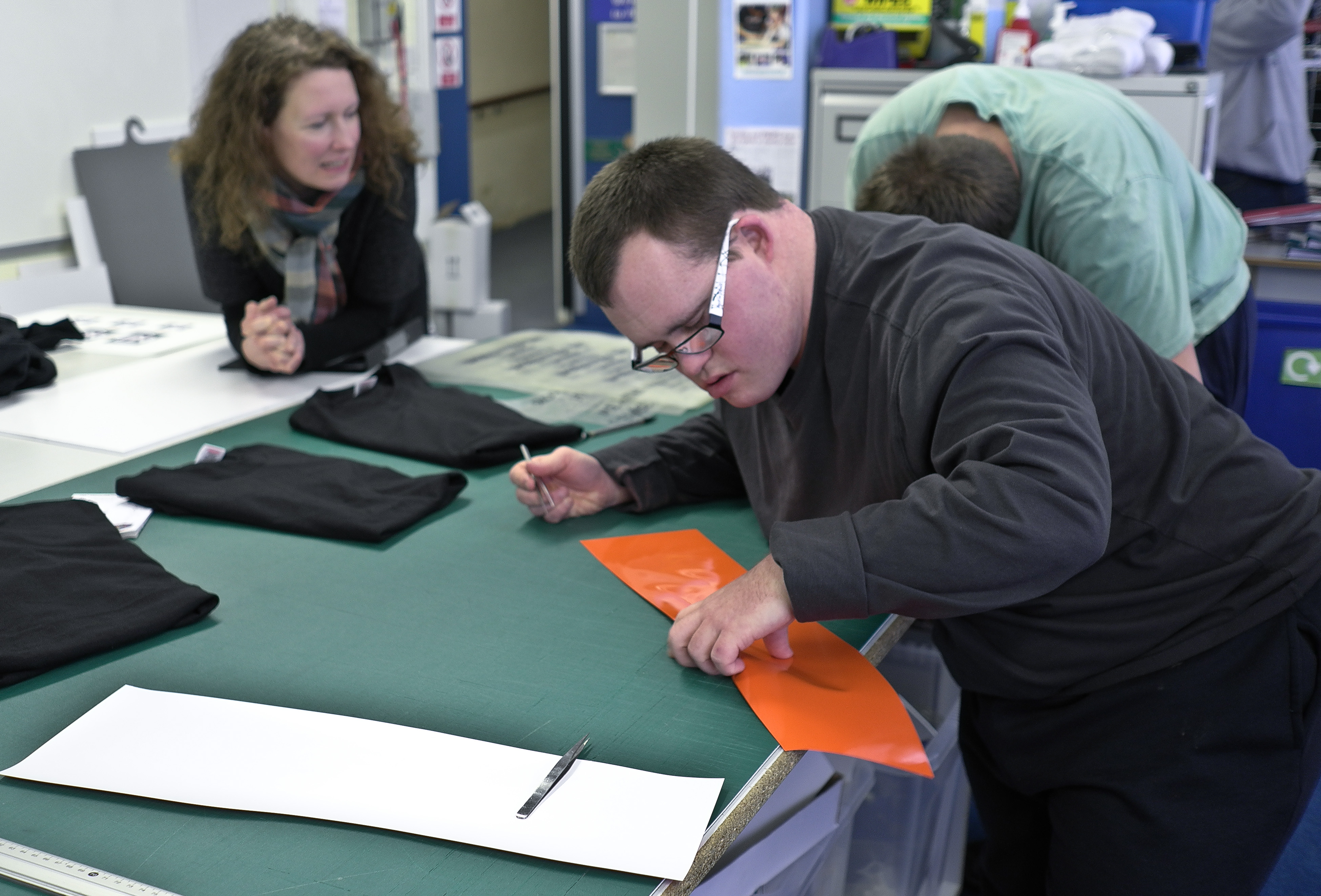
But the outing was about Props. And Dave and his crew delivered. Big time. Basically it’s a space for disabled young people to learn, work and flourish. As part of the community with a strong commercial focus. We hung out with Matthew and Jethro. Matthew was hugely impressive. He worked his socks off in an understated way. Making drinks, tidying up, keeping an eye on Jethro’s work, and demonstrating a sophisticated engagement with the tasks involved in print room work. Jethro added the comedic dimension to the visit, with hilarious one-liners and an easy engagement with everyone that I would love a dose of. They both shone.

And made us some great t-shirts.

ryan5-56

ryan5-55

ryan5-54

Wowsers, I hear you say. Social services must be chucking money at this organisation.

Of course they ain’t.

Boundaries

It’s a tough gig bringing up a disabled child. Yep. It shouldn’t be, I know. Appropriate, timely and sufficient support would make a huge difference. And a seismic shift in public attitudes. Of course these things overlap and I ain’t optimistic for all sorts of reasons that they will ever happen. But if they did, there would still be trickiness.

Take this morning. We’re in the midst of pretty dodgy times with LB and he’s booked into Parasol for four days for half term activities. A charity organising and supporting young disabled people’s access to, er, fun. Yep, it’s as simple as that.

But…

“IDON’TWANTOGOTOPARASOLMUM! I’MEIGHTEENMUM! YOUCAN’TMAKEMEGO.I’MGOINGBACKTOBEDMUM!”

Like his two younger brothers who will probably sleep/doze till lunchtime. Sigh.

All sorts of thoughts and considerations….

You’re kind of right…
We don’t want another major kick off….
You can’t watch youtube all day….
We’re both working today….

“You’ve got to go.” I said. Some ranting and raging. But at a low level. And he’s off to the Kassam Stadium for a day of bowling and cinema.

Now Parasol is an enigma to me. They organise a range of activities in and around Oxford. You drop your child off at stated destinations; outside the Playhouse in the town centre, or in the ice rink car park. Or at a local community hall. Believe me. This is seriously weird to a parent subjected to years of constrained, heavily policed and overly organised out of school child care for the ‘special needs child’.

Eh? Leaving LB at a community centre with the doors wide open, kids in the car park, and helpers running around having a laugh in squirrel onesies? Hello? These kids are runners, you know?! They’ve got no sense of stranger danger or road safety???? Hey, the door is open!!! Anything could happen. Anything! You hear me???

The organisation of Parasol appears chaotic and random.

But it isn’t. It’s run by and staffed by exceptional people who enjoy the kids, understand difference and get out there and get on with it. With impeccable leadership. And, in doing so, they allow some freedom, independence and fun for this group of young people.

Anyone who takes LB, and ten or more other young dudes, to watch Les Miserables (at an ‘ordinary’ showing) is cracking on in the right direction in my book. We all just need need to catch up with them.

Whose story is it anyway?

Got my first negative blog comment (on the ‘about’ page) this week. From someone from the masterclass of all places. Anyway, it raises the issue of should I be writing about LB on this blog? What right do I have to do that? And shouldn’t he be telling his own story?

Well the latter is easy to answer. Yes, of course he should. If he wants to.

The other questions are less straightforward. I had a long chat about this recently with a colleague who has a long term condition. She said she felt a bit irritated by her mum always telling her story over the years. And still.

Tricky.

I don’t think people have their own, exclusive, story. Disconnected from those around them. There are multiple stories that overlap with other stories. On this blog, I’m not telling LB’s ‘story’. I’m recounting the experience of being LB’s mum.

I think it’s important to share these experiences not least to raise awareness of the lack of support for learning disabled children/adults but also because LB’s ways of being and doing makes visible mainstream practices that are taken for granted and unquestioned (see The Unlikely Ethnographer).

It has also had (the unanticipated) consequence of providing other people with a way of chatting to him and about him, and asking after him or about him.  It’s given him a space to be known. I kind of knew (but being immersed in the everyday chaos that comes with a less straightforward life didn’t really do anything about) how difficult it is for people without experience of difference to engage with it. This meant that LB was often not a part of my interactions with the wider world. Now he is. In an ordinary way. As a funny dude who loves lorries.

Chewy stuff.

ryan5-52

A building with a snooker table

LB’s been off school a week now. Unmanageable distress associated with school, which manifests itself in violent outburst (towards himself and others), has led to a kind of informal home arrest. Home where he is largely a chill pill. Home which ain’t ideal when we both have full time jobs.

School are going to try to sort out some way of him returning part time. The plan was for him to stay at school until July 2014. A ‘mental health’ referral has been made with no one involved optimistic that this will happen within 4-6 weeks.  The care manager (who had discharged him after success at panel finger nail blackboard towards the end of last year) called today to sort out some sort of interim ‘care’ for him.

“Well he can go to respite pretty much straightaway…”
“What do you mean by respite?”
“He can go to Saxon Way. Into respite. I can get the manager to call you.”
“Sorry, I don’t understand. What is it exactly?”
“Well it’s a building.”
“Eh?”
“It’s a building with a snooker table and other stuff to do. He can stay there or maybe the staff will take him out into the community. Or if you prefer, some staff can come to your home and look after LB there. The advantage is, it’s pretty much an instant solution.”

So, after apparently huge shifts in the organisation of social care in the UK, the development of aspirational thinking around person centred care, and having spent 16 years in education, LB is consigned to a building with a snooker table. At the first hurdle.

I don’t get it. What about his future? His life? His capacity to be meaningfully productive in some way? He’s 18 years old and should be looking forward to the start of his adult life, some type of employment and everything that comes with that. Not written off and stuck in a day centre waiting for a half arsed referral to fictional mental health support. Seriously?

I must be missing something.

Surely.

A letter to the woman in the restaurant

Dear woman in the restaurant,

We were the people you spent your meal staring at. Or was it glaring? I’m not sure. It was fixed and unwavering which ever it was. And it made the situation so much worse. I’m not going to apologise for LB’s behaviour. He was stressed from the start (getting stuck in the revolving doors on the way in probably didn’t help), but for the most part he managed to keep a lid on it. He muttered to himself a lot, and tensed his body regularly, but only a couple of times did he actually do anything that could have disturbed your meal. Two, possibly three, very brief shout-outs about his fear of Irish lorries being stolen.

As you were staring so hard, you may have noticed that the three of us, Rich, Tom and I, were all working hard to try to keep him calm. There was a lot of talk of the security arrangements at Irish lorry companies and attempts to distract him with a running commentary of the Oxford buses driving past the restaurant. A lot of remedial work, as Erving Goffman, would call it. To be honest, this work was largely try to stop LB experiencing such stress rather than concern about other diners.

I’ve sat in plenty of places and had to listen to other people’s conversations because they talked so loud, I’ve listened to people shouting on mobile phones, sat near parties of people being drunkenly cheerful and excessively noisy. These people don’t get stared at. These behaviours are tolerated.

I’m not sure what you were hoping to achieve with your staring. To let us know some social rules were being broken? To let us know that young people like LB are not welcome in public places? Or to demonstrate that your meal was ruined? The latter would be peculiar. You were sitting far enough away not to look at him, and, as I said, other than the quick shouts, he was pretty quiet.

It was my birthday lunch. I wanted LB to be there (obviously), and don’t think it is (or should be) a big ask for you to just get on with your meal and ignore the odd disruption. Anyway, we got the bill before we’d finished our main course. And left. Staring, or glaring, like that, can sometimes make a difficult situation unmanageable.

Maybe next time, you could just take a few seconds to try to imagine what it must be like to  experience that distress, or have to try to manage it. It ain’t rocket science, it’s that thing known as empathy.

Yours,

Sara

Celebrating segregation?

I ain’t surprised that only 35/1000 ex-Remploy workers have found new jobs, despite the 18 months of ‘individualised support’ offered to them by Maz Miller. I can’t imagine the impact on those 965 unemployed people (and, as importantly, their families). Of losing that structure, social dimension, coherence, and wage. I dread to think how it will affect their sense of self worth, isolation and health. Especially with alternative employment looking an impossibility. Anyone who talks about ‘benefit scroungers’ is talking crap. Apart from a small minority, work is a central focus of human/social life. End of.

I don’t support (or celebrate) the idea of segregated employment at all. I support the right for people to work, regardless of their ability, and this work should be mainstream (whatever that means).  But I know that’s an idealistic and, in the current UK economic environment, totally unrealistic position.

Closing the Remploy factories was a financially driven decision. While throwaway and meaningless statements about decreasing segregation were made, it was about saving money. We are no nearer to an ‘inclusive society’ than landing on the moon, finding out what ’causes’ autism, or whether there is life on Mars. Shedloads of money are thrown at the latter two but very little is invested in workable solutions to increase and support learning disabled people in mainstream work.

Until people (learning disabled people, carers/family members, general public, policy makers, practitioners, government ministers) start to talk openly and realistically about the issues involved, nothing will change. It reminds me of my early research looking at the experiences of mothers, learning disabled children and going out in public places. I found there were limits to the tolerance you could expect from other people. The bar is commonly set way too high (for prissy reasons) but, even when lowered, some things ain’t gonna be acceptable. Until we engage with these (sometimes awkward, uncomfortable?) issues, and have some open, creative and realistic thinking about what can work and how, why force (longterm) unemployment on hundreds of Remploy workers?